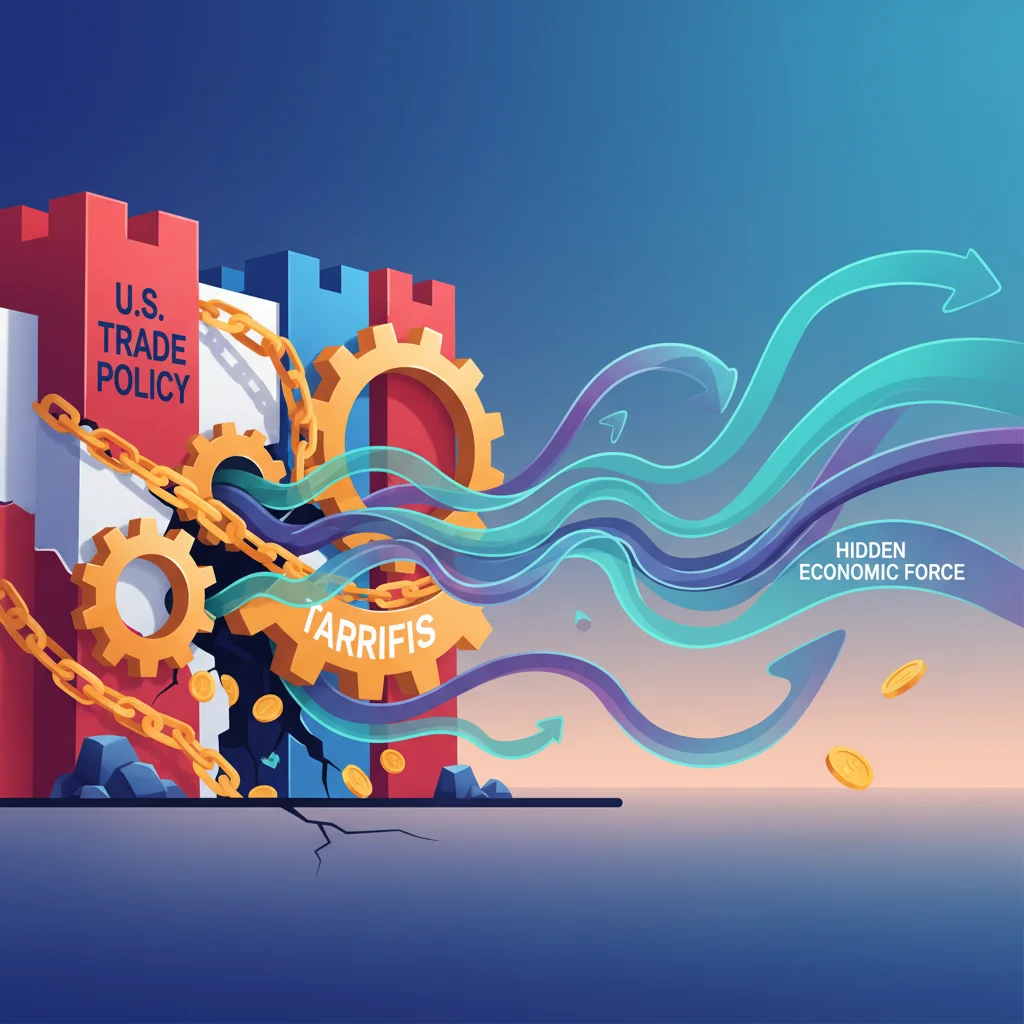
The Tariff Trap: Why U.S. Trade Policy Is Being Undermined by a Hidden Economic Force
In the high-stakes world of global economics, few tools are as politically potent and publicly debated as tariffs. For years, the narrative has been straightforward: impose tariffs on foreign goods, particularly from China, to protect domestic industries, bring back jobs, and shrink the persistent U.S. trade deficit. It’s a simple, intuitive solution to a complex problem. But what if this solution is fundamentally flawed? What if a more powerful, less visible economic force is rendering these tariffs almost completely ineffective?
This isn’t a hypothetical question. It’s the stark reality painted by the data, a reality highlighted in a recent letter to the Financial Times by Desmond Lachman of the American Enterprise Institute. While political rhetoric focuses on the trade war, the real story may lie in the intricate dance between government spending, international capital flows, and the formidable strength of the U.S. dollar. For investors, business leaders, and anyone involved in finance, understanding this dynamic is crucial for navigating an increasingly complex global economy.
The Persistent Puzzle of the Trade Deficit
The primary justification for the wave of U.S. tariffs initiated over the past several years was to rebalance trade, especially with China. The logic was clear: by making Chinese imports more expensive, American consumers and businesses would shift their purchasing to domestically produced goods, thereby reducing the trade deficit. However, the results have been underwhelming, to say the least.
Despite years of heightened tariffs, the overall U.S. trade deficit has not shrunk; in fact, it has often widened. According to Desmond Lachman’s analysis, the very policies designed to curb the deficit have been accompanied by macroeconomic trends that actively work against this goal. This isn’t a failure of intention but a failure to account for the interconnected nature of the modern financial system. The stock market, currency trading, and international investment are not separate from trade; they are deeply intertwined, and ignoring these connections leads to ineffective policy.
The Real Culprit: Capital Inflows and a Supercharged Dollar
So, if tariffs aren’t the answer, what is driving the trade deficit? The answer lies in a core principle of economics: the relationship between a country’s savings, investment, and its current account balance. In simple terms, the United States has a very low national savings rate. The U.S. government, in particular, runs a massive budget deficit, meaning it spends far more than it collects in taxes.
To finance this shortfall, the U.S. Treasury must issue bonds. Who buys these bonds? A significant portion is purchased by foreign investors, governments, and central banks. This is driven by the U.S. dollar’s status as the world’s primary reserve currency and the perception of U.S. government debt as one of the safest assets on the planet. This creates a massive and continuous inflow of foreign capital into the U.S. economy.
Here’s the critical link: to buy these U.S. assets, foreign investors must first buy U.S. dollars. This constant, high demand for dollars pushes up its value relative to other currencies. As Lachman points out, the dollar has appreciated significantly over the same period the tariffs have been in effect. Federal Reserve analysis also highlights the complex factors influencing the trade balance, where currency values play a pivotal role.
A strong dollar has two major effects on trade:
- It makes U.S. exports more expensive: A European company wanting to buy an American-made machine has to spend more euros to get the required dollars, making the U.S. product less competitive.
- It makes foreign imports cheaper: For an American consumer, a strong dollar means their money goes further when buying goods from China, Vietnam, or Germany.
This powerful currency effect directly counteracts the intended impact of tariffs. While a tariff might add 25% to the cost of a Chinese product, a 20% appreciation in the dollar effectively gives American importers a 20% discount, negating much of the tariff’s impact. It’s like trying to bail out a boat with a teaspoon while a firehose of capital inflow is blasting water back in.
The data starkly illustrates this relationship. The following table compares the U.S. trade deficit with the U.S. Dollar Index (DXY), a measure of the dollar’s strength against a basket of foreign currencies, around the period of major tariff implementations.
| Year | U.S. Trade Deficit in Goods & Services (Annual) | U.S. Dollar Index (DXY) – Annual Average | Key Policy Event |
|---|---|---|---|
| 2017 | -$552.3 Billion | ~96.6 | Pre-major tariff implementation |
| 2018 | -$627.7 Billion | ~93.6 | Major tariffs on China begin |
| 2020 | -$676.7 Billion | ~95.3 | Tariffs remain in place |
| 2022 | -$945.3 Billion | ~103.9 | Dollar strength peaks, deficit widens significantly |
Note: Data is approximate and compiled from sources like the Bureau of Economic Analysis (BEA) and market data providers for illustrative purposes.
The Ripple Effect on Investing, Finance, and Technology
This macroeconomic tug-of-war has profound implications for anyone involved in finance and investing. The strong dollar, while a headache for trade policy, creates clear winners and losers across the stock market and broader economy.
- Multinational Corporations vs. Domestic Firms: Large U.S. companies that earn a significant portion of their revenue overseas (like tech giants or major consumer brands) face a headwind. Their foreign profits, when converted back to a stronger dollar, are worth less. Conversely, companies that primarily source materials from abroad and sell domestically can benefit from cheaper import costs.
- The Impact on Trading and Markets: Currency fluctuations are a major driver of volatility. Investors and traders must now price in not just the impact of tariffs but also the Federal Reserve’s monetary policy, global capital flows, and their combined effect on the dollar. This adds a layer of complexity to risk management and asset allocation.
- The Role of Financial Technology: The very capital flows driving this dynamic are accelerated by modern financial technology (fintech). Cross-border payment systems, digital banking platforms, and high-frequency trading algorithms have made the global movement of capital faster and more seamless than ever before. While technologies like blockchain promise to further revolutionize cross-border transactions, for now, the existing fintech infrastructure is a key enabler of the capital inflows that are strengthening the dollar.
Diplomatic Deadlock: The Financial Fallout of Stalled Ukraine Peace Talks
Beyond Tariffs: A Call for a Holistic Economic Strategy
The evidence strongly suggests that tariffs are a blunt and ineffective instrument for correcting a trade imbalance that is fundamentally rooted in domestic fiscal policy. As long as the U.S. runs large budget deficits and fails to increase its national savings rate, it will continue to rely on foreign capital, which will in turn keep the dollar strong and the trade deficit wide.
For business leaders, this means that banking on a tariff-driven resurgence of American manufacturing is a risky bet. A more resilient strategy involves building flexible supply chains, hedging against currency risk, and focusing on innovation to compete on a global scale, regardless of dollar strength.
For investors, it serves as a critical reminder that macroeconomic trends often outweigh policy pronouncements. Understanding the drivers of currency valuation and capital flows is just as important as analyzing corporate earnings reports. The interplay between fiscal policy, monetary policy, and international finance creates the environment in which the stock market operates.
Ultimately, tackling the U.S. trade deficit requires a more sophisticated and honest approach. It demands a pivot away from the simplistic allure of tariffs and towards the more challenging, but ultimately more effective, path of fiscal responsibility and policies that boost domestic savings and investment. Without addressing the root cause, we will remain stuck in the tariff trap, fighting a trade war with one hand while undermining our efforts with the other.
The New Protectionism: Is 19th-Century Economic Nostalgia a Threat to Modern Finance?