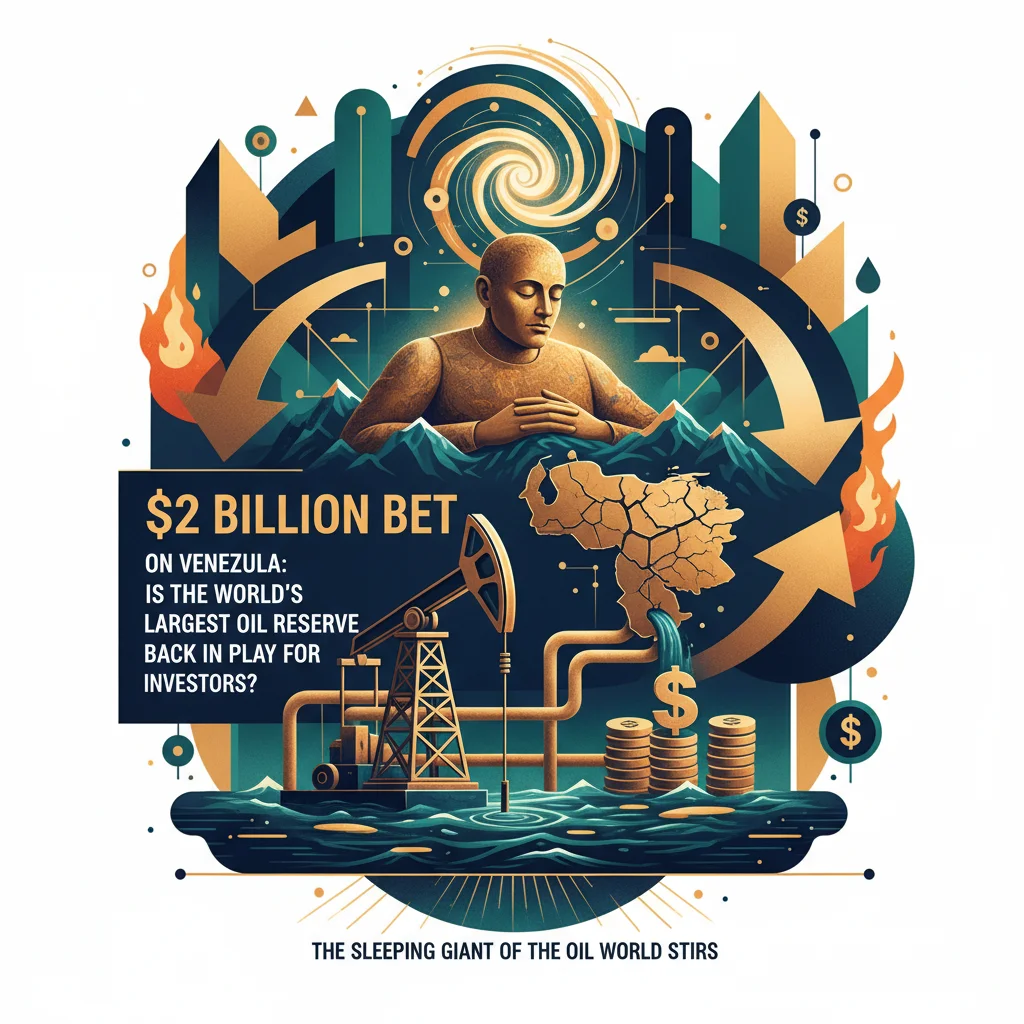
The $2 Billion Bet on Venezuela: Is the World’s Largest Oil Reserve Back in Play for Investors?
The Sleeping Giant of the Oil World Stirs
In the high-stakes world of global finance and energy, few opportunities are as tantalizing—or as perilous—as the prospect of tapping into Venezuela’s oil reserves. Sitting atop the world’s largest proven crude oil reserves, larger even than Saudi Arabia’s, the South American nation is a geological titan. Yet, for decades, its potential has been shackled by political turmoil, economic mismanagement, and crippling international sanctions. The country’s production has plummeted from over 3 million barrels per day to a fraction of that, leaving its vast infrastructure to rust.
Now, a seismic shift may be underway. Following the easing of some U.S. sanctions, a group of investors, led by a former Chevron executive, is embarking on an audacious plan: to raise $2 billion to breathe life back into Venezuela’s dormant oil projects. This move isn’t just about oil; it’s a litmus test for high-risk, high-reward investing in a post-sanction economy and a signal that the geopolitical landscape of energy is being redrawn. For professionals in finance, banking, and economics, this development is a critical case study in the complex interplay between capital, policy, and power.
The Architect and the Ambitious Blueprint
At the heart of this venture is a team with deep industry expertise, spearheaded by an executive who previously navigated the complex operational and political environment in Venezuela for Chevron. Their proposal, as outlined in the Financial Times, isn’t a simple wildcat drilling operation. It’s a calculated strategy to acquire stakes in existing joint ventures between Venezuela’s state-owned oil company, PDVSA, and its international partners. The goal is to inject much-needed capital and Western technical expertise to quickly ramp up production from fields that are already known to be prolific but are currently underperforming due to years of neglect and underinvestment.
The $2 billion fund represents a significant vote of confidence, signaling that some corners of the investment world believe the potential rewards outweigh the monumental risks. The strategy hinges on the belief that the political winds are shifting and that a window of opportunity has opened for savvy investors to get in on the ground floor of what could be the biggest comeback story in the history of the modern energy economy.
Beyond the 9-to-5: Unpacking the Hidden Economic Power of the Side Hustle
Navigating the Geopolitical Minefield
Investing in Venezuela is as much a political calculation as it is a financial one. The recent easing of sanctions by the Biden administration was a pragmatic move, aimed at encouraging fairer elections and potentially increasing global oil supply to stabilize prices. However, these concessions are fragile and reversible, contingent on the political conduct of President Nicolás Maduro’s government. Any investor must therefore have a stomach for volatility and an intimate understanding of Washington-Caracas diplomacy.
This high-stakes environment creates what investors call a “geopolitical discount.” The assets are incredibly cheap relative to their intrinsic potential, but the price reflects the severe risk of political reversal, expropriation, or the “snapback” of sanctions. Success requires not just capital, but also diplomatic acumen and the ability to structure deals that can withstand sudden shifts in the political climate. This is where sophisticated financial engineering and legal expertise become as crucial as geological surveys.
To better understand the calculus involved, let’s break down the core arguments for and against this type of investment.
| Potential Rewards (The Bull Case) | Significant Risks (The Bear Case) |
|---|---|
| Unparalleled Reserves: Access to the world’s largest proven crude oil reserves at a fraction of the cost of assets elsewhere. | Political Instability: The risk of sanction snapback, regime change, or contract nullification remains extremely high. |
| First-Mover Advantage: Establishing a foothold before competitors could yield enormous long-term returns if the country stabilizes. | Dilapidated Infrastructure: Billions are needed to repair pipelines, refineries, and export terminals after years of neglect. |
| Low Production Costs: Historically, Venezuelan heavy crude has been relatively cheap to extract once initial investments are made. | Legal & Corruption Risks: A weak rule of law and a history of corruption create a challenging business environment. |
| Support from Majors: The presence of established players like Chevron provides a degree of validation and operational precedent. | Debt & Creditor Claims: Venezuela has a mountain of sovereign debt and outstanding claims from previously nationalized assets. |
Modernizing the Investment: The Role of Financial Technology
A venture of this complexity and risk profile demands innovative financial structuring. This is where modern financial technology (fintech) could play a transformative role. Rather than traditional equity or debt, we could see the use of sophisticated, hybrid financial instruments. For instance, special purpose vehicles (SPVs) domiciled in neutral jurisdictions could be used to ring-fence assets and provide a layer of legal protection for investors.
Furthermore, one of the biggest historical plagues on Venezuela’s oil wealth has been a lack of transparency and corruption. A forward-thinking investment fund could leverage blockchain technology to create an immutable ledger for tracking everything from capital deployment to oil production and revenue distribution. This use of financial technology could offer unprecedented transparency to investors and stakeholders, potentially mitigating some of the governance risks that have deterred capital in the past. This isn’t just about trading oil; it’s about rebuilding trust in an entire nation’s core industry through technology.
Geopolitical Tremors: How a Single Phone Call is Shaking Up Eastern European Markets
Implications for the Global Economy and Stock Market
Should this and similar ventures succeed, the ripple effects on the global economy would be profound. The return of even one or two million barrels per day of Venezuelan oil to the market could act as a significant brake on global energy prices. For an inflation-weary world, this would be welcome news. It would reshape the strategic calculus of OPEC+ and impact the profitability of producers from Texas to Riyadh.
For investors monitoring the stock market, the implications are multifaceted. A sustained increase in Venezuelan production could put downward pressure on the stock prices of oil majors who rely on high prices for profitability. Conversely, companies that provide oilfield services, equipment, and technology could see a massive new market open up. The initial investment of $2 billion is just a drop in the bucket; analysts estimate that tens of billions would be needed to restore Venezuela’s industry to its former glory. This represents a colossal opportunity for the energy services sector.
The Diamond Standard: How Flawed Gems Are Forging the Future of Finance and Technology
The Final Word: A High-Stakes Gamble on a Brighter Future
The plan to channel $2 billion into Venezuela’s oil fields is more than just another large-scale energy investment. It is a bold wager on political and economic transformation. It represents a belief that after years of crisis, the nation may be on the cusp of rejoining the global economy. The road ahead is fraught with peril, and the risks of failure are as immense as the potential rewards.
For the finance and investing community, this is a live, real-world stress test of emerging market theory, geopolitical risk management, and the enduring power of natural resources. Whether this venture becomes a footnote in history or the opening chapter of Venezuela’s economic revival, one thing is certain: the world is watching, and the stakes couldn’t be higher.

Related Posts
Bitcoin’s Real-Time Reflex: How Crypto Outpaced Wall Street on the Venezuela Shock
Venezuela at a Crossroads: Political Turmoil, Economic Collapse, and What It Means for Global Investors