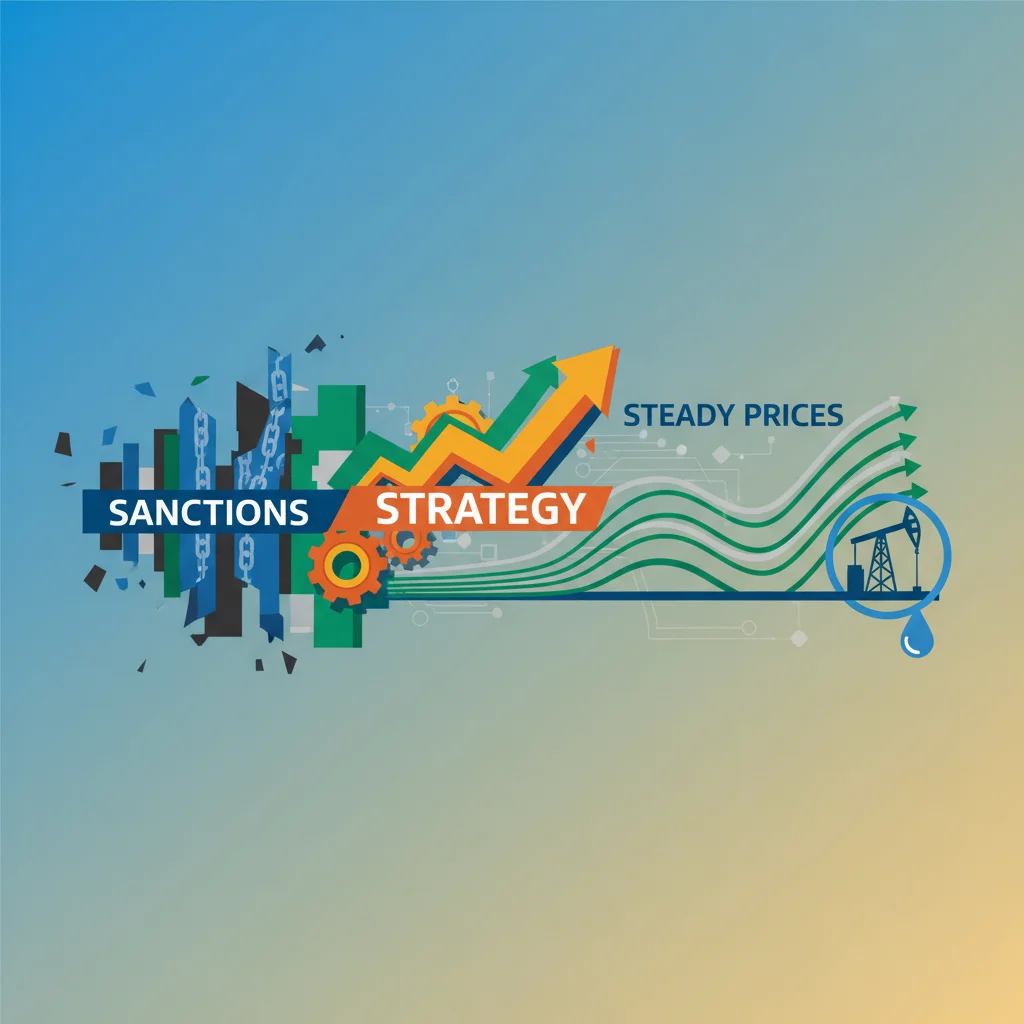
Sanctions, Strategy, and Steady Prices: Why Venezuelan Oil Sanctions Didn’t Shake the Market
In the world of finance and global economics, few events are as historically potent as sanctions on a major oil-producing nation. The traditional playbook, etched into the minds of traders and investors for decades, is simple: geopolitical turmoil in an oil-rich region equals a spike in crude prices. Yet, when the Trump administration levied powerful sanctions against Venezuela’s state-owned oil company, PDVSA, the global stock market and commodity exchanges responded not with a bang, but with a shrug. Oil prices remained remarkably steady, a paradoxical calm that left many observers scratching their heads.
This muted reaction wasn’t a sign of market indifference. Instead, it was a profound signal of a new era in energy markets, one governed by a complex interplay of shifting supply dynamics, sophisticated investor calculus, and the declining influence of once-mighty petrostates. Understanding why the market didn’t panic reveals crucial lessons about modern investing, geopolitical risk, and the intricate machinery of the global economy.
The Sanctions Unveiled: A Targeted Strike on a Faltering Giant
To grasp the market’s reaction, we must first understand the nature of the sanctions. This was not a blanket embargo but a calculated financial maneuver. The primary goal was to cut off the Maduro regime’s access to its most critical source of U.S. dollars, derived from oil sales to the United States. The measures effectively blocked U.S. companies from doing business with PDVSA and froze the company’s assets in the U.S., including proceeds from its U.S.-based refining arm, Citgo. According to reports at the time, the move was intended to redirect revenue to a new government, putting immense pressure on the incumbent regime (source).
For Venezuela, a nation sitting on the world’s largest proven oil reserves, this was a devastating blow. The U.S. was its largest cash-paying customer, and its Gulf Coast refineries were among the few in the world specifically configured to handle Venezuela’s unique heavy, sour crude. The sanctions aimed to sever this vital economic artery.
The Paradox of Stability: Deconstructing the Market’s Calm
Given the severity of the action, why did Brent crude, the global benchmark, barely budge? The answer lies in a confluence of factors that neutralized the immediate supply shock and painted a more nuanced long-term picture for traders.
1. The Crumbling Colossus: Venezuela’s Pre-existing Decline
The most critical factor was that Venezuela’s oil industry was already in a state of advanced decay. Years of corruption, underinvestment, and mismanagement had decimated its production capacity. At its peak in the late 1990s, Venezuela produced over 3 million barrels per day (bpd). By the time sanctions hit, output had already plummeted to around 1.2 million bpd, with many analysts forecasting further declines regardless of U.S. action. The market had, in effect, already priced in the slow-motion collapse of Venezuela’s oil sector. The sanctions were seen by many as merely formalizing an existing supply reality, rather than creating a new one. In fact, data from OPEC shows a consistent and dramatic decline in Venezuelan output long before the harshest sanctions were implemented (source).
2. The Global Supply Cushion: The Rise of Shale and OPEC’s Role
The 2010s witnessed a revolution in the energy landscape: the U.S. shale boom. America had transformed from the world’s biggest oil importer into a production powerhouse. This surge of light, sweet crude from Texas and North Dakota created a substantial buffer in global supply. Simultaneously, OPEC and its allies (OPEC+), led by Saudi Arabia, held significant spare capacity. The Kingdom made it clear it was ready to open the taps to prevent any destabilizing price spikes. This assurance from both a non-OPEC behemoth and the traditional market stabilizer gave traders confidence that any shortfall from Venezuela could be quickly and easily covered.
3. The Long-Term Investor’s Bet
Sophisticated trading desks and hedge funds look beyond immediate headlines. They were engaged in a multi-layered calculation. While the short-term effect was a disruption of about 500,000 bpd of Venezuelan exports to the U.S., the long-term view was more complex. The sanctions were designed to trigger a regime change. If successful, a new, Western-friendly government could invite foreign investment and expertise to rebuild PDVSA. This scenario could, over several years, bring millions of barrels of Venezuelan oil back online, creating a supply glut and sending prices *down*. Investors were therefore weighing a minor short-term bullish disruption against a potentially major long-term bearish outcome, a balance that served to anchor prices in the present.
Ripple Effects: The Unseen Consequences for the Economy
While the headline oil price remained stable, the sanctions created significant ripples beneath the surface, particularly for a specialized corner of the market.
The Gulf Coast Conundrum
U.S. refineries along the Gulf of Mexico are some of the most complex in the world, specifically designed to process heavy, high-sulfur (sour) crude oil from places like Venezuela, Mexico, and Canada into gasoline and diesel. This heavy crude is cheaper than light, sweet crude, giving these refineries a competitive advantage. The sudden loss of Venezuelan supply sent these refiners scrambling for alternatives. While Canada and Mexico could provide similar grades, logistical challenges and differing specifications complicated the picture. This disruption squeezed refining margins and highlighted a critical vulnerability in a key part of the U.S. energy infrastructure, a fact not immediately apparent from just looking at the Brent or WTI price tickers.
To illustrate the strategic calculations at play, consider the different layers of impact from a major geopolitical event in the energy sector.
| Factor | Short-Term Market Impact | Long-Term Potential | Key Investor Consideration |
|---|---|---|---|
| Supply Disruption | Minimal impact on global price due to pre-existing production decline. | Potentially bearish if regime change leads to a full production restart. | Global spare capacity and inventory levels are more important than a single nation’s output. |
| Crude Quality | Significant disruption for specialized U.S. Gulf Coast refiners needing heavy crude. | Increased investment in alternative heavy crude sources (e.g., Canada, Mexico). | The economics of refining margins can be a separate and lucrative play. |
| Geopolitical Risk | Increased uncertainty in Latin America, strengthening Russia’s and China’s roles as lenders. | A successful transition could stabilize the region; failure could lead to a humanitarian crisis. | Analyze the “second-order effects” on other countries and related industries. |
Powering the Dragon's Brain: The Nuclear Secret Behind China's AI Investment Boom
The Role of Technology in a Modern Financial World
This event also subtly highlighted the growing influence of technology in shaping market reactions. The world of finance is no longer solely reliant on human traders reacting to news wires.
Advanced fintech platforms, powered by AI and machine learning, continuously scan thousands of sources—from satellite imagery of oil tankers to social media sentiment in Caracas—to build complex predictive models. These systems likely anticipated the sanctions and their limited impact on supply long before the official announcement, allowing large funds to position themselves accordingly. This level of data-driven analysis contributes to market efficiency, preventing the kind of knee-jerk, panic-driven spikes that characterized earlier eras.
Looking forward, emerging technologies like blockchain could play an even larger role. In a world defined by sanctions and complex supply chains, a transparent, immutable ledger could be used to track oil shipments from wellhead to refinery. This would provide regulators, insurers, and ethical investors with an unprecedented ability to verify the origin of commodities and ensure compliance with international law. While still in its infancy for this use case, such financial technology offers a glimpse into a future where banking and trade finance are more transparent and responsive to geopolitical realities.
Conclusion: A New Playbook for a New Energy Era
The market’s non-reaction to the Venezuelan sanctions was not a sign of apathy but of profound understanding. It was a recognition that the world of energy had fundamentally changed. The monopoly power of traditional petrostates has been eroded by the flexibility of U.S. shale, the strategic calculus of OPEC+, and a global market that is more interconnected and forward-looking than ever before.
For investors, business leaders, and anyone involved in the global economy, the lessons are clear:
- Context is King: A geopolitical event cannot be analyzed in isolation. The broader supply, demand, and inventory picture is what ultimately dictates price.
- Markets are Forward-Looking: Today’s price reflects not just today’s reality but the weighted probabilities of multiple future scenarios.
- Technology is Reshaping Analysis: The speed and depth of analysis afforded by modern fintech are creating a more efficient, less sentiment-driven market.
The quiet response to the Venezuelan crisis was a watershed moment, closing the book on an old era of oil shocks and opening a new chapter where resilience, diversity of supply, and data-driven strategy reign supreme.
The Christmas Card Portfolio: Reimagining a Holiday Tradition for the Modern Investor