
Maduro’s Downfall: A Geopolitical Shockwave Jolting the Global Oil Market
In the world of finance and geopolitics, moments of profound change often arrive without warning, sending immediate and powerful ripples across the global stock market. The recent capture of Venezuela’s Nicolás Maduro is one such tectonic event. Almost instantaneously, the stock tickers of major US oil companies flickered green, surging on a wave of investor optimism. This wasn’t just a fleeting market reaction; it was a high-stakes bet on the potential rebirth of a fallen energy titan and the unlocking of the world’s largest oil reserves. But as the dust settles, a more complex picture emerges—one filled with immense opportunity, staggering risk, and profound implications for the global economy.
This single event has thrust Venezuela, a nation crippled by years of economic mismanagement and stringent international sanctions, back into the spotlight. For investors, business leaders, and policymakers, the question is no longer *if* change is coming, but what that change will look like and who will be positioned to benefit. This analysis will delve into the immediate market dynamics, the monumental task of rebuilding Venezuela’s oil sector, the intricate web of geopolitical risks, and the long-term strategies investors should consider in this new and uncertain landscape.
Decoding the Market’s Knee-Jerk Reaction
The immediate aftermath of the news saw a palpable surge in the share prices of US oil and gas companies with historical ties or potential future interests in Venezuela. Investors, from institutional funds to retail traders, began pricing in a future scenario where a new, more West-friendly government in Caracas could roll out the red carpet for foreign investment. According to a BBC report, the core belief driving this rally is the potential to “tap the country’s oil wealth,” a resource that has been largely inaccessible to Western firms for over a decade.
This market movement is a classic example of “forward-looking” investing. The gains are not based on current earnings or production increases but on the probability of future cash flows. The market is betting on a sequence of events: a stable political transition, the lifting of US sanctions, the establishment of a new legal framework for foreign investment, and ultimately, the successful revitalization of Venezuela’s dilapidated oil infrastructure. Each step is laden with uncertainty, but the sheer scale of the prize—access to over 300 billion barrels of proven reserves—is enough to fuel significant speculative interest.
Below is a simplified representation of the factors driving the immediate investor sentiment:
| Positive Driver (The “Bull” Case) | Underlying Assumption |
|---|---|
| Access to Massive Reserves | A new government will welcome foreign capital and expertise. |
| Lifting of Sanctions | The U.S. and E.U. will quickly remove economic barriers. |
| Geographic Proximity | Venezuelan crude is closer and cheaper to transport to U.S. refineries than Middle Eastern oil. |
| Reduced Global Supply Risk | A revived Venezuelan supply could act as a buffer against volatility in other regions. |
HS2 Off the Rails: What Project Delays Mean for the UK Economy and Your Investments
Venezuela’s Oil Sector: A Shadow of Its Former Self
To understand the magnitude of the opportunity, one must first grasp the depth of the collapse. Venezuela is home to the world’s largest proven oil reserves, surpassing even Saudi Arabia. At its peak in the late 1990s, the state-owned oil company, Petróleos de Venezuela, S.A. (PDVSA), was producing over 3 million barrels per day (BPD). Today, that figure has plummeted dramatically.
Years of underinvestment, nationalization, corruption, and the flight of skilled engineers have left the country’s oil infrastructure in ruins. Refineries are barely operational, pipelines are leaking, and oil fields are crippled. According to data from the U.S. Energy Information Administration (EIA), production has frequently fallen below 800,000 BPD in recent years—a catastrophic decline for a nation whose economy is almost entirely dependent on oil exports.
Revitalizing this sector is not a simple matter of turning a key. It will require tens, if not hundreds, of billions of dollars in new investment. It will necessitate rebuilding a skilled workforce, importing advanced technology, and establishing a stable and transparent regulatory environment. This is a project that will take years, even under the most optimistic scenarios.
Navigating the Labyrinth of Risk and Reward
For any company considering re-entry into Venezuela, the operational and financial hurdles are just one part of the equation. The geopolitical and legal landscape is a minefield. The first major step would be the complete and verifiable lifting of U.S. sanctions, which currently prohibit most dealings with PDVSA and the Venezuelan government. This process itself is political and could be tied to benchmarks like free and fair elections, which are far from guaranteed.
Furthermore, the legal status of contracts and assets seized under the Chávez and Maduro regimes remains a critical question. Companies like ConocoPhillips and ExxonMobil, which had their assets expropriated, have long-standing legal claims. A new government will have to untangle this complex web of international arbitration and private property rights before it can attract new capital. According to a study by the Center for Strategic and International Studies (CSIS), establishing a clear and credible legal framework will be paramount to securing the long-term investment needed for reconstruction.
The Pothole Economy: How a 90% Surge in Damage Claims Reveals Deeper Cracks in Our Financial System
The Future of Finance in a Rebuilt Venezuela
Beyond the oil fields, the reconstruction of Venezuela presents a fascinating case study for the future of finance and financial technology. The nation’s traditional banking system has been hollowed out by hyperinflation and economic collapse. A recovery would require a complete overhaul of its financial infrastructure.
This is where innovative technologies could play a transformative role. The concept of using a transparent, auditable blockchain to manage oil revenues is gaining traction among policy experts. Such a system could help prevent the corruption that has plagued the nation for decades, ensuring that wealth is channeled into public services and economic diversification rather than disappearing into offshore accounts. This intersection of energy, governance, and fintech could provide a model for other resource-rich but institutionally weak nations. International development banks and private equity will be watching closely, as the financing mechanisms for this reconstruction will need to be as innovative as the engineering solutions.
An Investor’s Playbook for the New Venezuelan Era
So, how should an investor approach this volatile but potentially lucrative situation? Chasing the initial rally is a high-risk strategy. A more prudent approach involves careful analysis and a tiered strategy.
1. The Majors vs. The Specialists: Large, integrated oil companies like Chevron, which maintained a minimal presence in Venezuela even during the sanctions, are best positioned. They have the institutional knowledge, political connections, and robust balance sheets to withstand the initial risks and capital outlay. Smaller, more speculative players face a much higher risk of failure.
2. The Ancillary Plays: The opportunity extends beyond the oil producers. A massive infrastructure rebuild will be required, benefiting oilfield services companies (like Halliburton or Schlumberger), engineering and construction firms, and logistics providers. These sectors offer a different risk-reward profile.
3. A Long-Term Horizon: This is not a short-term trade. The real value will be unlocked over a 5-to-10-year period. Investors must be prepared for volatility, political setbacks, and a non-linear path to recovery. Patience and a deep understanding of the geopolitical and economics landscape will be essential.
Here is a summary of potential investment avenues and their associated risk levels:
| Investment Category | Potential Reward | Risk Level | Example Companies/Sectors |
|---|---|---|---|
| Major Oil & Gas Producers | High | High | Chevron, ConocoPhillips, Repsol |
| Oilfield Services & Engineering | Medium-High | Medium-High | Schlumberger, Halliburton, Baker Hughes |
| Infrastructure & Logistics | Medium | Medium | Engineering firms, shipping companies |
| Emerging Market ETFs | Low | Low-Medium | Broad funds with potential future Venezuela exposure |
From Silver to Silicon: What a 900-Year-Old Coin Teaches Us About the Future of Finance
Conclusion: A New Dawn or a False Start?
The capture of Nicolás Maduro is undeniably a landmark event with the potential to reshape the global energy map. The enthusiastic response from the stock market highlights the immense pent-up demand for access to Venezuela’s vast resources. However, the road from political change to barrels of oil flowing freely into the global market is long, treacherous, and paved with uncertainty.
For investors and business leaders, this moment demands a dual perspective: the optimistic vision of a nation’s economic rebirth and the pragmatic realism of the immense challenges that lie ahead. The intersection of geopolitics, economics, and corporate strategy has rarely been more acute. The story of Venezuela’s oil revival is just beginning, and while fortunes may be made, a cautious, informed, and strategic approach will be the key to navigating the turbulence and capitalizing on one of the most significant investment opportunities of the 21st century.

Related Posts
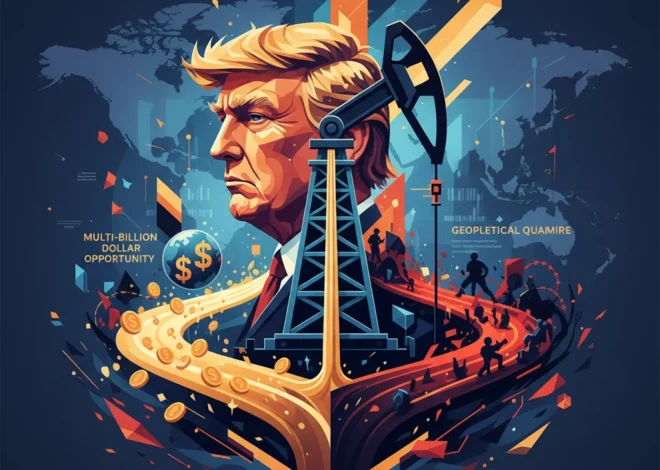
Trump’s Venezuelan Oil Gambit: A Multi-Billion Dollar Opportunity or a Geopolitical Quagmire?

The Vulture’s Gamble: Inside the High-Stakes Hunt for Venezuela’s Trillion-Dollar Debt