Maduro on Trial: The High-Stakes Legal Battle Redefining Global Finance and Presidential Power
A New Frontier in Lawfare: The United States vs. a Sitting Head of State
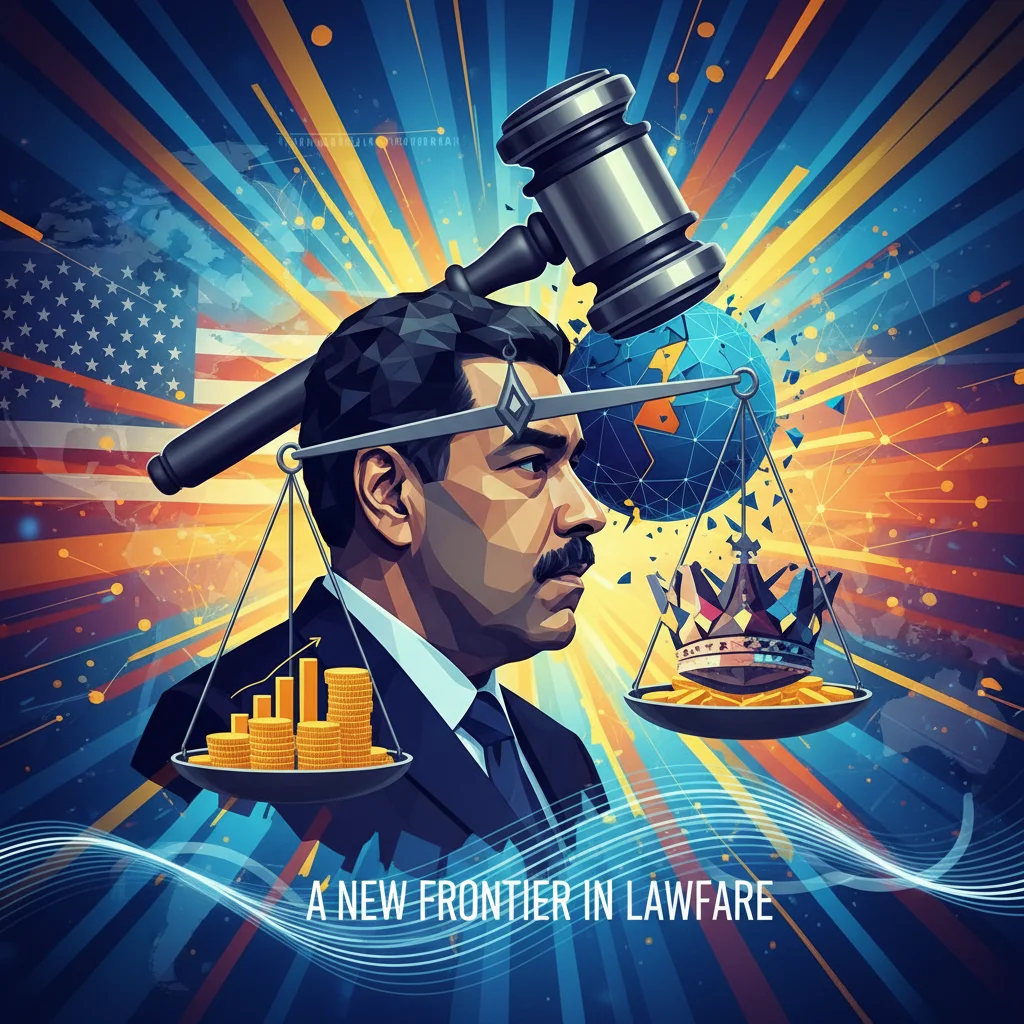
In an unprecedented move that blurs the lines between international diplomacy and domestic law enforcement, the United States Department of Justice has unsealed a criminal indictment against a sitting head of state: Venezuela’s Nicolás Maduro. The charges are severe, accusing him and other high-ranking officials of leading a narco-terrorism conspiracy for over two decades. This legal gambit is more than just a headline; it’s a high-stakes test of international law that carries profound implications for the global economy, international investing, and the very structure of the global banking system.
The U.S. alleges that Maduro, as the leader of the “Cartel of the Suns,” conspired with the FARC, a Colombian rebel group, to “flood the United States with cocaine” and use the drug trade as a weapon against America (source). While the charges are explosive, the central question is one of jurisdiction and precedent. Can a sovereign nation use its domestic courts to prosecute the recognized leader of another sovereign nation? The answer to this question will ripple through boardrooms, trading floors, and foreign ministries for years to come.
The Immunity Doctrine Under Fire: A Legal Minefield
At the heart of this case lies the legal principle of “head of state immunity,” a cornerstone of international relations that generally shields national leaders from foreign prosecution. The U.S. government’s strategy hinges on a critical, and controversial, assertion: that it does not recognize Nicolás Maduro as the legitimate president of Venezuela. Instead, since 2019, Washington has recognized opposition leader Juan Guaidó as the interim president, creating a legal loophole to bypass immunity claims.
This is not the first time the U.S. has targeted a foreign leader. The most notable precedent is the 1989 case against Panamanian General Manuel Noriega. However, the circumstances were vastly different. Noriega was captured and brought to Miami following a full-scale U.S. military invasion. Maduro, in contrast, remains firmly in control in Caracas, supported by the Venezuelan military and key international allies like Russia and China.
To understand the unique challenges of the Maduro case, a comparison with the Noriega precedent is essential.
| Factor | Nicolás Maduro (Venezuela) | Manuel Noriega (Panama) |
|---|---|---|
| Status When Charged | Sitting head of state, in power and in-country | De facto leader, captured after a U.S. invasion |
| U.S. Recognition | Not recognized as legitimate president; Juan Guaidó recognized | Not recognized as legitimate leader at the time of invasion |
| Primary Charges | Narco-terrorism, drug trafficking conspiracy | Drug trafficking, racketeering, money laundering |
| Geopolitical Context | Backed by major powers (Russia, China); deep economic crisis | Cold War context; primarily a regional U.S. concern |
| Economic Leverage | Control of the world’s largest oil reserves; subject to severe U.S. sanctions | Control of the Panama Canal; less global economic significance |
As the table illustrates, the Maduro indictment is an attempt to achieve a Noriega-like legal outcome without a military intervention. It represents a shift towards using the overwhelming power of the U.S. legal and financial systems as primary tools of foreign policy. This strategy, while avoiding military conflict, creates a new and unpredictable form of geopolitical risk for investors and multinational corporations. The Silent Crash: How Japan's Demographic Crisis Will Reshape the Global Economy
The Economic Fallout: Sanctions, Oil, and the Weaponization of Finance
For investors and finance professionals, the legal drama is secondary to its tangible economic consequences. The indictment serves as the legal backbone for an already crippling regime of economic sanctions that have effectively cut Venezuela off from the global financial system.
Here’s how this legal battle is reshaping the economic landscape:
- Paralyzing the Oil Sector: The sanctions, particularly those targeting the state-owned oil company PDVSA, have decimated Venezuela’s oil production. This has direct implications for global oil supply and price stability, affecting trading strategies and the broader stock market. Any company, from oil majors to shipping firms, risks “secondary sanctions” for dealing with Maduro’s government, creating a chilling effect on international trade.
- Weaponizing the Banking System: By designating Maduro’s government as a criminal enterprise, the U.S. has effectively locked Venezuela out of the U.S. dollar-denominated banking system. Transactions are blocked, assets are frozen, and international banks are unwilling to risk the massive fines associated with violating sanctions. This isolates the nation’s economy and makes even humanitarian trade incredibly difficult.
- Catalyzing Alternative Finance: This intense financial pressure has forced sanctioned nations to innovate. Venezuela launched the “Petro,” an oil-backed cryptocurrency, in an early attempt to circumvent U.S. control. While the Petro largely failed, the underlying strategy is significant. The case against Maduro underscores a global trend where nations are increasingly exploring blockchain and other fintech solutions to create parallel financial systems, challenging the dominance of the U.S. dollar and traditional financial technology infrastructure. According to the Financial Times, the charges are part of a “maximum pressure” campaign that has been in place for years.
Geopolitical Chess: A World of Unintended Consequences
The legal case is not happening in a vacuum. It is a key move in a larger geopolitical chess match. By indicting Maduro, the U.S. has drawn a hard line, making any diplomatic rapprochement nearly impossible. This hardline stance has several potential consequences that could impact global stability and, by extension, the global economy.
First, it may backfire by strengthening Maduro’s position at home. The indictment allows him to frame U.S. pressure as an imperialist attack on Venezuelan sovereignty, a powerful narrative that can rally his base and even some of his opponents. A former senior U.S. official noted that such actions could be counterproductive, stating, “Whenever we do this, it forces a closing of the ranks” (source).
Second, it pushes Venezuela further into the arms of U.S. adversaries. Russia and China have become Venezuela’s economic and diplomatic lifelines, providing loans, technology, and political cover at the United Nations. The U.S. legal action intensifies this dynamic, solidifying geopolitical blocs and increasing the potential for proxy conflicts over resources and influence. The Bardot Economy: Timeless Lessons in Branding, Disruption, and Asset Valuation
Finally, the case’s reliance on the non-recognition of Maduro creates a fragile legal foundation. Should U.S. foreign policy shift and Washington re-engage with the Maduro government—a possibility given the recent need for stable oil supplies—the entire legal case could crumble. This highlights the inherent instability of using domestic courts to prosecute what are fundamentally foreign policy disputes.
Conclusion: A Precedent with a Price
The U.S. prosecution of Nicolás Maduro is a landmark event that transcends the individuals involved. It is a bold experiment in the use of legal and financial power to achieve foreign policy goals. For the financial world, it serves as a stark reminder that geopolitical risk is no longer a fringe concern but a central factor in international investing, trading, and corporate strategy.
The case challenges the foundational principles of state sovereignty and could usher in an era where indictments become a standard tool in the diplomatic arsenal. Whether this leads to greater accountability for corrupt leaders or a chaotic free-for-all in international relations remains to be seen. What is certain is that business leaders and investors must now add “foreign indictment risk” to their due diligence checklists, as the long arm of the law increasingly becomes an extension of the long arm of foreign policy. The outcome will not only decide Maduro’s fate but will also help define the rules of engagement in the global economics of the 21st century. The Trillion-Dollar Text: Why Elon Musk's Vision for Self-Driving Teslas is a Bellwether for the Global Economy