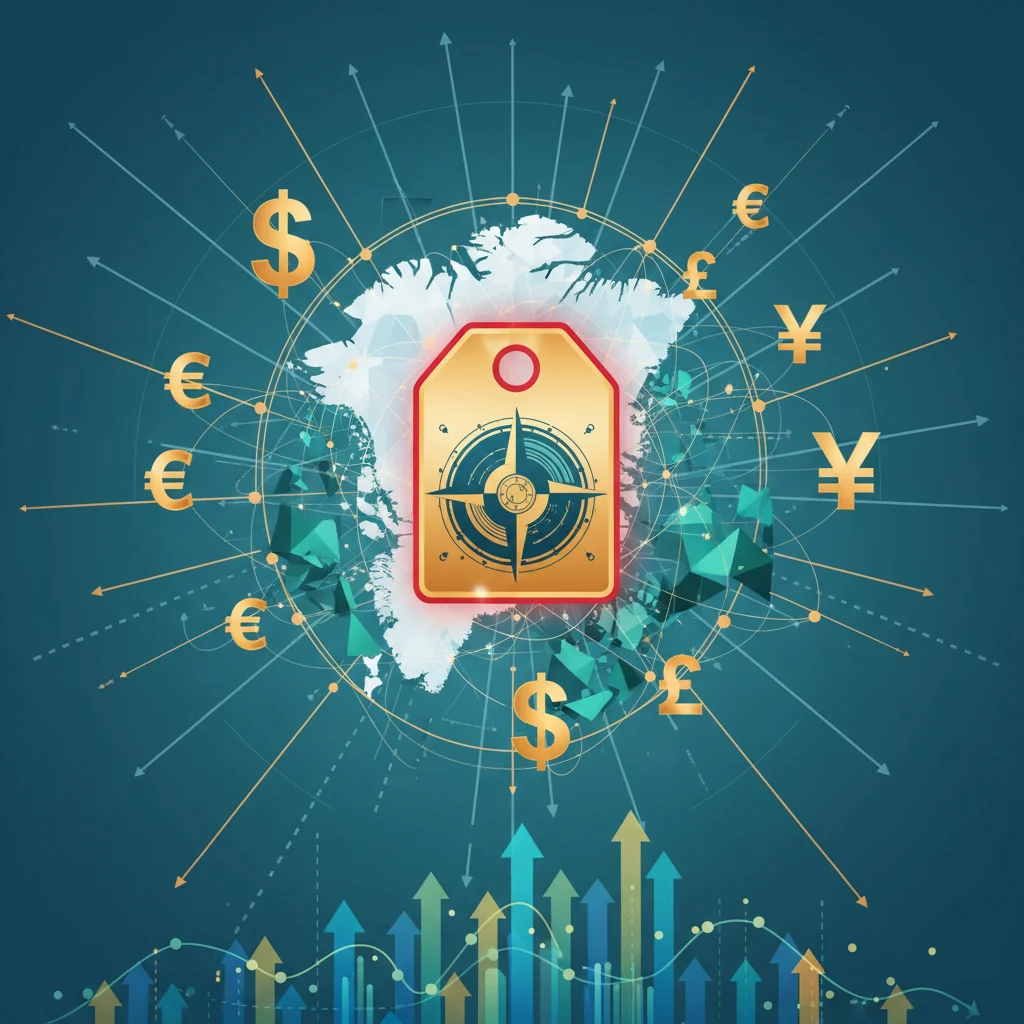
Greenland’s Geopolitical Price Tag: Why a Seemingly Absurd Proposal Reveals a New Economic Frontier
An Unconventional Offer Shakes the Geopolitical Landscape
In the world of international relations and high-stakes finance, headlines occasionally emerge that seem to belong more to a historical novel than a modern newsfeed. One such moment was the revelation that former U.S. President Donald Trump had seriously considered, and discussed, the idea of the United States acquiring Greenland from Denmark. The response from Copenhagen was swift and unequivocal. Danish Prime Minister Mette Frederiksen labeled the notion “absurd,” stating clearly, “Greenland is not for sale… I strongly hope that this is not meant seriously.” The Financial Times reported that Denmark firmly told the Trump administration to cease any threats or suggestions of seizing the autonomous Arctic island.
While the proposal was dismissed as a diplomatic faux pas, for astute investors, finance professionals, and business leaders, the incident served as a stark indicator of profound shifts in the global economy. It peeled back the curtain on a new era of great power competition, where geography, climate change, and resource scarcity are converging to create unprecedented economic opportunities and geopolitical risks. The Greenland episode was not just a diplomatic spat; it was a signal flare illuminating the future of global investing and the strategic importance of the Arctic.
Beyond the Ice: Valuing Greenland’s Strategic and Economic Potential
To understand why the world’s largest island has suddenly become a focal point of geopolitical interest, one must look beneath the ice sheet. Greenland’s value proposition is a potent cocktail of military strategy, untapped natural resources, and the transformative economic effects of a warming planet.
Historically, U.S. interest is not new. In 1946, the Truman administration offered Denmark $100 million for Greenland, recognizing its strategic importance in the burgeoning Cold War. Today, that military value persists with the Thule Air Base, the U.S. armed forces’ northernmost installation, which plays a critical role in missile warning and space surveillance systems. This strategic military footprint underpins the stability of transatlantic trade and security, a cornerstone of the modern global economy.
However, the 21st-century calculus extends far beyond military positioning. Climate change is paradoxically unlocking immense economic potential. As Greenland’s ice melts, it is revealing vast, untapped reserves of natural resources. This includes not only oil and natural gas but, more critically, a wealth of rare earth elements (REEs). These minerals are the lifeblood of the modern digital and green economy, essential for everything from smartphones and electric vehicles to wind turbines and advanced defense systems. The very hardware that powers the latest innovations in financial technology (fintech) and high-frequency trading depends on a stable supply of these materials.
This resource wealth places Greenland at the center of a global supply chain battle. With China currently dominating the rare earth market, Western nations are desperately seeking to diversify their sources to mitigate economic and national security risks. The potential for Greenland to become a major non-Chinese supplier has enormous implications for commodity markets and long-term investing strategies in the technology and manufacturing sectors.
Beyond the Handshake: Decoding the Financial Shockwaves of the US-Ukraine Summit
The following table provides a conservative estimate of the potential resources lying in wait beneath Greenland’s ice, illustrating the tangible economic stakes at play.
| Resource Category | Estimated Potential & Economic Significance |
|---|---|
| Rare Earth Elements (REEs) | Potentially one of the world’s largest deposits outside of China. Crucial for tech, green energy, and defense industries. A game-changer for supply chain stability. |
| Oil & Gas | The U.S. Geological Survey estimates the region could hold up to 50 billion barrels of undiscovered oil and natural gas equivalents, according to a 2008 assessment. |
| Base & Precious Metals | Significant deposits of zinc, lead, iron ore, gold, and platinum. Attracting major interest from international mining corporations. |
| Strategic Location (Shipping) | Melting ice is opening new Arctic shipping routes like the Northwest Passage and the Northern Sea Route, potentially cutting travel time between Asia and Europe by 40%. |
The Market’s Reaction: Geopolitical Risk and Sector Opportunities
For the financial community, this event serves as a crucial case study in geopolitical risk—the idea that politics, international relations, and security events can have a material impact on financial markets. An unexpected bid for a territory, however outlandish, sends ripples through the stock market, forcing analysts to re-evaluate sovereign risk, supply chain stability, and the long-term prospects of specific industries.
The immediate implications create clear winners and losers:
- Mining and Exploration Sector: Companies with the technology and capital to operate in the harsh Arctic environment see their long-term value proposition increase. Any indication of a stable, Western-aligned development framework for Greenland’s resources would be a significant boon for this sector.
- Defense and Aerospace: Heightened strategic competition in the Arctic directly translates to increased government spending on surveillance, patrol aircraft, icebreakers, and satellite technology. This boosts the outlook for major defense contractors.
- Shipping and Logistics: The prospect of new, faster shipping lanes creates a paradigm shift in global trade. This could disrupt traditional shipping hubs and create new opportunities for ports and logistics firms positioned to serve Arctic routes. Investors in this space must monitor the pace of ice melt and the development of necessary infrastructure.
Furthermore, the incident impacts the world of international banking and finance. Any large-scale development in Greenland would require trillions of dollars in capital investment. This would involve complex financing structures from multinational banks, private equity, and sovereign wealth funds, all of whom must weigh the immense opportunity against the environmental, social, and governance (ESG) risks of operating in a fragile ecosystem. As noted by the Brookings Institution, Greenland’s path to potential economic independence is intrinsically linked to its ability to attract this kind of massive foreign investment.
Powering the Dragon's Brain: The Nuclear Secret Behind China's AI Investment Boom
The New ‘Great Game’ in the Arctic
The U.S. interest in Greenland cannot be viewed in a vacuum. It is part of a broader, multi-polar competition for influence in the Arctic, primarily involving Russia and China. Russia has been aggressively remilitarizing its Arctic coastline, viewing the Northern Sea Route as a vital national artery. China, despite having no Arctic territory, has declared itself a “near-Arctic state” and is heavily investing in the region through its “Polar Silk Road” initiative.
This geopolitical maneuvering has profound implications for global economics. The Arctic is rapidly transforming from a desolate wasteland into a central node of global trade and resource competition. The stability of this region will directly influence energy prices, commodity supply chains, and international security for decades to come. For investors, ignoring the Arctic is no longer an option; it is a burgeoning theater of economic activity where the actions of superpowers will dictate market trends.
The Danish rejection of Trump’s overtures was a defense of national sovereignty and the international rules-based order. The idea that a powerful nation could simply annex or purchase a territory from another is a direct challenge to the post-World War II consensus that underpins global financial stability. A world where borders are transactional is a world of immense uncertainty—the ultimate enemy of stable, long-term investing.
The New Resource Cold War: Why US Traders Are Chasing a Critical Metal in Pakistan's Wild Frontier
Conclusion: From an Absurd Proposal to an Essential Analysis
What began as a bizarre headline about buying Greenland has evolved into a critical lesson for the global financial community. It underscores the undeniable fact that we are entering a new geopolitical era where the old rules are being tested. The intersection of climate change, resource scarcity, and superpower competition is creating a new economic frontier in the Arctic, replete with risks and once-in-a-generation opportunities.
For business leaders, the takeaway is the critical need to build resilient supply chains and anticipate geopolitical shocks. For finance professionals, it is the necessity of integrating sophisticated geopolitical risk analysis into every investment thesis. The story of Greenland is a reminder that in the complex world of global finance, the most valuable assets are not always found on a balance sheet but are sometimes buried under a mile of ice, waiting for the world to get warmer.