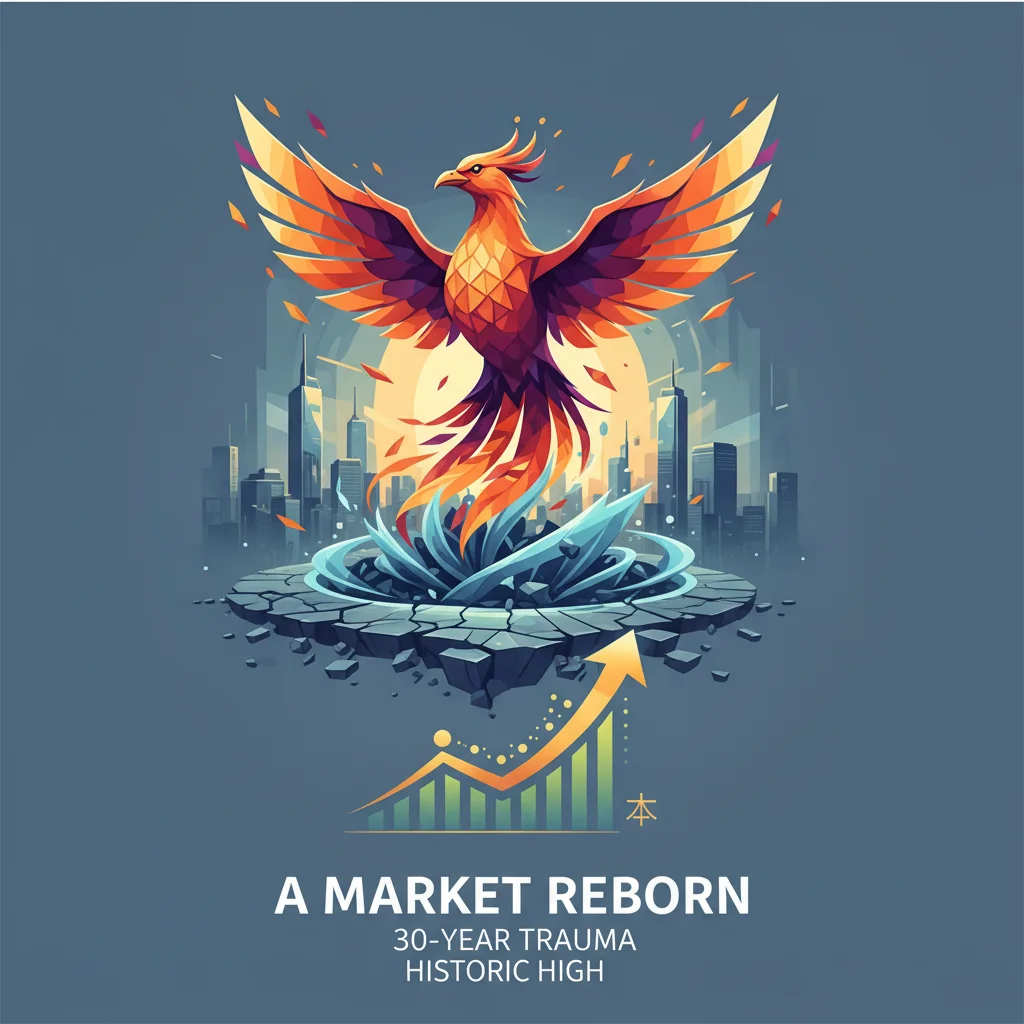
The Phoenix Economy: Why Corporate Japan Must Conquer its 30-Year Trauma to Thrive
A Market Reborn: Japan’s Stock Market Hits a Historic High
For over three decades, the Japanese stock market has been a story of stagnation, a ghost haunting the global financial landscape. The Nikkei 225 index, which peaked in 1989, became a symbol of a lost era. But in early 2024, the impossible happened: the Nikkei finally surpassed its bubble-era high. For investors and finance professionals worldwide, this wasn’t just a number on a screen; it was a seismic event signaling a potential paradigm shift in the world’s fourth-largest economy.
This resurgence, however, is fragile. It hinges on a profound psychological and strategic transformation within corporate Japan. The very companies driving this rally are now facing their greatest test: overcoming a deep-seated “trauma” from the past. According to veteran asset manager Shuhei Abe, the challenge is to shed the deflationary mindset that has defined Japanese business for a generation and embrace a new era of growth. This is a story about more than just economics; it’s about a nation’s corporate psyche at a historic inflection point.
The Ghost of 1989: Understanding the “Bubble-Era Trauma”
To understand the present, we must look back to the late 1980s. Japan’s “bubble economy” was a period of unprecedented speculative fervor. Real estate and stock market values soared to dizzying, unsustainable heights. The Imperial Palace grounds in Tokyo were famously said to be worth more than all the real estate in California. When the bubble burst in the early 1990s, the crash was catastrophic, ushering in a period now known as the “Lost Decades.”
This economic cataclysm inflicted a deep psychological wound on the nation’s business leaders. It fostered an intense culture of risk aversion and an obsession with cost-cutting. Most importantly, it created a crippling fear of raising prices. For thirty years, Japan was caught in a deflationary spiral: prices fell, so consumers delayed purchases, which forced companies to cut prices further, leading to stagnant wages and economic malaise. In this environment, any manager who suggested a price hike was seen as reckless, risking the loss of market share in a fiercely competitive, price-sensitive market.
As Shuhei Abe, founder of asset manager Sparx Group, highlighted in a recent interview, this period left an entire generation of managers “traumatised” by the experience of deflation (source). Their playbook was written for a world where survival meant cutting costs, not creating value. This mindset became a self-fulfilling prophecy that suppressed corporate profits, shareholder returns, and the overall dynamism of the Japanese economy.
The Elephant in the Room: Could a UK Return to the EU Customs Union Redefine its Economic Future?
The Unlikely Savior: Inflation’s Return and the Call for a New Mindset
Ironically, the very force that has plagued the rest of the world—inflation—may be the key to Japan’s revival. Driven by global supply chain disruptions, rising commodity prices, and a weaker yen, Japan is finally experiencing sustained price increases. While this presents challenges, it also offers a golden opportunity to break the deflationary curse. For the first time in decades, companies have a legitimate reason to raise prices, and consumers are beginning to accept it as the new normal.
This is where the true test of leadership begins. Shuhei Abe is now actively seeking out a new breed of corporate manager—one who sees this inflationary environment not as a threat, but as an opportunity. He is looking for leaders who are ready to exert “pricing power,” the ability to raise prices without losing business. This requires a fundamental shift from a cost-plus mentality to a value-based one. Instead of just covering costs, companies must now confidently price their goods and services based on the value they provide, investing in branding, innovation, and quality to justify the increase.
This shift represents a complete reversal of the survival strategies honed during the Lost Decades. The table below illustrates the profound difference in thinking required for this new economic era.
| Attribute | Old Deflationary Mindset (“The Trauma”) | New Growth Mindset (The Opportunity) |
|---|---|---|
| Primary Goal | Survival & Cost Containment | Growth & Value Creation |
| Pricing Strategy | Price reduction to maintain market share | Strategic price increases based on value (Pricing Power) |
| Investment Focus | Efficiency, automation, cost-cutting | R&D, Branding, Marketing, Human Capital |
| Attitude to Cash | Hoard cash on balance sheets as a safety buffer | Deploy capital for growth and shareholder returns |
| Shareholder Relations | Passive, focused on stability | Active, focused on increasing ROE and dividends |
The Investor’s Playbook for a Resurgent Japan
For those involved in investing and trading, Abe’s perspective provides a clear roadmap. The old strategy of simply buying the Japanese market index is outdated. The new approach requires a discerning eye for identifying companies led by management with this “new attitude.” So, what are the key signals investors should look for?
- Demonstrated Pricing Power: Look for companies that have successfully implemented price increases and can articulate a clear strategy for doing so in the future. Analyze their earnings reports to see if these hikes are leading to margin expansion. A prime example is Fast Retailing, the parent company of Uniqlo, which has managed to raise prices while maintaining its strong brand loyalty.
- Strategic Capital Allocation: For years, Japanese firms were notorious for hoarding cash. The new vanguard of companies is actively deploying this capital. Look for rising dividends, aggressive share buyback programs, and strategic M&A aimed at growth rather than consolidation. This is a clear sign that management is focused on improving return on equity (ROE), a key metric for shareholder value.
- Investment in Intangibles: In an inflationary world, a strong brand is the ultimate defense. Seek out companies that are investing heavily in research and development, marketing, and technology to build a competitive moat. This is what allows them to command higher prices. This shift is also creating opportunities in Japan’s burgeoning financial technology (fintech) sector, as companies look for innovative ways to enhance customer experience and operational efficiency.
This active approach to stock selection is critical. The performance gap between the forward-thinking companies and the laggards stuck in the past is likely to widen significantly in the coming years. The Circular Economy's Hidden Engine: How Second-Hand Fashion is Reshaping Global Finance
Beyond the Boardroom: A Nationwide Economic Transformation
This corporate metamorphosis is a crucial part of a much larger story about Japan’s entire economic structure. For this new era to be sustainable, it cannot be built on price hikes alone. It requires a virtuous cycle of rising prices, rising profits, and, most importantly, rising wages.
The annual “shunto” spring wage negotiations are now more critical than ever. In 2023, major firms agreed to the biggest pay increases in 30 years, a trend that continued into 2024 (source). If wages can consistently outpace inflation, it will boost consumer spending power, creating a durable domestic demand that the economy has lacked for decades.
This shift is also being supported by the Bank of Japan (BoJ), which, after years of ultra-loose monetary policy, finally ended its negative interest rate policy in 2024. This normalization of banking and finance signals the central bank’s confidence that the country has truly escaped the grip of deflation. This new financial environment will force companies to be more disciplined with their capital, further rewarding the efficient and penalizing the stagnant.
Global Implications: Why Japan’s Awakening Matters to Everyone
A dynamic, growing Japan is a significant event for the global economy. For decades, international investors have largely underweight Japan in their portfolios, discouraged by its stagnant growth. A sustained recovery could trigger a massive reallocation of global capital into the Japanese stock market.
A stronger Japanese economy also means a more robust and innovative trading partner and a more influential player in global geopolitics. Furthermore, Japan’s journey offers valuable lessons in economics and finance for other developed nations grappling with low growth and demographic challenges. Its success—or failure—in navigating this transition from deflation to mild inflation will be studied in business schools and central banking circles for years to come.
However, the path is not without risk. If wage growth fails to keep pace with price increases, it could stifle consumer demand and send the economy back into a slump. A premature or overly aggressive tightening by the Bank of Japan could also choke off the recovery. The challenge is to manage this transition delicately, fostering a “good” inflation that fuels a virtuous cycle of growth.
The £200 Micro-Miracle: How a Community Shop Rewrites the Rules of Economics and Investing
Conclusion: A New Dawn for the Land of the Rising Sun
Japan stands at a historic crossroads. The economic and psychological scars of the last thirty years run deep, but the forces of change are undeniable. The return of inflation has acted as a powerful catalyst, forcing corporate Japan to confront its past and choose a new future. The call from influential investors like Shuhei Abe is clear: the era of timid, defensive management is over. The future belongs to the bold leaders who can wield pricing power, invest for growth, and create lasting value for shareholders.
For investors, the message is equally clear. The Japanese stock market is no longer a monolith. It is a dynamic landscape of opportunity, where discerning stock-pickers who can identify the agents of this change stand to be rewarded handsomely. The phoenix is rising, but its flight will depend on whether its corporate leaders have truly learned to leave the ashes of the past behind.

Related Posts

Trump’s Venezuelan Oil Gambit: A Multi-Billion Dollar Opportunity or a Geopolitical Quagmire?

The Bard’s Billions: What Shakespeare Can Teach Modern Investors About Building Wealth