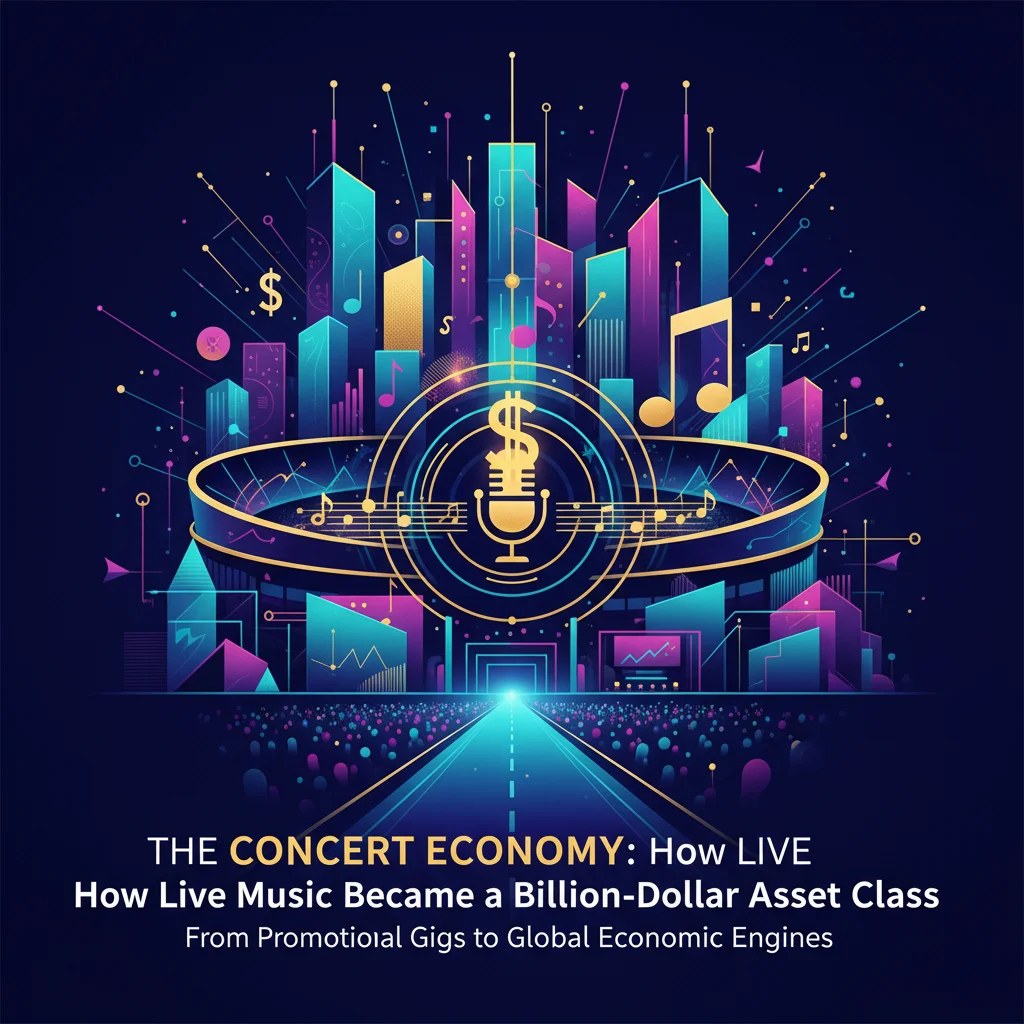
The Concert Economy: How Live Music Became a Billion-Dollar Asset Class
From Promotional Gigs to Global Economic Engines
In the summer of 2023, Taylor Swift’s Eras Tour didn’t just sell out stadiums; it tangibly impacted local economies. The U.S. Travel Association estimated the tour generated an economic impact of over $10 billion for the U.S. alone. This phenomenon, dubbed “Swiftonomics,” is the explosive culmination of a half-century transformation. How did live music, once a promotional tool designed to sell $15 vinyl records, evolve into a multi-billion dollar business that can influence the financial trajectory of entire cities?
The answer lies at the intersection of technological disruption, a fundamental shift in consumer behavior, and the sophisticated financialization of the live experience. The journey from smoky clubs to data-driven global tours is a masterclass in business adaptation, revealing powerful lessons for investors, business leaders, and anyone interested in the modern economy. It’s a story of how an industry, faced with the near-total collapse of its core product, reinvented itself to sell something that could never be pirated: an unforgettable experience.
The Old World Order: When the Album Was King
For decades, the music industry’s business model was straightforward and highly profitable. The physical album—be it vinyl, cassette, or CD—was the primary revenue generator. In this paradigm, live tours served a crucial but secondary role. They were, in essence, marketing expenses—loss leaders designed to create buzz, connect artists with their fanbases, and, ultimately, drive consumers to their local record store.
The economics were simple: a record label would invest in an artist, covering the costs of recording, manufacturing, and promotion. The tour was part of this promotional budget. While ticket sales generated some revenue, the real prize was a hit album that could “go platinum.” The financial ecosystem was centered around these tangible products, with traditional banking and finance institutions providing the capital for record production and distribution on a predictable, product-based model.
The Digital Disruption: A Cataclysm and a Catalyst
Then came the internet, and with it, services like Napster. The turn of the millennium brought a seismic shock to the music industry. Digital piracy decimated physical album sales, and the subsequent rise of streaming services, while providing a new revenue stream, offered fractions of a penny per stream. The industry’s core asset was suddenly devalued almost to zero. Global recorded music revenue plummeted by nearly 40% between 1999 and 2014 (source).
Faced with an existential crisis, the industry was forced to pivot. Artists, managers, and promoters realized they still held one unassailable, non-replicable asset: the live performance. You can copy an MP3 file, but you cannot pirate the feeling of being in a stadium with 70,000 other fans, hearing your favorite song performed live. This realization coincided with a broader shift in the global economy—the rise of the “Experience Economy,” where consumers began to prioritize spending on experiences over material goods.
Live music was perfectly positioned to capitalize on this trend. The concert was no longer the advertisement; it was the premium product. The Shelter Deficit: Poland's Military Buildup and the Hidden Economic Gamble
Anatomy of a Modern Mega-Tour: A Financial Powerhouse
Today’s global tours are incredibly complex financial operations, resembling multinational corporations more than artistic endeavors. The revenue streams are diversified and optimized with a precision that would impress any Wall Street analyst. The global live music market is projected to reach over $39 billion by 2028, a testament to its robust financial structure.
Let’s examine the key financial components of a hypothetical stadium tour:
| Revenue Stream | Financial Strategy & Notes |
|---|---|
| Primary Ticket Sales | The core engine. Prices are now often determined by dynamic pricing algorithms—a form of fintech that adjusts prices in real-time based on demand, similar to how airline tickets or stock market assets are priced. |
| VIP Packages & Upsells | High-margin offerings that include premium seating, merchandise, and exclusive access. This strategy segments the market, maximizing revenue from the most dedicated fans. |
| Merchandise | A massive profit center. Selling branded apparel and souvenirs at the venue captures impulsive, high-emotion purchases, with margins often exceeding 50-70%. |
| Corporate Sponsorships | Brands pay millions to associate themselves with a global star’s tour, providing significant upfront capital that de-risks the venture for promoters and artists. |
| Secondary Market Fees | Through platforms like Ticketmaster’s “Verified Fan” resale, artists and promoters can now capture a percentage of the resale value, a market they were previously cut out of. |
This intricate financial model is managed by powerful players like Live Nation Entertainment, a vertically integrated giant that owns venues, promotes shows, and sells tickets through its subsidiary, Ticketmaster. For those interested in investing in the sector, companies like Live Nation (NYSE: LYV) represent a direct play on the continued growth of the experience economy.
The Financialization of Fandom: Dynamic Pricing and Market Dynamics
Perhaps the most controversial and financially significant innovation in live music is dynamic pricing. Using sophisticated algorithms, ticketing platforms analyze demand in real-time—monitoring how many people are on the site, what seats they are looking at, and how quickly tickets are selling. Based on this data, prices for the best seats can fluctuate dramatically, a practice that mirrors algorithmic trading on financial markets.
From a purely business perspective, this is rational. It’s a mechanism to capture the maximum price a consumer is willing to pay, preventing that value from being siphoned off by scalpers on the secondary market. However, it has also led to public outcry over soaring ticket prices, highlighting a fundamental tension between maximizing revenue and maintaining fan goodwill. This debate underscores the complete transformation of the concert ticket: from a simple pass to a dynamically priced, tradable asset whose value is determined by market forces. Audit Overhaul: Is the SEC Loosening the Leash on Corporate Watchdogs?
The Tour as a Traveling Economic Stimulus
The impact of a mega-tour extends far beyond the venue walls. According to the BBC’s “The Inquiry” podcast, which explores this very topic, a major artist descending on a city acts as a powerful, short-term economic stimulus. Hotels sell out, restaurants are packed, and local transportation services see a massive surge in demand. This influx of spending supports local jobs and generates significant tax revenue.
This economic power has turned tour scheduling into a high-stakes competition between cities. Municipalities now view attracting a multi-night stadium tour as a major economic win, akin to hosting a major sports championship. The financial ecosystem required to support this—from local banking providing lines of credit to small businesses gearing up for the surge, to the complex insurance policies needed to underwrite the events—demonstrates how deeply the live music industry is now integrated into the broader financial and economic landscape. Beyond the Bargains: Decoding the Economic Signals of a Record-Breaking Boxing Day
Conclusion: The Ultimate Unpiratable Asset
The evolution of live music from a marketing expense to a multi-billion dollar financial juggernaut is a defining business story of the 21st century. It’s a case study in resilience, innovation, and the power of adapting to technological disruption. By recognizing that the communal, visceral experience of a live show was their most valuable and unassailable asset, the industry didn’t just survive the digital age; it found a way to thrive in it on a scale previously unimaginable.
For investors and business leaders, the concert economy offers a clear lesson: in a world of digital reproducibility, the future belongs to those who can create, package, and monetize unique, real-world experiences. The humble concert has been transformed into a sophisticated financial instrument, proving that sometimes, the most powerful investment is in an unforgettable moment.

Related Posts
Hollywood’s High-Stakes Choice: Why Warner Bros. is Betting its Future on Netflix, Not Paramount
Trump’s Venezuelan Oil Gambit: A Stock Market Fantasy or a Future Geopolitical Shift?