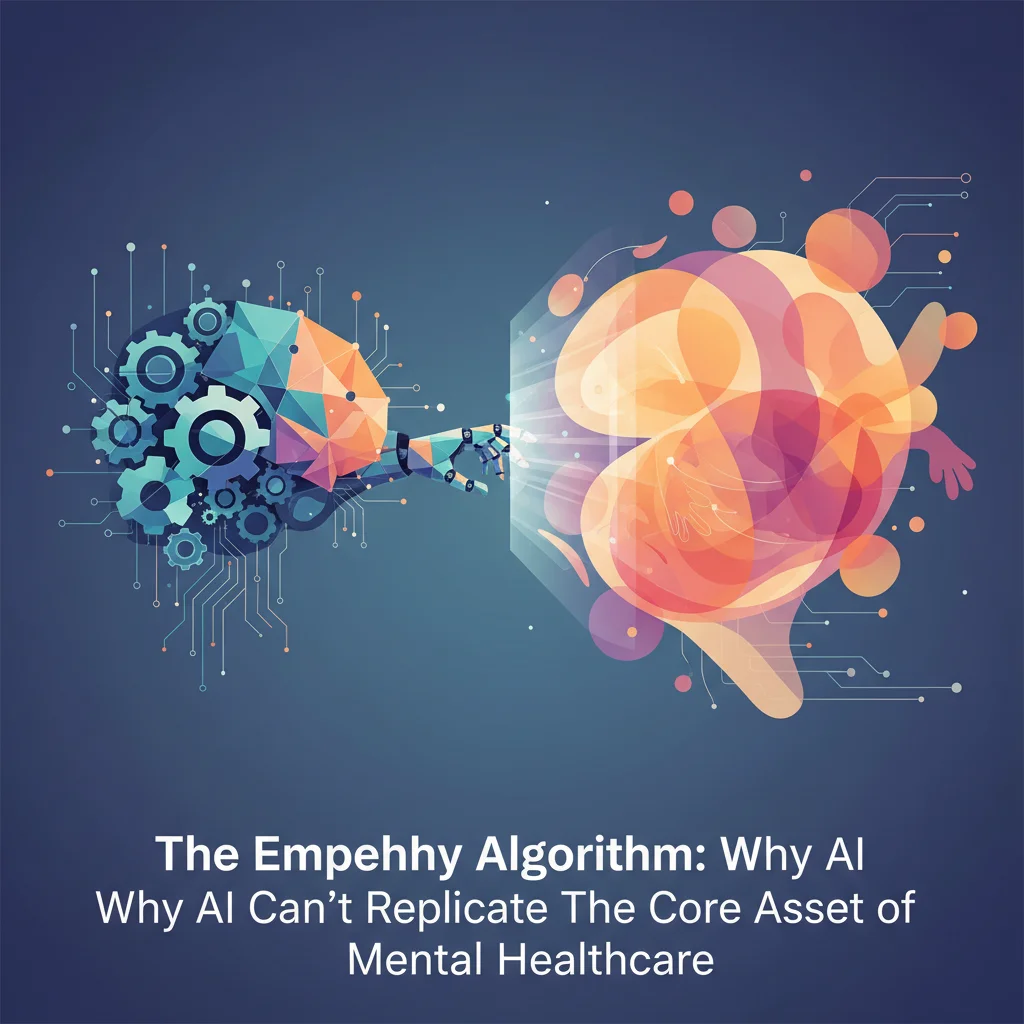
The Empathy Algorithm: Why AI Can’t Replicate The Core Asset of Mental Healthcare
The global economy is witnessing an unprecedented wave of digital transformation, with artificial intelligence poised to reshape industries from banking to healthcare. In the world of finance, algorithms now execute trades on the stock market in microseconds, and fintech platforms have democratized investing for millions. It seems inevitable that this technological momentum would turn its focus to one of society’s most pressing and underserved markets: mental healthcare. The investment thesis is compelling—a scalable, low-cost, 24/7 solution to a global crisis. Venture capital is pouring in, and the mental health tech market is projected to reach nearly $20 billion by 2030.
But as we rush to deploy capital and code, a critical question emerges, one eloquently raised in a letter to the Financial Times by psychotherapist Hilda Burke. She argues that chatbots, no matter how sophisticated, “are not about to replace the healing that therapy offers.” (source). This isn’t a Luddite’s complaint against progress; it’s a fundamental challenge to the core premise of the AI therapy business model. It suggests that investors and business leaders may be overlooking the single most valuable—and irreplaceable—asset in mental wellness: the human connection.
The Bull Case: Investing in a Mental Health Revolution
From a purely economic standpoint, the argument for AI-driven mental health support is powerful. The traditional therapy model suffers from classic market inefficiencies. There is a profound supply-demand imbalance, with a shortage of qualified therapists leading to long waitlists and high costs. This creates significant barriers to entry for a large portion of the population, impacting workforce productivity and the broader economy.
Financial technology has a history of tackling such inefficiencies. Just as fintech disrupted traditional banking by offering lower fees and greater accessibility, health tech aims to do the same for mental wellness. AI chatbots present a solution that is:
- Scalable: A single platform can serve millions of users simultaneously, a feat impossible for human therapists.
- Accessible: Support is available anytime, anywhere, reducing geographic and scheduling barriers.
- Affordable: Subscription models are often a fraction of the cost of traditional therapy sessions, opening the market to a wider demographic.
For investors, this represents a massive addressable market. The potential for high-margin, recurring revenue makes these platforms incredibly attractive. The narrative is one of disruption, innovation, and social good—a potent combination for attracting capital in today’s market. This is more than just an app; it’s a new frontier in the application of financial technology principles to human well-being.
The Unwanted Gift Economy: A Financial Guide to Post-Holiday Asset Recovery
The Unquantifiable Asset: The Therapeutic Alliance
However, this bullish outlook collides with a reality well-understood within the field of psychology but often missed in pitch decks: the “therapeutic alliance.” Decades of research have shown that the single greatest predictor of a positive outcome in therapy is not the specific technique used, but the quality of the relationship between the therapist and the client. A 2018 meta-analysis published by the American Psychological Association reaffirmed that a strong therapeutic alliance is robustly linked to positive treatment outcomes across a wide range of modalities (source).
As Hilda Burke notes in her letter, the essence of healing is “to be seen, to be heard and to be ‘held’ by another human being.” This isn’t about data processing or pattern recognition. It’s about empathy, non-verbal cues, shared experience, and the intuitive, often unspoken, understanding that builds trust. An AI, trained on vast datasets of text, can mimic empathetic language. It can reflect a user’s statements and offer textbook cognitive-behavioral therapy (CBT) exercises. What it cannot do is genuinely feel or create a bond of mutual trust and vulnerability.
Consider the analogy of investing. A robo-advisor can perfectly execute a diversification strategy based on an algorithm. But it cannot sit with a family, understand their fears about retirement, and provide the human reassurance needed to weather a volatile stock market. The algorithm provides the transaction; the human provides the relationship. Therapy is almost entirely relational, making it uniquely resistant to purely technological replacement.
Risks Beyond the Algorithm: Data, Liability, and the Uncanny Valley
For business leaders and investors, the limitations of the therapeutic alliance are not just a philosophical problem; they translate into tangible business risks.
1. Data Privacy and Security: Conversations with a therapist are among the most sensitive data a person can generate. The risk of a data breach is catastrophic, not just for the user, but for the company’s reputation and financial standing. While some propose solutions like blockchain for securing health records, the implementation is complex and the technology is not a panacea.
2. Regulatory and Liability Minefields: What happens when a chatbot fails to recognize a user in acute crisis? Who is liable if a user harms themselves after interacting with the app? As these tools become more advanced, they will attract greater scrutiny from regulatory bodies. The legal framework for AI malpractice is non-existent, creating a universe of unquantifiable risk for companies in the space.
3. The Uncanny Valley of Empathy: As AI becomes more sophisticated in mimicking human conversation, it risks hitting the “uncanny valley”—a point where it is realistic enough to be unsettling. A user who senses they are being manipulated by a “fake empathy” algorithm may lose trust entirely, destroying the product’s utility. This is a delicate balance that is difficult to code.
To put these factors in perspective, here is a comparison of the value propositions and inherent risks:
| Feature | Human Therapist | AI Chatbot Support |
|---|---|---|
| Cost | High | Low / Subscription-based |
| Accessibility | Limited by schedule/location | 24/7, Global |
| Scalability | Low (1-to-1) | Extremely High (1-to-many) |
| Therapeutic Alliance | High Potential (Core value) | Low / Simulated |
| Emotional Nuance | High (Reads non-verbal cues) | Low (Text-based analysis) |
| Data Privacy Risk | Low (Confidentiality rules) | High (Centralized data, hacking risk) |
| Liability | Clear (Malpractice insurance) | Unclear / High Corporate Risk |
Beyond the Barricades: Why Boxing Day's Decline Signals a Seismic Shift in the UK Economy
A Hybrid Future: Augmenting, Not Replacing, Human Expertise
The future of mental healthcare innovation is not a binary choice between a human in a chair and an algorithm on a phone. The most robust and ethical path forward—and likely the most successful from an investing perspective—lies in a hybrid model. This is where the principles of economics and human-centered care can align.
In this vision, AI serves as a powerful tool to augment the human therapist. It can:
- Handle Triage and Intake: Efficiently gather patient history and initial information.
- Provide Between-Session Support: Offer journaling prompts, CBT exercises, and mood tracking to keep clients engaged.
- Automate Administrative Tasks: Manage scheduling and billing, freeing up therapist time for clinical work.
- Analyze Data for Insights: Identify patterns in a client’s language or behavior that a human therapist might miss, presenting them as insights for discussion in a live session.
This “human-in-the-loop” approach leverages technology for what it does best—data processing and task automation—while reserving the irreplaceable, high-value work of building a therapeutic relationship for the human expert. It mitigates liability, enhances the standard of care, and creates a more efficient and effective mental health economy.
The Unwanted Gift Portfolio: An Investor's Guide to Managing Misallocated Holiday Assets
Ultimately, the conversation sparked by Hilda Burke’s letter is a necessary one for anyone involved in the finance or technology sectors. While the allure of disrupting a multi-billion dollar market with AI is strong, true, sustainable value will be created by companies that respect the profound complexity of the human mind. The core of therapy is not a data problem to be solved, but a human connection to be forged. The smartest investment will be in technologies that empower, rather than attempt to replace, that fundamental truth.