London’s New Gridlock: Inside the High-Stakes Robotaxi Race Between US and China
The Dawn of a New Era on London’s Ancient Streets
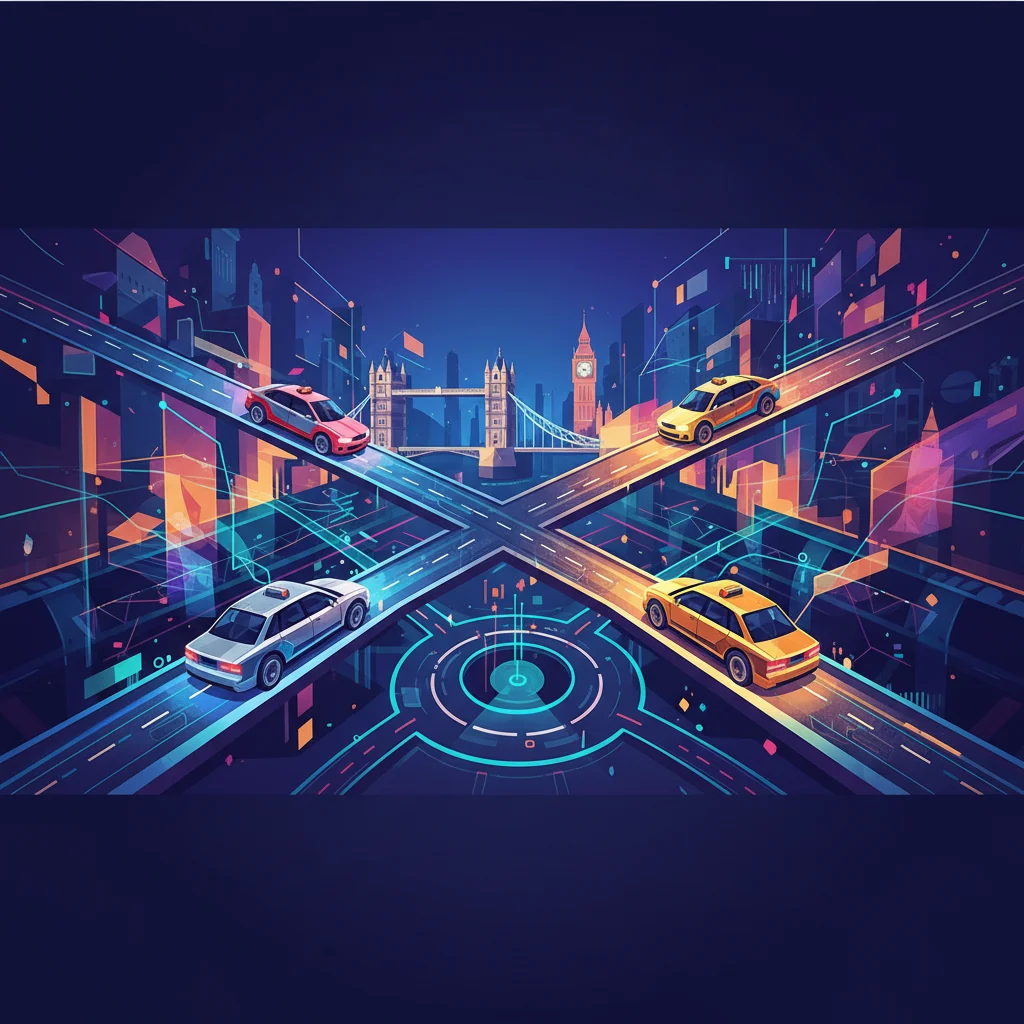
Imagine turning a corner near the Tower of London or navigating the complex roundabout at Hyde Park Corner, not in a classic black cab or a red double-decker bus, but in a vehicle with no one behind the wheel. This isn’t a scene from a futuristic film; it’s the impending reality for the UK capital. London, a city steeped in history, is set to become the next major frontline in a quintessentially modern conflict: the global technology and economic battle between the United States and China. The prize? Dominance in the multi-trillion-dollar autonomous vehicle market.
According to a report from the Financial Times, two of the world’s leading autonomous driving companies are preparing to launch driverless ride-hailing services in London as soon as 2026. In one corner, we have Waymo, the formidable self-driving unit of US tech giant Alphabet (Google). In the other, Baidu, China’s artificial intelligence champion with its sophisticated Apollo platform. Their convergence on London signals more than just a technological milestone; it represents a seismic shift in urban mobility, international investment, and the very fabric of the city’s economy.
For investors, business leaders, and anyone interested in the future of our economic landscape, this is not just a story about cars. It’s a story about data, geopolitical influence, financial technology, and the massive investment pouring into a sector poised to redefine the 21st century.
The Contenders: A Tale of Two Tech Titans
To understand the significance of this showdown, we must first understand the players. While both are leaders in AI and autonomous driving, their origins, strategies, and backing paint a picture of the differing philosophies of Silicon Valley and Beijing.
Waymo: The American Pioneer
Born from a moonshot project within Google over a decade ago, Waymo is arguably the West’s most advanced and experienced autonomous vehicle developer. With millions of real-world miles driven across US cities like Phoenix and San Francisco, Waymo has a wealth of data and a safety-first reputation. Backed by the immense financial and computational power of Alphabet, its entry into London represents a significant international expansion. For investors, Waymo’s success is a key long-term growth driver for the Alphabet stock market valuation, a bet on a future where Google’s data dominance extends from the digital world to the physical one.
Baidu Apollo: The Chinese Challenger
Baidu, often called the “Google of China,” has leveraged its deep expertise in AI and mapping to create the Apollo self-driving platform. Operating in multiple Chinese megacities, including Wuhan and Chongqing, Baidu has benefited from a supportive regulatory environment and access to vast, complex urban datasets. Its move into London is a bold statement of global ambition, aiming to prove that its technology can compete and win on neutral ground. This is a critical test for Baidu and a bellwether for the international expansion of Chinese tech, deeply impacting its position in the global economy.
Here’s a snapshot of how the two giants compare:
| Feature | Waymo (USA) | Baidu Apollo (China) |
|---|---|---|
| Parent Company | Alphabet Inc. (GOOGL) | Baidu, Inc. (BIDU) |
| Primary Markets | Phoenix, San Francisco, Los Angeles | Wuhan, Chongqing, Beijing, Shanghai |
| Technological Edge | Over a decade of real-world testing, advanced sensor fusion, conservative safety-focused approach. | Massive data sets from complex Chinese cities, strong government support, rapid iteration. |
| Geopolitical Alignment | Represents US technological leadership and Silicon Valley innovation. | A key player in China’s “Made in China 2025” strategic initiative. |
| Financial Backing | Deep pockets of Alphabet, plus external venture capital. | Corporate funds, significant backing from the Chinese state and related entities. |
Why London? The Strategic and Economic Prize
The choice of London is no accident. It is a calculated, strategic move by both companies for several key reasons:
- A Complex, Prestigious Challenge: Navigating London’s narrow, winding streets, unpredictable weather, and chaotic mix of cyclists, pedestrians, and vehicles is the ultimate test for any autonomous system. Conquering London is a globally recognized badge of honor.
- A Favorable Regulatory Environment: The UK government has been actively courting autonomous vehicle companies. The recent passage of the Automated Vehicles Act creates a legal framework for their operation, providing a level of clarity that is still lacking in many other parts of the world. This is a deliberate strategy to position the UK as a hub for AI and tech investing post-Brexit.
- A Global Financial Hub: As a world center for finance and banking, London offers a high-value market of tech-savvy professionals and tourists willing to pay for premium, innovative services. Success here provides a powerful business case for expansion into other major European cities.
The Financial and Economic Shockwaves: Beyond the Ride
The arrival of robotaxis will trigger a cascade of economic and financial transformations. This is a multi-layered disruption that extends far beyond the transport sector, creating new opportunities and existential threats.
The Investment Thesis
For those in finance and investing, the autonomous revolution is a long-term thematic play. The global autonomous vehicle market is projected to grow to over $1.8 trillion by 2030, and the London launch will be a key indicator of market leaders. Direct investment means looking at the parent companies, Alphabet (GOOGL) and Baidu (BIDU). However, a smarter approach may involve a “picks and shovels” strategy, investing in the ecosystem that enables this technology:
- Semiconductor firms: Companies like Nvidia and Qualcomm that make the powerful chips (the “brains”) for these vehicles.
- AI and software platforms: The underlying code that makes autonomous decisions.
– LiDAR and sensor manufacturers: The “eyes and ears” of the car.
This is not short-term trading; it’s a long-term bet on a fundamental shift in our economy.
The Fintech and Banking Nexus
How will millions of automated transactions be processed daily? This is where financial technology, or fintech, comes in. We can expect to see the emergence of sophisticated Mobility-as-a-Service (MaaS) platforms. This could involve:
- Seamless Micropayments: Integrated digital wallets that charge by the second or the meter, requiring robust and low-cost payment processing.
- Subscription Models: “All-you-can-ride” monthly subscriptions that could replace car ownership for many urbanites, fundamentally altering consumer spending and credit models used in banking.
- Decentralized Systems: While still speculative, some experts believe blockchain technology could be used to create secure, transparent, and decentralized networks for managing vehicle identity, ride data, and payments, reducing reliance on a single corporate entity.
Red Oceans and Red Ink: Decoding Meituan's Costly War for China's Instant Retail Crown
Navigating the Roadblocks: A Marathon, Not a Sprint
Despite the 2026 target, the road ahead is fraught with challenges that could delay or derail these ambitious plans. The technology, while impressive, is not yet infallible. London’s environment will push these systems to their absolute limits. A single high-profile accident could trigger a massive public and regulatory backlash, setting the industry back years.
Furthermore, the economics of the service must be viable. The cost of these high-tech vehicles is immense, and companies will need to achieve significant scale and efficiency to offer prices competitive with existing options like the Tube, Uber, or traditional taxis. This will inevitably lead to a period of heavy cash burn, testing the patience of even the most deep-pocketed investors on the stock market.
Finally, the societal impact cannot be understated. The displacement of professional drivers is a serious concern that will require policy solutions. Public acceptance, data privacy, and the cybersecurity of an entire fleet of connected vehicles are all monumental hurdles that must be cleared before this vision can become a widespread reality.
The Customs Union Conundrum: A Game-Changer for the UK Economy or a Political Fantasy?
The Race to 2026: Placing Your Bets
The race to launch robotaxis on London’s streets is more than a technological competition; it’s a defining moment in the 21st-century global economy. It’s a convergence of AI, geopolitics, urban planning, and high-stakes finance. As Waymo and Baidu prepare for this historic deployment, they are not just programming vehicles; they are programming the future of our cities.
For the next two years, all eyes will be on London. The winner of this race won’t just capture a key market; they will gain immense prestige, a wealth of invaluable data, and a critical head start in the global autonomous revolution. The starting pistol has been fired, and the outcome will ripple through the world’s financial markets for decades to come.