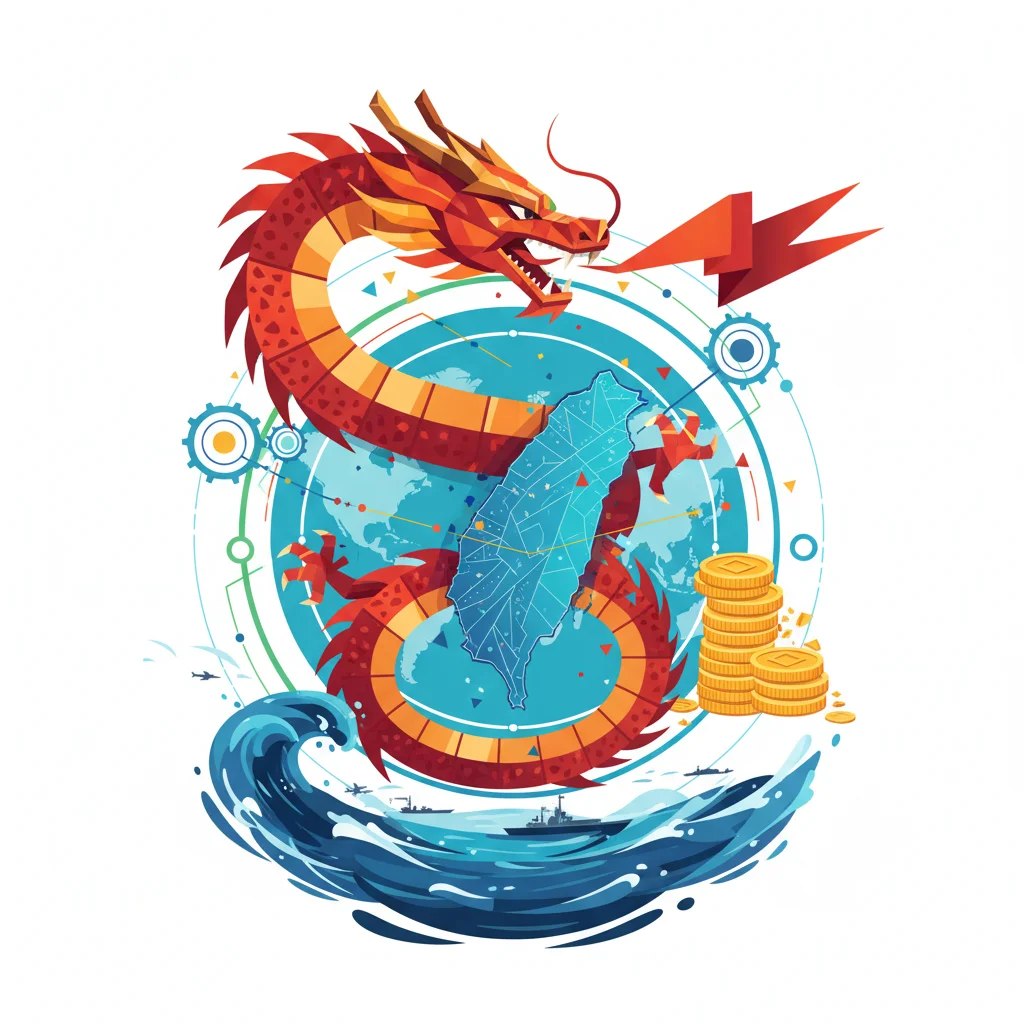
The Dragon’s Gambit: Why China’s Taiwan Drills Are a Red Flag for the Global Economy
The waters of the Taiwan Strait are once again churning with tension. In a significant escalation of military pressure, China’s People’s Liberation Army (PLA) has launched a series of large-scale military drills, including live-fire exercises, effectively simulating a maritime blockade of Taiwan. While political rhetoric, including dismissive comments from figures like Donald Trump, often dominates the headlines (source), the true implications of these actions extend far beyond the realm of geopolitics. For investors, finance professionals, and business leaders, these maneuvers are not distant news; they are a direct signal of rising risk that threatens to disrupt the global economy, roil the stock market, and reshape the future of international trade.
Understanding the gravity of this situation requires looking past the military hardware and focusing on the intricate economic web that is now under threat. This isn’t merely a regional dispute; it’s a high-stakes gambit with the potential for catastrophic global fallout. The tremors from these exercises are already being felt in boardrooms and on trading floors worldwide, forcing a critical re-evaluation of supply chain vulnerabilities, investment strategies, and the very stability of our interconnected financial system.
The Economic Epicenter: Why Taiwan Matters to Everyone
To grasp the potential financial impact of a conflict or blockade, one must first understand Taiwan’s outsized role in the global economy. While a relatively small island, Taiwan is a technological and manufacturing titan. Its dominance in one specific sector—semiconductors—makes it an indispensable linchpin of modern civilization.
Semiconductors are the lifeblood of the 21st-century economy. They are the brains behind everything from iPhones and laptops to cars, data centers, and advanced military equipment. The world’s overwhelming reliance on a single geographic location for these critical components represents a systemic risk of staggering proportions. Taiwan Semiconductor Manufacturing Company (TSMC) alone is responsible for producing the vast majority of the world’s most advanced chips.
The table below illustrates just how critical Taiwan is to the global semiconductor supply chain, a fact that should be at the forefront of every investor’s mind.
| Metric | Taiwan’s Global Share | Implication for Global Economy |
|---|---|---|
| Overall Semiconductor Foundry Market | Over 60% (source) | A disruption would halt production for countless global industries. |
| Advanced Logic Chips (<10nm) | Over 90% (source) | The most critical technology for AI, 5G, and high-performance computing would be cut off. |
| Share of Global Shipping via Taiwan Strait | Nearly 50% of global container fleet (source) | A blockade would cripple global trade, causing massive delays and skyrocketing costs. |
A blockade, even a temporary one, would instantly sever these critical arteries. The ripple effects would be immediate and severe. Tech companies would face production standstills, automakers would see assembly lines grind to a halt, and the progress of next-generation financial technology could be delayed by years. The shock to the stock market would be profound, with tech and manufacturing sectors bearing the brunt of the sell-off. This is the tangible, economic reality behind the PLA’s naval formations.
From Market Jitters to Systemic Shock: Mapping the Financial Contagion
The potential consequences of an escalated conflict extend far beyond supply chains. They strike at the heart of the global finance and banking systems. A military confrontation would trigger a cascade of economic warfare measures with unpredictable outcomes.
1. Sanctions and Asset Freezes
In response to any aggression, the United States and its allies would almost certainly impose crippling sanctions on China, potentially cutting off its access to the U.S. dollar-based global financial system. This would be a move far more significant than the sanctions placed on Russia. China’s economy is deeply integrated with the world’s, and such a move would cause an unprecedented global financial crisis. The stability of international banking would be tested as institutions scramble to unwind their exposure to Chinese entities.
2. Insurance and Shipping Chaos
A simulated blockade is a direct threat to one of the world’s busiest shipping lanes. Insurance premiums for vessels transiting the region would skyrocket, effectively acting as a tax on global trade. Many shipping companies would reroute, adding weeks to delivery times and sending logistics costs into the stratosphere. This would fuel global inflation, putting further pressure on central banks and complicating economic forecasts.
3. The Rise of Alternative Systems?
A major disruption to the traditional, dollar-denominated financial system could, paradoxically, accelerate the search for alternatives. Some analysts in the fintech and blockchain space argue that a crisis of this magnitude could be a catalyst for the adoption of decentralized finance (DeFi) or state-backed digital currencies as nations seek to insulate themselves from the weaponization of traditional finance. While still a fringe theory for many, a full-blown crisis would force a re-evaluation of every aspect of global financial technology and the infrastructure that underpins it.
The Age of Turbo Blurbo: Navigating Noise and Jargon in Modern Finance
Navigating the New Reality: A Playbook for Investors and Leaders
The military drills around Taiwan are a clear signal that geopolitical risk is no longer a theoretical concept but a core factor in modern investing and business strategy. Ignoring these developments is not an option. So, how can stakeholders prepare?
- Diversification Beyond Asset Class: True diversification now must include geographic considerations. Over-concentration of supply chains or investments in any single politically volatile region is a significant liability. Investors should scrutinize companies for their supply chain resilience and geographic exposure.
- Hedging and Risk Management: Sophisticated investors will increasingly look to hedge against geopolitical shocks. This could involve investing in commodities, defense stocks, or using derivatives to protect portfolios from sharp downturns in the stock market.
- Focus on Resilient Sectors: Companies that are actively re-shoring or near-shoring their manufacturing, or those that provide the tools for supply chain security (e.g., cybersecurity, logistics tech), may present new opportunities. The principles of sound economics—valuing resilience alongside efficiency—are making a comeback.
- Scenario Planning: Business leaders must engage in rigorous scenario planning. What happens to your business if the Taiwan Strait is closed for a month? Six months? What are your alternative suppliers? These are no longer academic exercises but essential components of corporate governance.
The PLA’s live-fire drills are more than just a show of force; they are a live stress test of the global economic order. They expose the fragility of our interconnected systems and the profound dependence we have on a few critical nodes. While the immediate outcome of these exercises remains uncertain, the message is crystal clear: the era of predictable, stable globalization that powered the global economy for decades is over. The future belongs to those who are vigilant, adaptable, and prepared for a world where geopolitical fault lines can erupt into economic earthquakes with little warning.
The Buzz Aldrin Principle: What a Secret Spacesuit Patch Teaches Us About Financial "Tells"
The challenge now for everyone, from the individual trader to the CEO of a multinational corporation, is to translate this geopolitical awareness into concrete action. The stability of our portfolios and the health of the global economy depend on it.

Related Posts

The Bill Bailey Principle: Why a Small Correction Reveals a Billion-Dollar Truth About Finance and Investing

The Cockroach Portfolio: Why Resilience Beats Unicorns in a Volatile Economy
