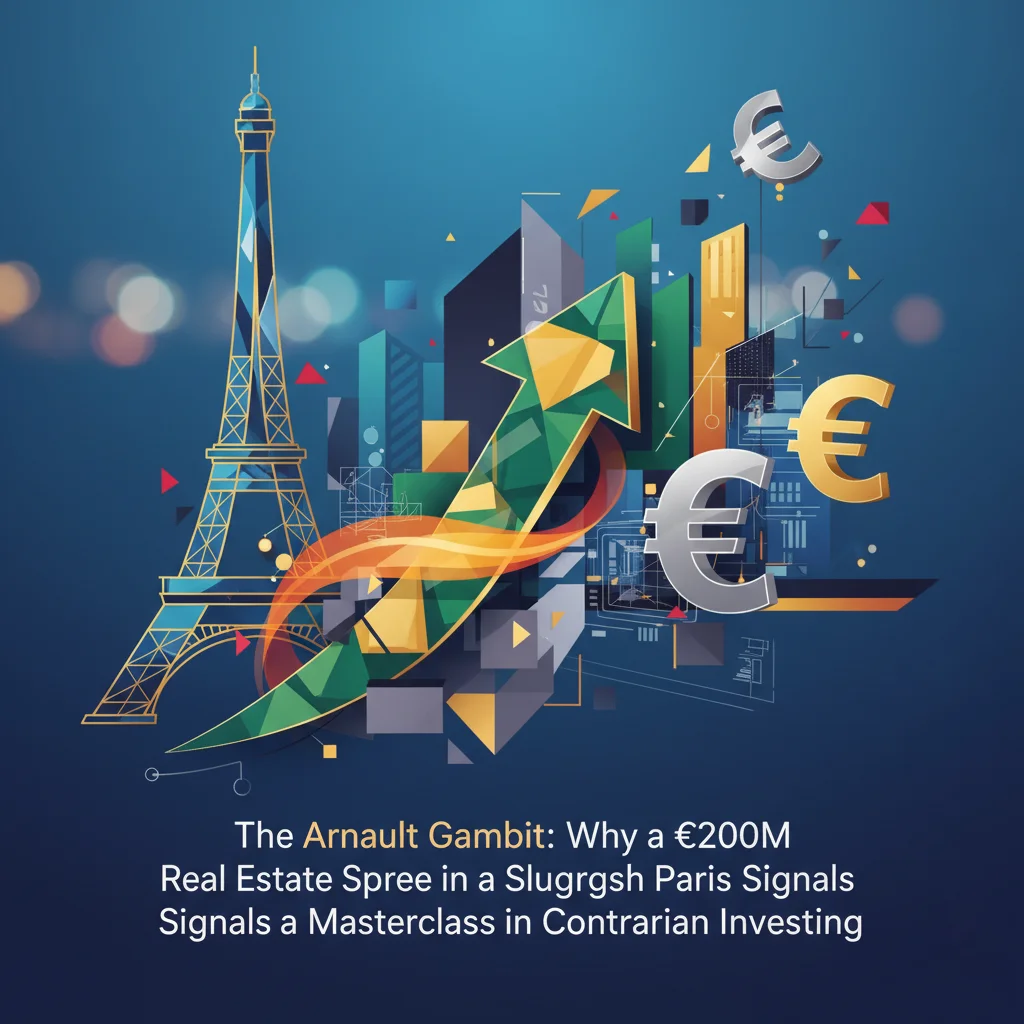
The Arnault Gambit: Why a €200M Real Estate Spree in a Sluggish Paris Signals a Masterclass in Contrarian Investing
A Billionaire’s Vote of Confidence in the City of Light
In the world of high-stakes finance and global luxury, few names command as much attention as Bernard Arnault. The chairman of LVMH, the world’s largest luxury goods conglomerate, is a figure whose business decisions are scrutinized by investors, economists, and market analysts worldwide. So, when the Arnault family quietly orchestrates a nearly €200 million buying spree in the heart of Paris, it’s more than just a real estate transaction; it’s a powerful market signal that reverberates through the entire economy.
At a time when the Parisian luxury property market is described as “sluggish,” facing headwinds from rising interest rates and political uncertainty, the Arnault family has made a decisive and audacious move. They have acquired three prime properties in the French capital’s most exclusive districts, making it one of the most significant sets of private real estate deals in the city over the past year. This isn’t just about acquiring opulent homes; it’s a strategic play that offers a profound lesson in wealth preservation, market timing, and the enduring allure of tangible, trophy assets.
Dissecting the €200 Million Portfolio
The acquisitions, executed through companies linked to Bernard Arnault and his sons, Antoine and Frédéric, are a testament to strategic location and architectural significance. These aren’t just apartments; they are landmark properties that represent the pinnacle of Parisian real estate. The purchases demonstrate a clear focus on acquiring irreplaceable assets in world-class locations.
Here is a breakdown of the key properties that now fall under the Arnault family’s portfolio:
| Property Type | Location | Reported Price | Significance |
|---|---|---|---|
| Hôtel Particulier (Private Mansion) | Rue de l’Université, 7th arrondissement | €90 million | A prestigious address known for its historic mansions, proximity to government institutions, and unparalleled elegance. |
| Building | Rue Bayard, 8th arrondissement | €73 million | Located in the “Golden Triangle,” the epicenter of Parisian luxury, near the Champs-Élysées and Avenue Montaigne. |
| Smaller Building | Near the Invalides, 7th arrondissement | €23 million | Another prime location in a historic and highly sought-after neighborhood, reinforcing the focus on the city’s best districts. |
These acquisitions, likely intended for personal family use or as a consolidated family office, underscore a long-term vision that transcends short-term market fluctuations. It’s a classic strategy of the ultra-wealthy: securing generational assets that are insulated from the volatility of the public stock market.
Beyond the Balance Sheet: Why the Titans of Finance Are Seeking a Higher Calling
Reading the Tea Leaves: A Contrarian Move in a Cooling Market
The timing of these purchases is what makes them particularly noteworthy. The broader Parisian luxury real estate market has been experiencing a significant cooldown. Several macroeconomic factors have contributed to this trend, creating a challenging environment for sellers and a cautious stance among buyers.
High interest rates, a global phenomenon orchestrated by central banks to combat inflation, have made borrowing more expensive, dampening demand across the property sector. Furthermore, political uncertainty in France and new capital gains taxes on second homes have added layers of complexity for potential investors. The data paints a clear picture: according to the Financial Times, transactions for properties valued over €10 million plummeted by 45% in the first half of 2023 compared to the previous year.
In this climate of hesitation, the Arnault family’s aggressive acquisitions are a powerful contrarian statement. While others see risk, they evidently see opportunity. This is a hallmark of sophisticated investing—the ability to act decisively when the market is fearful and to acquire premium assets at potentially more favorable terms than would be possible in a bull market. It’s a move that suggests a belief that the long-term value of prime Parisian real estate will inevitably outweigh any short-term economic turbulence.
The “Flight to Quality”: A Timeless Investment Doctrine
The Arnault family’s strategy is a masterclass in the “flight to quality,” a fundamental principle in economics and finance. This doctrine dictates that during periods of market stress or economic uncertainty, investors abandon riskier assets in favor of safer, more stable investments. We often see this behavior in the public markets, where investors might sell speculative tech stocks and move their capital into blue-chip dividend-paying companies or government bonds.
In the realm of the ultra-wealthy, this principle extends to tangible assets. Trophy real estate in global cities like Paris, London, or New York is considered a premier safe-haven asset. Why?
- Scarcity: There is a finite supply of historic mansions in the 7th arrondissement. This inherent scarcity protects value.
- Enduring Demand: These properties attract a global elite, ensuring consistent demand regardless of local economic cycles.
- Low Volatility: Compared to the daily fluctuations of the stock market, prime real estate values tend to be more stable over the long term.
- Inflation Hedge: Tangible assets like real estate often appreciate in value during inflationary periods, preserving purchasing power.
This strategy is not just about wealth preservation; it’s also about legacy. Such properties are often held for generations, becoming part of a family’s heritage. The complex financial structuring and execution of these deals would have involved sophisticated private banking services, showcasing how traditional wealth management intersects with large-scale, tangible asset acquisition.
The Yen on the Brink: Is Japan Preparing for a Massive Currency Intervention?
Broader Implications for the Economy and Investors
A move of this magnitude by a figure like Bernard Arnault does not happen in a vacuum. It creates ripples that extend far beyond the property deeds. For investors and market watchers, there are several key takeaways.
A Potential Market Floor
While not a guarantee, such a significant investment from a well-informed local titan can be interpreted as a signal that the market may be nearing its bottom. It’s a vote of confidence that could encourage other high-net-worth individuals and institutional investors who have been on the sidelines to re-enter the market, potentially stabilizing prices.
The Future of Asset Management
This highlights the growing importance of tangible and alternative assets in modern investment portfolios. As digital finance evolves, with advancements in fintech and discussions around asset tokenization using blockchain technology, the core principles of securing value in physical, scarce assets remain paramount. This move is a reminder that while financial technology is transforming how we conduct transactions, the fundamental value of what is being transacted—in this case, a piece of Paris—is timeless.
A Boost for the French Economy
Symbolically, this is a powerful endorsement of the French economy and its long-term stability. At a time of social and political tensions, having the country’s wealthiest citizen invest so heavily at home is a patriotic act as much as it is a financial one. It reinforces Paris’s status as a premier global capital for business, culture, and luxury, which can have positive knock-on effects for tourism, foreign investment, and national morale.
The TikTok Deal: A High-Stakes Game for Global Finance, Technology, and Your "For You" Page
The Final Word: Strategy, Legacy, and the Power of Place
The Arnault family’s €200 million real estate investment is far more than a simple acquisition of luxury homes. It is a multi-layered strategic maneuver that offers invaluable insights into contrarian investing, the psychology of wealth, and the enduring power of place. By moving against the grain in a cooling market, they have not only secured a portfolio of irreplaceable assets but have also broadcasted a powerful message of confidence in the future of Paris.
For finance professionals, investors, and business leaders, this serves as a compelling case study. It reminds us that the most astute investment decisions are often made when consensus points in the opposite direction. In an age of digital assets and fast-paced trading, the Arnault gambit is a powerful testament to the timeless wisdom of investing in tangible, scarce, and beautiful assets for the long run. It proves that sometimes, the most sophisticated financial strategy is to simply buy the best, and hold on.