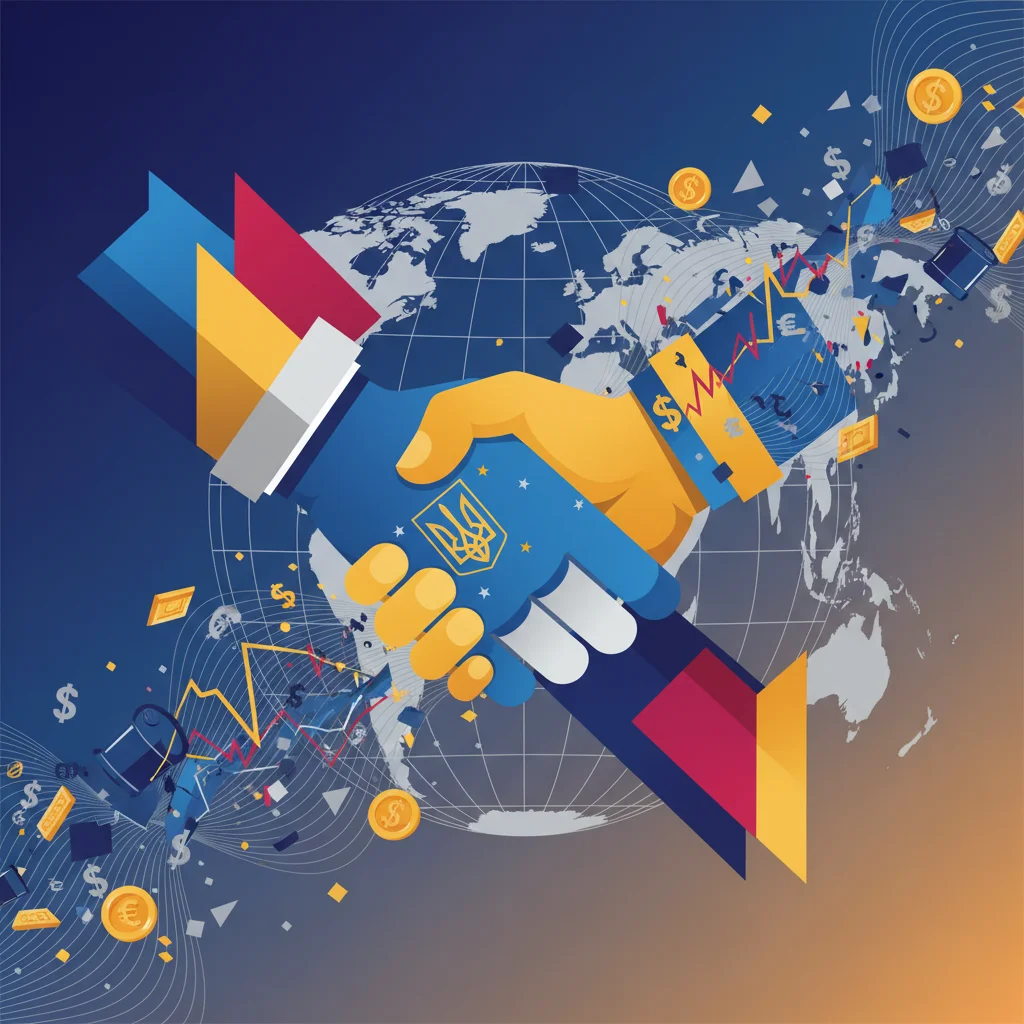
Beyond the Handshake: Decoding the Financial Shockwaves of the US-Ukraine Summit
In the world of global finance, geopolitical handshakes can trigger market tsunamis. The recent summit between U.S. President Donald Trump and Ukrainian President Volodymyr Zelenskyy was no exception. While the meeting concluded with a cautiously optimistic tone, highlighting “progress towards ending the war,” the concurrent admission that “several issues remain” has sent a complex and deeply nuanced signal to investors, business leaders, and the global economy at large. This is not just a story about diplomacy; it’s a critical inflection point for international finance, investment strategy, and the future of European economic stability.
The initial report from the summit, as noted by the Financial Times, was a study in contrasts. On one hand, any movement toward peace is a fundamentally bullish signal for markets that have been battered by the winds of conflict. On the other, the lingering uncertainty acts as a powerful brake, reminding us that the path from conflict to reconstruction is fraught with financial and political risk. For the discerning investor and business leader, the real story lies not in the headlines, but in dissecting the economic undercurrents and identifying the long-term opportunities and threats that this summit has unveiled.
The Economic Scars of Conflict: A Global Reckoning
To understand the significance of the summit, we must first appreciate the profound economic damage the conflict has inflicted. The war in Ukraine has been a primary driver of global inflation, supply chain disruption, and energy market volatility for the past several years. According to analysis from the Organisation for Economic Co-operation and Development (OECD), the war was projected to lower global GDP growth significantly while pushing inflation up by several percentage points, a reality that has played out across both developed and emerging economies.
This conflict has reshaped global trading routes, forced a rapid and costly energy transition in Europe, and placed immense pressure on food security, given Ukraine’s role as a major grain exporter. The global stock market has reflected this turmoil, with defense and energy stocks experiencing significant rallies while consumer-facing sectors have struggled under the weight of inflation and diminished confidence. Therefore, a summit aiming to end the conflict is not merely a political event; it’s a potential catalyst for the largest economic pivot of the decade.
The Swedish Christmas Portfolio: Building Financial Resilience in a Volatile World
A Glimmer of Hope vs. a Wall of Worry: The Market’s Dichotomy
The summit’s dual message creates a classic “risk-on, risk-off” tension for the markets. The “progress” narrative suggests a future where:
- Energy Prices Stabilize: A reduction in conflict-related risk premiums could bring down oil and natural gas prices, easing inflationary pressures on a global scale.
- Supply Chains Re-Open: The Black Sea shipping lanes could fully reopen, easing the flow of grain, steel, and other critical commodities, directly impacting the global economics of food and manufacturing.
- Investment Confidence Returns: A credible peace plan would unlock a wave of capital that has been sitting on the sidelines, particularly into European assets that were deemed too risky.
- The Stock Market Rallies: Sectors like logistics, construction, agriculture, and consumer goods would likely see a significant boost as the global economy begins to normalize.
However, the caveat that “several issues remain” is a powerful counterforce. This uncertainty keeps investors on edge, as unresolved territorial disputes, security guarantees, and the monumental task of war reparations could easily derail any fragile peace. This prolongs market volatility, making long-term capital allocation a high-stakes gamble. For those involved in active trading, this environment presents opportunities, but for institutional investors and corporations planning multi-year projects, the lack of clarity is a significant headwind.
The Trillion-Dollar Question: Rebuilding Ukraine and the Fintech Revolution
Perhaps the most significant long-term financial implication of peace is the reconstruction of Ukraine. The scale of this undertaking is staggering. The World Bank, in a joint assessment with the Ukrainian government and the European Commission, estimated that the cost of reconstruction and recovery had reached $486 billion over the next decade. This figure represents one of the largest concentrated investment opportunities in modern history, a new Marshall Plan for the 21st century.
This is where traditional finance will intersect with cutting-edge financial technology. The sheer volume of capital required will test the limits of conventional banking and international aid systems. The challenges of transparency, speed, and last-mile delivery of funds in a post-conflict zone are immense. This is a prime use case for the disruptive power of fintech and blockchain.
Imagine a reconstruction effort powered by a new financial architecture:
- Blockchain for Transparency: Aid funds from international donors could be distributed via a transparent, immutable ledger. Every dollar could be tracked from the source to the specific project—a hospital, a school, a bridge—drastically reducing corruption and improving accountability.
- Fintech for Financial Inclusion: Mobile payment platforms and digital wallets can empower citizens who have been displaced or lost access to physical banking infrastructure, allowing them to receive aid directly and participate in the rebuilding economy.
- Tokenization of Assets: Real estate and infrastructure projects could be fractionalized and tokenized, allowing a broader base of global investors to participate in the reconstruction with smaller capital outlays, democratizing the investment process.
To illustrate the potential shift, consider the differences between legacy and future-facing aid distribution models.
| Feature | Traditional Aid Model (Legacy Banking) | Fintech & Blockchain Model (Future Finance) |
|---|---|---|
| Transparency | Opaque, funds pass through multiple intermediaries | Fully transparent, transactions recorded on an immutable public ledger |
| Speed | Slow, can take weeks or months for funds to clear | Near-instantaneous, cross-border transactions in minutes |
| Overhead Costs | High, due to administrative and banking fees | Significantly lower, minimal transaction fees |
| Accountability | Difficult to track last-mile delivery and impact | Directly traceable to specific projects or individuals |
| Accessibility | Requires access to traditional banking infrastructure | Accessible to anyone with a smartphone and internet connection |
This technological layer is not a panacea, but it offers a powerful toolkit to make the reconstruction of Ukraine more efficient, transparent, and successful, creating a new paradigm for post-conflict finance.
Flawed Models, Hidden Growth? Debunking the Brexit 'Doppelgänger' Narrative
Sector-Specific Shockwaves: Identifying Winners and Losers
For investors, a potential resolution to the conflict necessitates a re-evaluation of sector allocations. The market dynamics that have defined the wartime economy will almost certainly invert.
- Construction & Materials: This is the most obvious beneficiary. Companies specializing in infrastructure, heavy machinery, cement, and steel are poised for a generational boom.
- Agriculture & Food Production: The return of Ukraine as a fully functioning “breadbasket of Europe” will stabilize global food prices. Agribusiness, logistics, and food processing companies will thrive.
- Technology & Fintech: As discussed, companies providing the digital backbone for reconstruction—from financial technology to project management software and cybersecurity—will find a massive, untapped market.
- Energy: This is more complex. While a resolution could lower the risk premium on oil and gas, the long-term winners will be companies involved in rebuilding and modernizing Ukraine’s energy grid, with a strong focus on renewables and energy efficiency to ensure future independence.
- Defense: The short-term view might suggest a downturn for defense stocks. However, the medium-term reality is that European nations will continue to re-arm and modernize, shifting the focus from supplying an active war to building next-generation deterrent capabilities.
The Path Forward: Navigating a Landscape of Volatile Peace
The US-Ukraine summit did not deliver a final peace treaty, but it did fire the starting gun on the post-conflict economic race. For business leaders and finance professionals, the key takeaway is that the global economy is at a turning point. The era of conflict-driven economics may be giving way to a new era of reconstruction-driven growth.
Navigating this transition requires a strategic mindset:
- Look Beyond the Noise: Daily market reactions will be volatile. Focus on the long-term structural shifts in supply chains, energy policy, and capital flows.
- Embrace Innovation: The reconstruction of Ukraine will be a testing ground for new technologies. Companies and investors who understand the role of fintech, blockchain, and green tech will have a significant advantage.
- Price in Political Risk: The “several issues” that remain are not trivial. A comprehensive risk analysis must include the potential for political instability and the fragility of any peace agreement.
Ultimately, the meeting between Trump and Zelenskyy was a single chapter in a much longer saga. But it was a chapter that clearly signaled a potential climax is approaching. For those in the world of finance and investing, the challenge now is to read between the lines of diplomacy and position for the profound economic transformation that is set to follow.

Related Posts
From Battlefields to Balance Sheets: Europe’s Defense Giants Unleash a $5 Billion Windfall for Investors
Solving the Financial Puzzle: What the FT Crossword Teaches Us About Modern Investing