Beyond the Bling: How Flawed Diamonds are Building the Future of Tech
When you think of a diamond, what comes to mind? Probably a flawless, brilliant-cut gemstone—a symbol of luxury, permanence, and perfection. For centuries, we’ve cherished these stones for their blemish-free beauty. But in the world of quantum physics and next-generation technology, it’s the imperfections that are truly priceless.
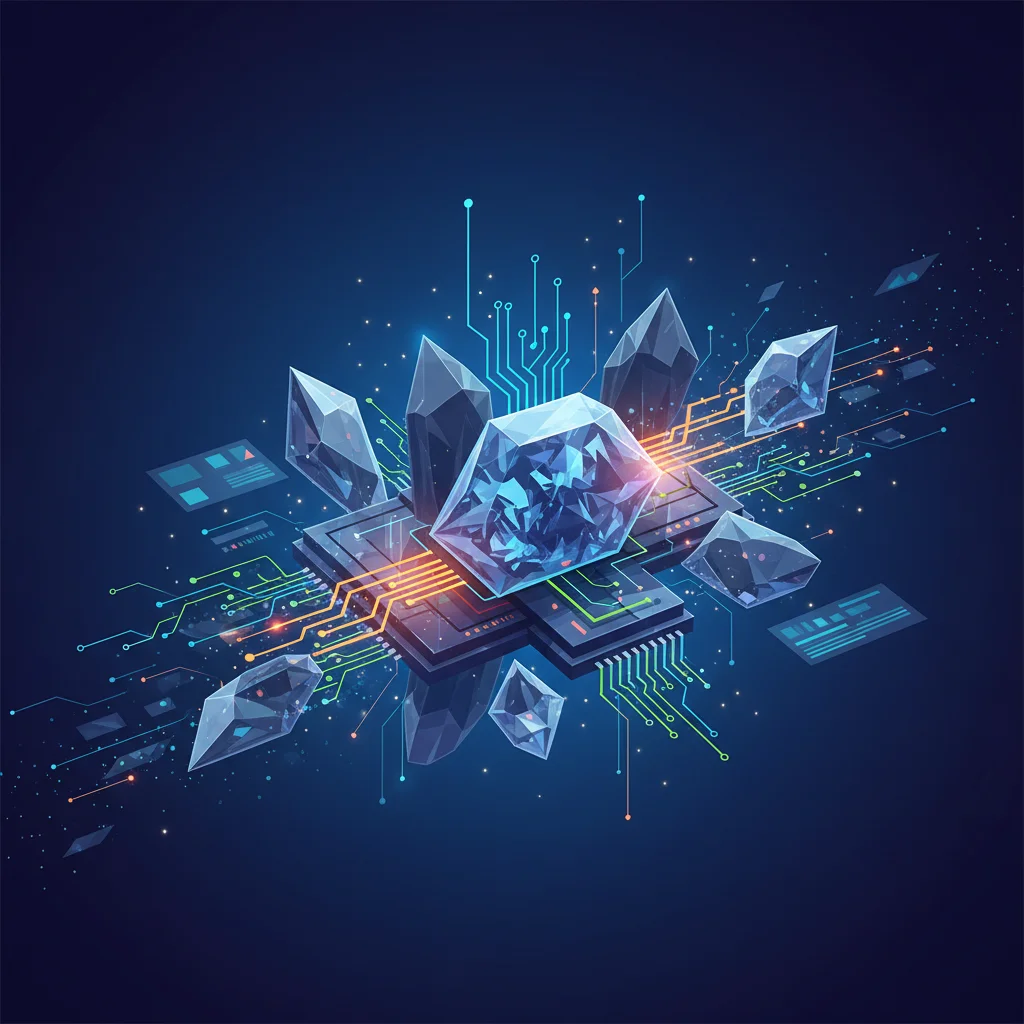
Scientists and engineers are now intentionally creating tiny, atom-sized flaws in diamonds. These aren’t your jeweler’s nightmare; they’re meticulously engineered gateways to a new technological era. By swapping a single carbon atom for a nitrogen atom and leaving an adjacent spot empty, they create what’s known as a Nitrogen-Vacancy (NV) center. This tiny imperfection turns a simple diamond into a powerful, room-temperature quantum machine.
This isn’t just a lab curiosity. This is the bedrock of a quantum revolution that promises to reshape everything from artificial intelligence and cybersecurity to medical diagnostics and navigation. For developers, entrepreneurs, and tech leaders, what’s happening inside these flawed diamonds is a glimpse into the future of computing, and it’s time to pay attention.
From Perfect Gem to Quantum Bit: What’s the Big Deal?
To grasp why this is so revolutionary, let’s quickly recap the difference between classical and quantum computing. Your laptop, your phone, and every server in the cloud runs on classical bits. A bit is a simple switch, either a 0 or a 1. It’s a binary system that has powered every digital innovation for the past 70 years.
Quantum computing, however, operates on a completely different set of rules, thanks to the bizarre principles of quantum mechanics. Its fundamental unit is the qubit.
- Superposition: Unlike a bit, which is either 0 or 1, a qubit can be 0, 1, or both at the same time. Think of it like a spinning coin—it’s neither heads nor tails until it lands. This ability to exist in multiple states simultaneously allows quantum computers to process a vast number of possibilities at once.
- Entanglement: This is what Einstein famously called “spooky action at a distance.” Two qubits can be linked in such a way that their fates are intertwined, no matter how far apart they are. Measuring the state of one instantly influences the state of the other.
Together, superposition and entanglement give quantum computers an exponential advantage for certain types of problems. The challenge? Qubits are incredibly fragile. Most quantum systems, like those built by Google and IBM using superconducting circuits, need to be kept in massive refrigerators at temperatures colder than deep space to protect their delicate quantum states from the slightest disturbance. This is where diamonds crash the party.
The Diamond Advantage: A Perfect Cage for Quantum Chaos
The carbon atoms in a diamond are locked into an exceptionally rigid and stable lattice structure. This makes a diamond an ideal environment for a qubit—it’s like putting a fragile object in a perfectly soundproof, vibration-proof box. The NV center acts as a tiny quantum system trapped within this protective cage.
The magic happens with the electron trapped at this NV center. Scientists can use precisely tuned lasers and microwaves to control the electron’s “spin,” which is a quantum property. This spin can be put into a state of superposition to act as a robust qubit. Best of all, because the diamond lattice is so protective, this can all be done at room temperature. This single fact dramatically lowers the barrier to building and operating quantum devices, a game-changer that has attracted significant investment and R&D from both startups and established players (source).
TikTok's Digital Iron Curtain: How ByteDance Averted a US Ban and Redefined Global Tech
The Killer Apps: How Diamond Quantum Tech Will Transform Industries
So, we have a stable, room-temperature qubit. What can we actually do with it? The applications span across some of the most critical and fastest-growing sectors in technology.
1. Unbreakable Cybersecurity and the Quantum Internet
Today’s encryption standards rely on mathematical problems that are too hard for classical computers to solve in a reasonable amount of time. A powerful quantum computer could, in theory, break many of them. But quantum mechanics also offers a solution: Quantum Key Distribution (QKD).
By encoding information in the quantum states of entangled photons—which can be generated and processed using diamond NV centers—we can create fundamentally secure communication channels. The laws of physics dictate that if a third party tries to intercept and measure the quantum state, the state itself is altered, immediately revealing the eavesdropper’s presence. This could lead to a new generation of unhackable networks, a critical innovation for governments, financial institutions, and critical infrastructure running on the cloud.
2. Hyper-Sensitive Sensors with Unprecedented Precision
The electron spin in an NV center is exquisitely sensitive to its local environment. It’s affected by magnetic fields, electric fields, temperature, and pressure. By monitoring these tiny changes, we can build sensors with staggering precision.
Consider the possibilities:
- Medicine: Creating detailed, real-time maps of brain activity by detecting the minuscule magnetic fields generated by neural firings, without the need for cumbersome equipment.
- Navigation: Building GPS-free navigation systems for submarines or autonomous vehicles by sensing tiny variations in the Earth’s magnetic field.
- Materials Science: Inspecting the integrity of microchips at the nanoscale or analyzing the chemical composition of a single protein.
This level of sensing capability will fuel a new wave of automation and data-driven discovery, powered by advanced software and machine learning algorithms to interpret the results.
3. A New Path for Artificial Intelligence and Computing
While a universal, fault-tolerant quantum computer is still a long way off, diamond-based systems are a promising platform. Researchers are working on linking multiple NV centers together to create more powerful processors. According to the Financial Times, Element Six, the synthetic diamond arm of De Beers, is a key supplier in this field, producing “quantum-grade” diamonds for researchers and startups worldwide.
These quantum processors could revolutionize AI by tackling complex optimization problems that are currently impossible to solve. This includes designing new drugs and materials, optimizing global supply chains, and developing more sophisticated financial models. The programming paradigm will be entirely different, opening up a new frontier for developers and computer scientists.
To better understand where diamond-based quantum technology fits, let’s compare it to other leading approaches.
| Quantum Technology | Operating Principle | Operating Temperature | Key Advantage | Primary Challenge |
|---|---|---|---|---|
| Diamond NV Centers | Electron spin in a nitrogen-vacancy flaw | Room Temperature | Stable, long coherence time, operates in ambient conditions | Scalability and entangling many qubits |
| Superconducting Circuits | Microwave circuits cooled to a quantum state | Near Absolute Zero (~15mK) | Fast gate operations, advanced fabrication | Extreme cooling needs, sensitive to noise |
| Trapped Ions | Individual ions held by electromagnetic fields | Near Absolute Zero | Very high fidelity, long coherence times | Slow gate operations, complex laser control |
| Photonic Qubits | Quantum states of single photons | Room Temperature | Natural for communication, low decoherence | Difficult to make photons interact for logic gates |
The New Tech Whales: Why Consulting Giants Are Buying Up Startups
The Road Ahead: Overcoming Hurdles with Startup Innovation
The path to a diamond-powered quantum future is not without its challenges. The primary hurdle is scalability. While controlling a single NV center is well-established, creating large, interconnected networks of thousands or millions of entangled qubits is a monumental engineering feat. Precisely manufacturing diamonds with NV centers placed at specific locations, just nanometers apart, is at the bleeding edge of materials science.
This is where the startup ecosystem shines. Companies like Quantum Diamond Technologies Inc. (QDTI), a spin-off from Harvard, are focused on near-term applications like medical sensing. As noted in the Financial Times article, their goal is to develop a “desktop-sized machine” capable of accelerating drug discovery. Others are focused on building the fundamental hardware for quantum networking and computing.
This fusion of deep physics, materials science, and software engineering is creating a fertile ground for innovation. We are witnessing the birth of a new industry where the ability to manipulate matter at the atomic level is the core value proposition.
Decoding the Matrix: What Blackstone, AI Risk, and Crypto Politics Reveal About Our Future
A Flawless Future Built on Imperfection
The story of the quantum diamond is a powerful reminder that progress often comes from unexpected places. For centuries, we sought perfection in these stones. Now, we realize that a carefully introduced flaw is the key to unlocking a new dimension of computational and sensory power.
The implications are profound. For developers, it signals the dawn of a new programming paradigm. For entrepreneurs, it opens up a universe of opportunities in hardware, software, and services. For all of us, it promises a future where challenges in medicine, AI, and cybersecurity that seem insurmountable today could one day be solved by the quantum heart of a tiny, imperfect diamond.
The quantum revolution won’t be televised; it will be built, atom by atom, inside the most unlikely of materials. The “forever” in “diamonds are forever” is about to take on a whole new meaning.