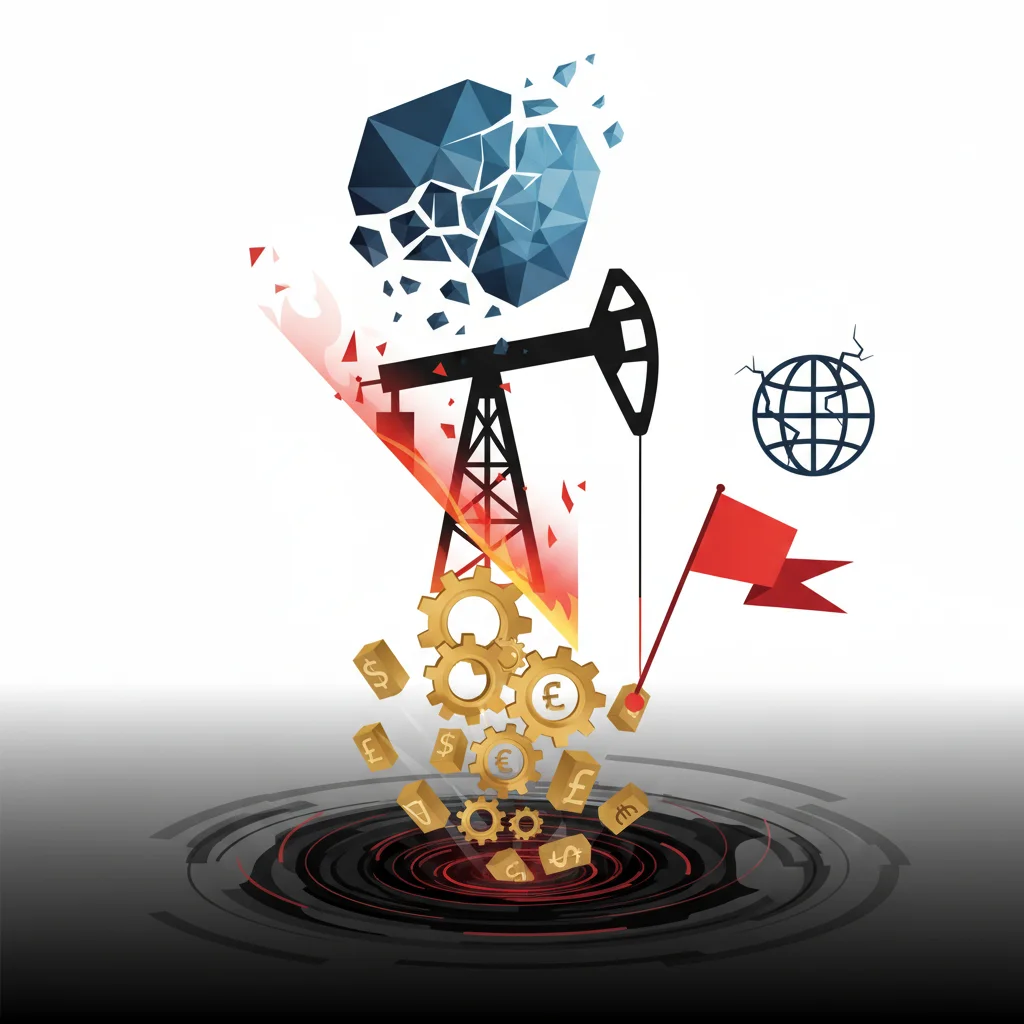
The Silent Collapse: Why the North Sea’s Worst Year Since the 70s Is a Red Flag for the Global Economy
Introduction: The Ebbing Tide of Black Gold
For over half a century, the North Sea has been the beating heart of the UK’s energy landscape—a turbulent, grey expanse concealing vast reserves of oil and gas that have fueled a nation, generated immense wealth, and cemented London’s status as a global hub for finance and energy trading. But the relentless rhythm of the pumpjacks is faltering. A chilling silence is creeping across the basin. Recent reports paint a stark picture: the UK’s offshore oil and gas industry has just endured its most challenging year since the bell-bottomed, crisis-ridden 1970s. Exploration activity has cratered to its lowest level since the first commercial discoveries were made nearly 60 years ago, a stunning retreat of capital that signals more than just a cyclical downturn.
This isn’t merely a story for industry insiders. The freeze in investment in one of the world’s most mature and historically significant oil basins is a canary in the coal mine for the global economy. It’s a complex narrative woven from threads of volatile geopolitics, controversial fiscal policy, and the inexorable, planet-altering shift towards a green future. For investors, finance professionals, and business leaders, understanding the dynamics at play in the North Sea is crucial for navigating the treacherous waters of modern capital markets and anticipating the seismic shifts in the global energy paradigm.
The Anatomy of the Decline: A 60-Year Low
The numbers are unequivocal and alarming. According to a detailed analysis by the Financial Times, the number of exploration wells drilled in the UK continental shelf has fallen off a cliff. In the past year, a mere handful of new wells were initiated, a figure that represents a near-total cessation of the frontier exploration that has historically been the lifeblood of the industry (source). This is not a gradual decline; it’s a sudden and dramatic capital strike.
To grasp the magnitude of this event, one needs a sense of historical context. Since the 1960s, the North Sea has been a bastion of British economic strength. It helped the UK weather the oil shocks of the 1970s, funded public services through decades of tax receipts, and created a world-class ecosystem of engineering, geology, and financial technology services. The current investment freeze, therefore, is a historic anomaly with profound implications.
This decline in new activity is a direct reflection of a collapse in investor confidence. Capital, especially in the high-risk, long-term world of oil and gas exploration, is famously fluid and famously cowardly. It flows to regions offering stability, predictability, and a favorable return on investment. Right now, the UK North Sea is perceived as offering none of the above.
Europe's Trillion-Dollar Battery Dilemma: Why Local Content is the New Gold Standard
A Perfect Storm: The Three Forces Squeezing the North Sea
Why has capital fled so decisively? The current crisis is not the result of a single factor but a convergence of powerful headwinds, creating a perfect storm for drillers and their backers in the stock market.
1. The Chilling Effect of Fiscal Policy
Perhaps the most immediate catalyst is the UK government’s Energy Profits Levy (EPL), commonly known as the “windfall tax.” Introduced to capture the soaring profits of energy producers following Russia’s invasion of Ukraine, the tax has been extended and now imposes a marginal rate of 75% on profits from UK oil and gas production. While politically popular, industry leaders argue that the tax is punitive and poorly designed. Unlike similar regimes in countries like Norway, it offers limited relief for new capital investment, effectively disincentivizing the very activity needed to sustain the basin’s future. As one industry report noted, this has made the UK one of the least attractive fiscal regimes for energy investment globally (source).
2. The Spectre of the Energy Transition
Looming over every boardroom decision is the global energy transition. With mounting pressure from ESG (Environmental, Social, and Governance) investors and a tightening regulatory environment, oil and gas majors are navigating a delicate balancing act. They must satisfy current energy demand while simultaneously pivoting their massive operations toward renewables. This creates immense uncertainty for projects with 20- to 30-year lifecycles. Why sink billions into a new North Sea field when its long-term viability could be curtailed by future climate policy? This uncertainty is a significant deterrent to the kind of bold investing the basin requires.
3. A Matured Basin in a Volatile World
The North Sea is not the frontier it once was. The remaining reserves are often in smaller, more geologically complex pockets that are more expensive to extract. When oil prices were soaring above $100 a barrel, these projects were viable. But with prices stabilizing at lower levels, the risk-reward calculation has shifted dramatically. Companies are now prioritizing capital discipline, favoring lower-risk projects in other parts of the world with better returns and more stable political and fiscal landscapes.
The Ripple Effect: From Aberdeen to Your Portfolio
The hollowing out of the North Sea’s exploration pipeline will have far-reaching consequences that extend well beyond the oil rigs themselves. These effects will be felt across the UK economy and in the portfolios of investors worldwide.
Below is a table illustrating the stark decline in North Sea activity, based on aggregated industry data. It highlights the precipitous drop in both exploration and capital expenditure, painting a clear picture of the investment drought.
| Year | Exploration & Appraisal Wells Drilled | Total Capital Investment (£ billion) |
|---|---|---|
| 2014 | 26 | £14.8 |
| 2016 | 14 | £11.5 |
| 2018 | 12 | £7.5 |
| 2020 | 9 | £5.5 |
| 2023 | 4 (source) | £3.1 |
Impact on the UK Economy and Energy Security
A shrinking North Sea sector means a direct hit to the UK’s GDP, significant job losses in specialized fields, and a decline in tax revenues that fund public services. More critically, it cedes control over the nation’s energy supply. As domestic production falls, reliance on imported oil and, particularly, liquefied natural gas (LNG) will rise. This exposes the UK to the whims of volatile international markets and the geopolitical agendas of other nations, a precarious position in an increasingly fractured world.
Implications for Investors and Financial Markets
For those invested in energy majors like Shell and BP, this signals a strategic pivot. While their global portfolios are diversified, the struggles in their home basin impact their valuation and strategic outlook. The uncertainty may weigh on their stock market performance. It also raises broader questions for portfolio managers: How do you balance the ethical considerations of ESG with the pragmatic need for energy security? The North Sea’s decline is a real-world case study in this modern investment dilemma.
The Dragon Takes a Breath: Why China's Stock Market Rally Is Facing a Harsh Economic Reality
Navigating the Future: Can the North Sea Be Revived?
Is this the beginning of the end, or can the tide be turned? The path forward is fraught with challenges and requires a delicate policy balance. A potential recalibration or replacement of the windfall tax with a more investment-friendly regime is seen by many as a prerequisite to coaxing capital back. Predictability is paramount.
Technology will also play a crucial role. Innovations in seismic imaging, drilling efficiency, and operational automation can lower the cost of extracting the remaining reserves. Furthermore, the infrastructure and expertise of the North Sea oil and gas industry are uniquely positioned to pivot towards new energy vectors like carbon capture, utilization, and storage (CCUS) and green hydrogen production. Some are exploring how technologies like blockchain could be used to create transparent, auditable carbon credit markets, providing new revenue streams. New fintech platforms could also emerge to facilitate more agile financing models for smaller, specialized energy projects.
Ultimately, the future of the North Sea hinges on a clear, long-term energy strategy from the government—one that acknowledges the dual challenge of ensuring energy security today while building the renewable infrastructure of tomorrow. Without it, the basin’s decline may become irreversible.
Conclusion: A Warning from the Waves
The silent rigs and frozen investment pipelines of the North Sea are more than just an industry-specific problem. They are a potent symbol of the immense challenges facing advanced economies in the 21st century. The crisis is a microcosm of the global tug-of-war between short-term fiscal needs, long-term energy security, and the urgent imperative of climate action. For investors and business leaders, it serves as a stark reminder that political and regulatory risk can be just as powerful as market risk. The fate of this historic basin offers a critical lesson in the profound economic consequences that unfold when policy uncertainty meets a fundamental industrial transition. The world is watching to see if the UK can navigate these stormy waters, or if a vital engine of its economy will be left to rust away.