Your Barista Is Not Your AI Training Data: The Hidden Tech Cost of a Viral Video
The Croissant That Went Viral—And What It Cost a Worker
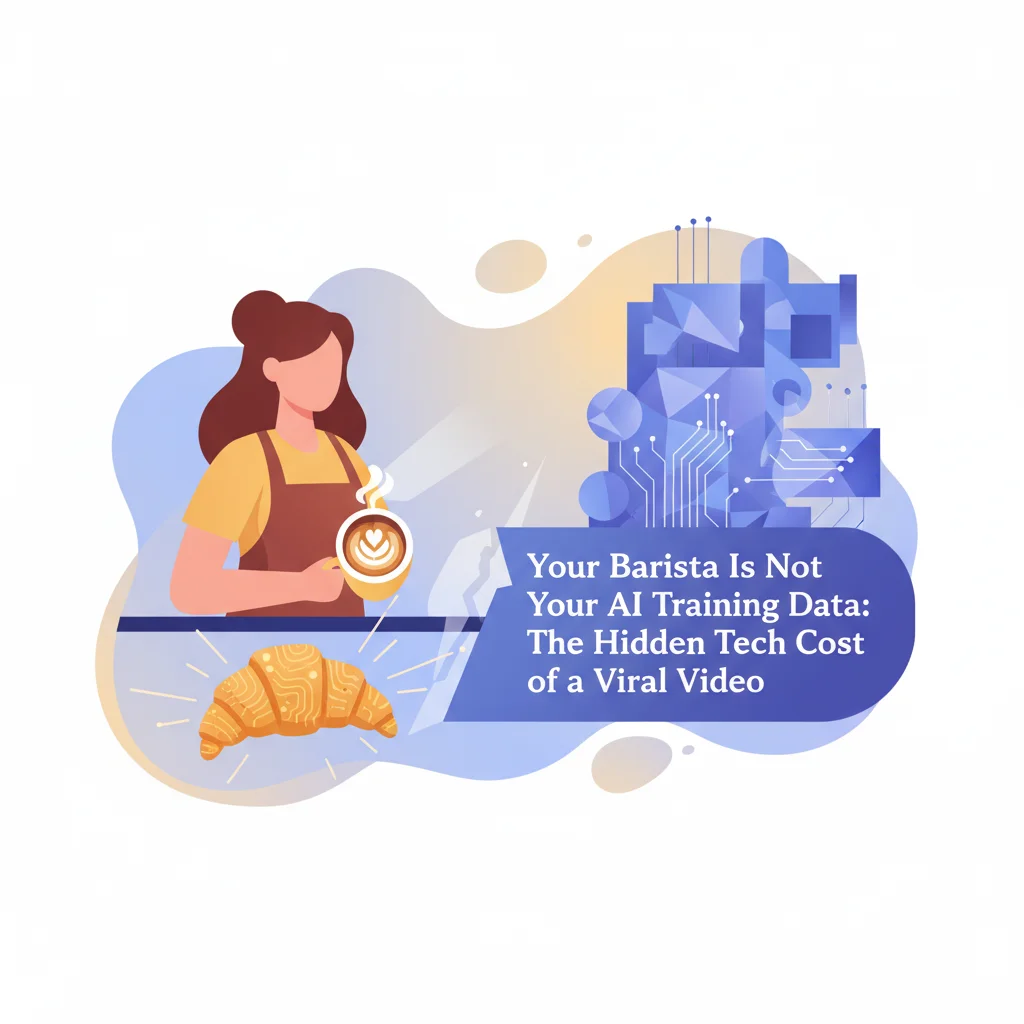
Imagine this: you’re a baker at a small, trendy café. Your craft is your passion, and one of your creations—a perfectly laminated, circular croissant—suddenly becomes an Instagram sensation. Lines form around the block. Every day, dozens of phones are pointed in your direction, their lenses capturing your every move as you meticulously work the dough. You’re not just a baker anymore; you’re an unwilling supporting actor in countless TikToks and Reels. You’ve become, as one employee at a real-life viral bakery described it, part of the “scenery” for someone else’s content.
This isn’t a hypothetical scenario. It’s the reality for service workers everywhere, as highlighted in a recent Financial Times article about an employee’s fight for a shred of privacy in the face of constant, casual surveillance. While the immediate issue feels like one of social etiquette, it peels back the curtain on a much larger, more complex technological problem. The casual recording of a stranger isn’t just a fleeting digital moment; it’s the first step in a data supply chain that feeds the hungry engines of modern artificial intelligence and automation.
For developers, entrepreneurs, and tech professionals, this story is more than just a human-interest piece. It’s a critical case study on the unforeseen consequences of the technologies we build. It forces us to ask a difficult question: When does user-generated content become non-consensual data harvesting?
From Social Media Post to Machine Learning Model
When a customer films a barista making a latte or a chef plating a dish, their intent is usually simple: to create engaging content. But once that video is uploaded to the cloud, it becomes a piece of data, untethered from its original context. It can be scraped, cataloged, and analyzed by anyone with the right tools. And today, the most powerful of those tools are driven by machine learning.
Think about the data contained within a simple 15-second video of our baker:
- Biometric Data: High-resolution facial scans, unique physical identifiers.
- Behavioral Data: The precise, skilled hand movements of a craftsperson.
- Audio Data: Ambient conversations, workplace jargon, machine sounds.
* Environmental Data: The layout of a commercial kitchen, the equipment used, the workflow efficiency.
Individually, these data points might seem trivial. But in aggregate, they are a goldmine for companies developing the next generation of AI. A robotics startup could feed thousands of such videos into a neural network to train a robot arm to replicate a baker’s technique. A retail analytics company could use facial recognition to track employee efficiency across different store locations. The footage of a person simply doing their job becomes free, high-quality training data for systems designed, in some cases, to eventually automate that very job. According to one analysis, the market for data collection and labeling services for AI is already a multi-billion dollar industry, and user-generated content is a massive, largely untapped reservoir (source).
This transformation from a social media post into a corporate asset happens silently, with zero consent from or compensation for the person whose likeness and labor are being used. It is the raw, unfiltered fuel for an innovation engine that rarely considers the rights of the individuals in the footage.
Beyond the Ban: How TikTok's New Deal Rewrites the Rules for AI, Cloud, and Global Tech
The Data Lifecycle of a Viral Service Worker Video
To understand the full scope of the issue, it helps to visualize the journey of a single video clip from a customer’s phone to a corporate dataset. The process highlights multiple points where technology and ethics collide, often with significant risks to privacy and cybersecurity.
| Stage | Description | Key Technologies | Privacy & Security Risk |
|---|---|---|---|
| 1. Capture | A customer films an employee without explicit consent during their work. | Smartphone cameras, high-resolution video | Initial violation of expected privacy in a workplace context. |
| 2. Distribution | The video is uploaded to social media platforms and shared, often going viral. | Cloud Storage, SaaS Platforms (TikTok, Instagram), Content Delivery Networks | Massive, uncontrollable proliferation of the individual’s likeness. |
| 3. Scraping & Aggregation | Third-party data brokers or AI companies systematically download public videos. | Web scraping bots, data warehousing, automation scripts | Non-consensual collection and consolidation of personal data. |
| 4. Analysis & Labeling | AI analyzes the video, identifying faces, actions, and objects. Humans may label data for training. | Facial Recognition, Pose Estimation, Object Detection Software | Misidentification, creation of a permanent biometric profile, potential for deepfakes. |
| 5. AI Model Training | The labeled data is used to train a commercial machine learning model. | Neural Networks, Deep Learning Frameworks (TensorFlow, PyTorch) | The individual’s skill and likeness are monetized by a third party without their knowledge or consent. |
Where Law, Ethics, and Code Collide
The legal landscape is a murky patchwork. In many jurisdictions, there is no reasonable expectation of privacy in a public place, a precedent established long before every citizen carried a 4K video camera. Legal experts note that while filming in public is generally allowed, businesses retain the right to set policies on their own property. However, enforcing a “no filming” rule can be a customer service nightmare for a small business that thrives on social media buzz.
This is where the responsibility shifts to the tech industry. For startups and established companies alike, the mantra of “move fast and break things” is dangerously irresponsible when applied to human data. The challenge isn’t just legal compliance; it’s ethical foresight. The programming of our platforms and software should reflect a deeper respect for digital dignity.
What would this look like in practice?
- Smarter Upload Filters: Social media platforms could use AI to detect when a video appears to be filmed in a commercial establishment, focusing on an individual who is clearly working. The platform could then prompt the uploader: “It looks like your video prominently features someone at their job. Do you have their permission to post this?”
- Privacy-Preserving AI: Researchers are making strides in techniques like federated learning and differential privacy. The next wave of innovation should focus on training effective models without needing raw, identifiable data.
- Consent as a Feature: For SaaS companies providing B2B services, building consent management directly into their products is crucial. Imagine a retail analytics platform that automatically blurs the faces of both customers and employees by default, requiring an explicit, audited opt-in for any form of identification. This would be a powerful fusion of cybersecurity and ethical design.
Decoding the Matrix: What Blackstone, AI Risk, and Crypto Politics Reveal About Our Future
These aren’t simple fixes, but they represent a fundamental shift in mindset: from data extraction to user empowerment. The onus cannot solely be on the service worker to police every customer with a phone.
Building a More Human-Centric Tech Future
The story of the viral baker is a microcosm of a societal negotiation we are all a part of. The convenience of the cloud, the engagement of social platforms, and the power of artificial intelligence come with hidden costs, often paid by those with the least power to object. As builders of this future, the tech community has a profound responsibility to lead this conversation.
We need to champion an approach where innovation is not measured just by capability, but by its compassion. It requires us to look past the code and see the human on the other side of the lens. The goal should be to build systems that enhance human creativity and dignity, not simply catalog them for algorithmic consumption. After all, the most sophisticated automation in the world is meaningless if it’s built upon the non-consensual exploitation of the very people it claims to help.
The next time you see a viral video of someone just doing their job, take a moment to consider the invisible data supply chain you’re witnessing. The fight for the right to simply be a baker—not a meme, a data point, or a training set for a robot—is a fight for a more ethical and sustainable technological future for us all.
The New Cold War is Digital: Unpacking the UK Government Hack and What it Means for Tech