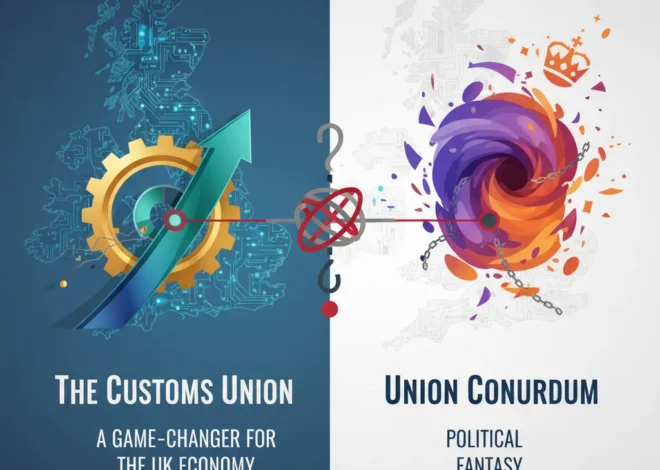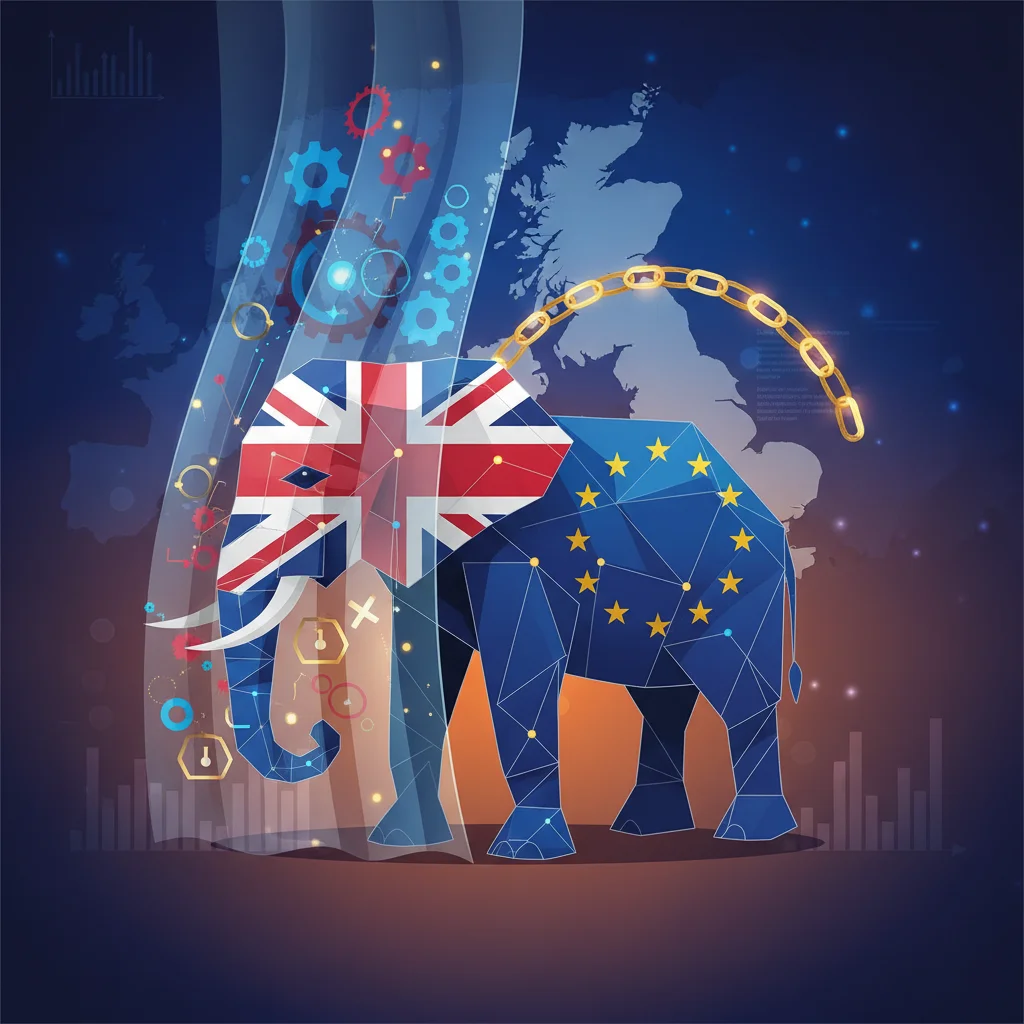
The Elephant in the Room: Could a UK Return to the EU Customs Union Redefine its Economic Future?
The Unspoken Question in British Economics
In the corridors of power and on the trading floors of the City of London, a sensitive topic is re-emerging from the political shadows: the UK’s post-Brexit relationship with the European Union. For years, the debate was considered closed, a settled matter of national sovereignty. Yet, as the UK economy grapples with sluggish growth and persistent inflation, pragmatic questions are beginning to outweigh political dogma. The latest voice to join this chorus comes from an influential quarter. Paul Nowak, the General Secretary of the Trades Union Congress (TUC), has publicly urged Labour leader Sir Keir Starmer not to “rule out” a future customs union with the EU, advocating for the “closest possible” economic relationship.
This statement is more than just a headline; it’s a potential tremor that could reshape the landscape of British finance, investing, and long-term economic strategy. For business leaders, finance professionals, and investors, understanding the nuances of this debate is critical. It’s a conversation about more than just trade; it’s about the fundamental architecture of the UK economy for decades to come.
What is a Customs Union, and Why Does It Matter Now?
Before diving into the complex financial implications, it’s essential to clarify what a customs union entails. It is often confused with the Single Market, but the two are distinct economic arrangements.
- A Customs Union: This is primarily an agreement about goods. Members agree to eliminate tariffs (taxes on imports) on goods traded between them. Crucially, they also agree to apply a common external tariff (CET) to all goods entering the union from outside countries. A key consequence is that members give up the ability to negotiate their own independent trade deals for goods.
- The Single Market: This is a much deeper form of integration. It aims to remove all barriers to trade, creating a single economic area. This is built on the “four freedoms”: the free movement of goods, services, capital, and people.
The UK’s current arrangement, the Trade and Cooperation Agreement (TCA), is a free trade agreement that ensures zero tariffs and zero quotas on most goods. However, it does not eliminate the significant non-tariff barriers—the costly paperwork, customs declarations, and regulatory checks (known as “rules of origin”)—that have added friction and expense to UK-EU trade since Brexit. According to the Office for Budget Responsibility, Brexit is expected to reduce the UK’s long-run productivity by 4 per cent and trade intensity by 15 per cent (source). It is this persistent economic drag that is prompting figures like Nowak to re-examine arrangements like a customs union.
Beyond the Headlines: The Economic Resonance of a National Tragedy in Australia
The Economic Calculus: A Balancing Act for the UK Economy
Re-entering a customs union would represent a monumental shift in UK economic policy. The potential impacts would ripple through every sector, influencing everything from the stock market to the banking industry. Let’s analyze the potential pros and cons from a financial and business perspective.
Potential Benefits: A Boost for Trade and Stability?
Proponents argue that joining a customs union would be a powerful antidote to some of the UK’s current economic ailments. The primary benefit would be the near-elimination of trade friction for goods moving between the UK and the EU. This would be a game-changer for industries like automotive, aerospace, agriculture, and manufacturing, which rely on complex, just-in-time supply chains that span the continent.
Below is a simplified comparison of the current trading reality versus a hypothetical customs union membership:
| Trade Aspect | Current UK-EU Agreement (TCA) | Hypothetical EU Customs Union Membership |
|---|---|---|
| Internal Tariffs on Goods | Zero (if goods meet ‘rules of origin’) | Zero (unconditionally) |
| Customs Declarations | Required for all shipments | Not required |
| ‘Rules of Origin’ Paperwork | Complex and mandatory to qualify for zero tariffs | Eliminated |
| External Tariffs | UK sets its own (UK Global Tariff) | Must apply the EU’s Common External Tariff |
| Independent Trade Deals | UK can negotiate its own deals globally | UK cannot negotiate independent trade deals on goods |
For investors, this shift could signal a move towards greater economic stability. A reduction in trade barriers would likely boost the earnings and valuations of UK-listed companies with heavy EU export exposure. The pound sterling could strengthen on the back of an improved trade balance and increased investor confidence. The overall effect could be a more attractive environment for foreign direct investment (FDI), which has been a cornerstone of the UK’s economic success.
The Drawbacks: The Price of Frictionless Trade
The argument against a customs union is centered on sovereignty and global trading ambitions. The primary cost is the loss of an independent trade policy for goods. The UK would have to align with the EU’s external tariffs and could no longer pursue its own bespoke free trade agreements with fast-growing economies in the Indo-Pacific or the Americas. This was, for many, a core promise of Brexit—the ability to become a nimble, independent “Global Britain” on the world trading stage.
This constraint could have significant long-term implications for the UK’s economic diversification and growth strategy. Furthermore, being in a customs union without being an EU member state creates an asymmetric power dynamic. The UK would be bound by the EU’s trade policy decisions without having a seat at the table where those decisions are made—a situation often described as becoming a “rule taker.” Turkey’s long-standing customs union with the EU is often cited as an example of this complex relationship (source).
The West End Anomaly: A Deep Dive into Retail Resilience and What It Signals for the UK Economy
Implications for Financial Technology, Banking, and Trading
While a customs union is about physical goods, its second-order effects on the UK’s world-leading financial and technology sectors would be profound. A more stable and predictable trading environment for goods underpins the health of the entire economy, which directly impacts banking and finance.
For the banking sector, a healthier manufacturing and export base means stronger corporate clients, fewer loan defaults, and greater demand for business investment and lending. The economics are straightforward: what’s good for UK Plc is generally good for its lenders.
The world of fintech and financial technology also stands to be impacted. The current maze of customs paperwork has created opportunities for “customs tech” firms, but a simplified regime could unlock different innovations. Consider the role of blockchain in supply chain management. A common customs framework with the EU would make it vastly easier to implement a unified, transparent blockchain ledger for tracking goods from factory to consumer across the UK-EU border, reducing fraud and enhancing efficiency.
Furthermore, simplifying the physical leg of trade finance could allow fintech innovators to focus on higher-value problems. Instead of solving for complex customs declarations, the focus could shift to digitizing bills of lading, streamlining cross-border payments, and providing more sophisticated trade finance solutions to SMEs. Easier trade flows reduce risk, and reduced risk lowers the cost of capital and insurance, creating a virtuous cycle for businesses engaged in international trading.
For the stock market, the sectoral impact would be clear. Companies in the automotive, food and drink, and industrial manufacturing sectors would likely see their share prices react positively to any credible move towards a customs union. Conversely, sectors that have benefited from divergence or new global trade deals might face new challenges. Investors would need to re-evaluate their portfolios based on this new geopolitical and economic paradigm.
A Canary in the Coal Mine? Why Australia's 0 Billion Pension Fund is Selling AI Stocks
Conclusion: A Fork in the Road for the British Economy
Paul Nowak’s comments have served to reignite a crucial debate about the UK’s economic identity and future. The conversation is no longer about re-litigating the past but about charting a pragmatic course for the future. The choice between an independent global trade policy and frictionless commerce with our largest and nearest trading partner is not a simple one. It involves complex trade-offs with significant consequences for the UK economy, its industries, and its financial markets.
For investors and business leaders, this is a key development to monitor. The direction of UK-EU trade policy will be one of the most significant variables shaping the investing landscape in the years ahead. Whether the UK ultimately opts for a formal customs union, a series of bespoke agreements, or maintains the status quo, the decision will send a powerful signal about its priorities. It will determine the operating environment for thousands of businesses and influence the flow of capital, defining the UK’s economic trajectory for a generation.

Related Posts
The Great Pharma Migration: Why Europe is Losing Billions in Investment to the US

The Great Banking Retreat: Why Lloyds’ Exit from Invoice Financing Spells Trouble for SMEs and Opportunity for Fintech