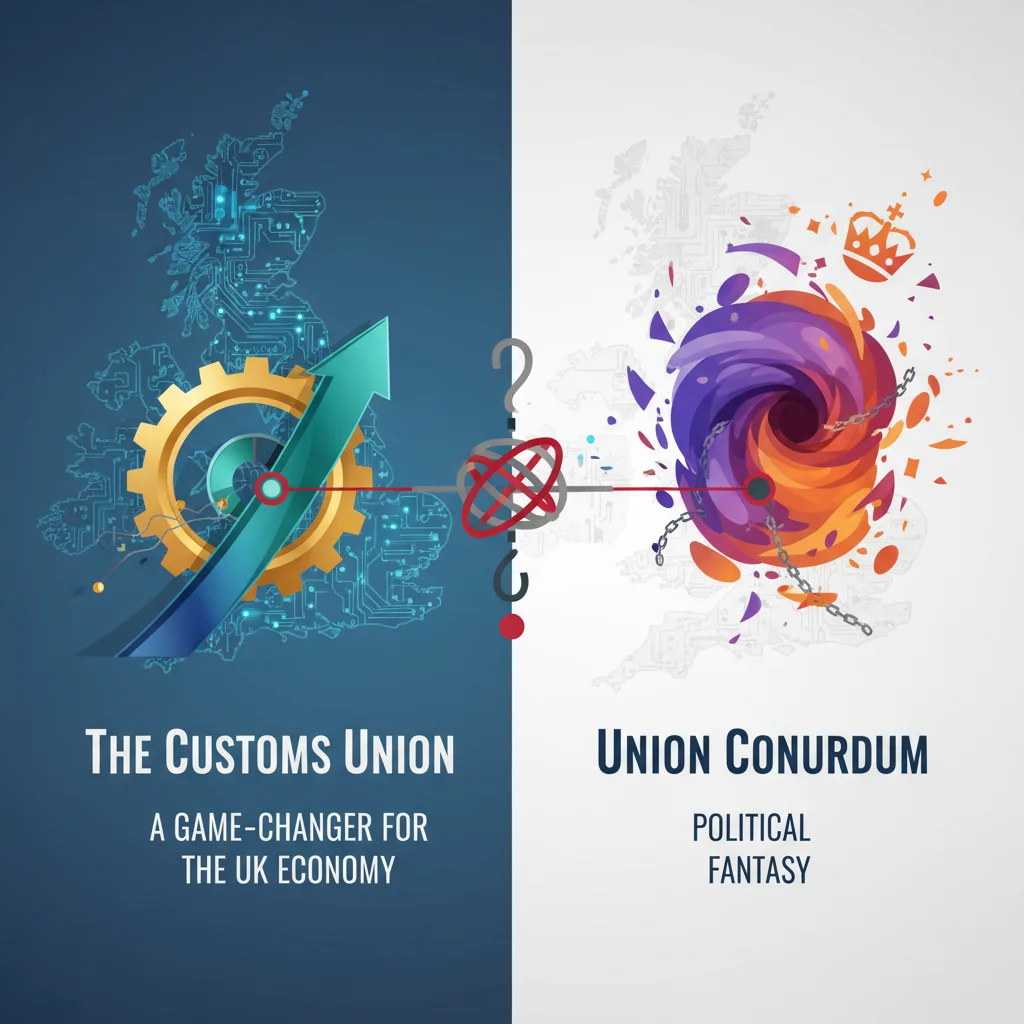
The Customs Union Conundrum: A Game-Changer for the UK Economy or a Political Fantasy?
In the intricate dance of post-Brexit economics, every move and suggestion is scrutinized for its potential to alter the UK’s trajectory. A significant new voice has just joined the chorus calling for a closer relationship with the European Union. Paul Nowak, the head of the Trades Union Congress (TUC), has thrown his weight behind calls for the UK to rejoin the EU’s customs union, a move he argues is essential for improving the living standards of British workers. This proposition, reported by the Financial Times, reopens a deeply complex and politically charged chapter in the UK’s relationship with its largest trading partner.
For investors, business leaders, and anyone with a stake in the UK’s financial future, this isn’t just political noise. It’s a signal of growing pressure to address the economic realities of the current trade arrangement. But what would a customs union actually entail? And could it truly be the panacea for the UK’s economic woes, or is it a political non-starter with significant downsides? This article delves into the economic arguments, the market implications, and the formidable political hurdles surrounding this pivotal debate.
Decoding the Jargon: What Exactly Is a Customs Union?
Before we can analyze the impact, it’s crucial to understand the terminology. The UK’s current relationship with the EU is governed by the Trade and Cooperation Agreement (TCA). While it eliminates most tariffs, it creates significant non-tariff barriers, primarily through customs checks and complex “rules of origin” paperwork. A customs union is a fundamentally different model.
In essence, a customs union involves two key components:
- No internal tariffs: Member countries trade goods with each other without any tariffs or customs duties.
- A common external tariff (CET): All member countries apply the exact same set of tariffs to goods imported from outside the union.
The crucial advantage is the near-elimination of customs paperwork for goods moving between members, as the origin of the product no longer needs to be proven. This is a major friction point under the current TCA. To clarify the differences, let’s compare the main UK-EU trading models.
Below is a table comparing the key features of the UK’s current TCA, a potential Customs Union membership, and the Single Market.
| Feature | Current TCA | Customs Union | Single Market |
|---|---|---|---|
| Tariffs on Goods | Zero (if goods meet ‘rules of origin’) | Zero | Zero |
| Customs Checks | Yes (declarations, rules of origin checks) | No (for goods) | No |
| Common External Tariff | No (UK has its own tariff schedule) | Yes | Yes |
| Independent Trade Deals | Yes | No | No |
| Free Movement of People | No | No | Yes |
| Regulatory Alignment (Goods) | Partial (risk of divergence) | Partial (less friction but still requires checks) | Yes (common standards) |
| Services Trade | Limited access (no ‘passporting’) | Limited access (not covered) | Full access (‘passporting’) |
As the table illustrates, a customs union would significantly streamline the trade in goods but comes at the cost of an independent trade policy—a cornerstone of the Brexit campaign.
The Economic Case: A Lifeline for Ailing Living Standards?
Paul Nowak’s central argument is that a customs union would directly benefit UK households. The logic is compelling. The Office for Budget Responsibility (OBR), the UK’s fiscal watchdog, has maintained that leaving the EU will reduce the UK’s long-run productivity by 4% and that both exports and imports will be 15% lower than if the UK had remained in the EU (source). These trade frictions create costs for businesses, which are inevitably passed on to consumers through higher prices, squeezing household budgets and contributing to inflation.
By eliminating a vast swathe of customs bureaucracy, a customs union could:
- Reduce Business Costs: Companies would save billions in administrative overheads, compliance costs, and logistics delays. This capital could be redirected towards investment, innovation, and higher wages.
- Lower Consumer Prices: A more efficient supply chain and reduced import costs would likely lead to lower prices on the shelves for everything from food to electronics.
- Boost Investment: A more stable and predictable trading relationship with the UK’s largest market would make the country a more attractive destination for foreign direct investment (FDI), particularly in manufacturing and integrated supply chain industries.
This renewed focus on the `economics` of Brexit reflects a growing concern over the UK’s sluggish growth performance. The Bank of England has repeatedly highlighted weak business investment as a key challenge for the UK `economy` since the 2016 referendum, and a closer trading arrangement could be a powerful antidote.
Ripple Effects: What This Means for Finance, Trading, and the Stock Market
Any significant shift in UK trade policy would send powerful ripples through financial markets. For investors, the prospect of a customs union presents both opportunities and risks.
The most immediate impact would likely be on the UK `stock market`. Domestically-focused companies, particularly those in the FTSE 250 index, would be seen as major beneficiaries. Retailers, manufacturers, and food producers who rely heavily on EU supply chains would see their margins improve and their operational headaches decrease. This could lead to a re-rating of UK equities, which have traded at a persistent discount compared to global peers since the Brexit vote.
In the world of currency `trading`, the pound sterling (GBP) would likely strengthen on the news of a more stable economic outlook and reduced trade friction. A customs union would be interpreted by markets as a de-risking event for the UK `economy`, potentially attracting a fresh wave of `investing` into UK assets.
However, the picture for the `banking` and broader financial services sector is more complex. A customs union primarily deals with goods. It would not restore the “passporting” rights that were lost with Brexit, which allowed UK-based financial firms to sell their services seamlessly across the EU. While a healthier overall economy is good for banks, this move wouldn’t solve the core structural challenges facing the City of London post-Brexit. Interestingly, this is where `financial technology` could play a role. While policy changes are slow, `fintech` innovations, including `blockchain`-based trade finance platforms, are already working to reduce the friction of cross-border transactions, though they cannot eliminate the need for customs checks mandated by the TCA.
The Other Side of the Coin: Sovereignty and the Inevitable Trade-Offs
A balanced analysis requires acknowledging the significant drawbacks. The primary argument against a customs union is the loss of sovereignty over trade policy. The UK would be bound by the EU’s common external tariff, effectively outsourcing its trade negotiations with the rest of the world to Brussels. The UK would be unable to sign its own free trade agreements with fast-growing economies like India or the CPTPP bloc, a key strategic goal of the post-Brexit “Global Britain” agenda.
Critics would argue that this model represents the “worst of both worlds”: the UK would be subject to EU trade rules without having a seat at the table to influence them. Furthermore, as mentioned, it does nothing to help the UK’s dominant services sector, which accounts for around 80% of the economy. This is a critical limitation that cannot be overlooked.
An Economic Christmas Carol: Is a Bank of England Rate Cut the Ghost of Growth Yet to Come?
The Political Minefield: A Bridge Too Far?
Ultimately, the fate of this proposal will be decided in the political arena, not in economic textbooks. As it stands, there is no mainstream political appetite for such a move. The Conservative party remains committed to maximizing the regulatory freedoms of Brexit. The Labour Party, while seeking a closer relationship and aiming to reduce trade barriers, has been adamant that its plans will not involve rejoining the customs union, single market, or restoring freedom of movement (source).
This political consensus makes the TUC’s intervention all the more notable. It signifies that key stakeholders in the UK `economy` are becoming more vocal about the costs of the current arrangement. While it may not shift policy overnight, it will undoubtedly fuel the ongoing conversation about what the UK’s long-term relationship with the EU should look like.
Conclusion: An Unfolding Debate for a New Economic Era
Paul Nowak’s call to reconsider a customs union is more than just a headline; it’s a reflection of the persistent economic gravity exerted by the European Union. The arguments for a less frictional trading relationship are powerful, promising a potential boost to living standards, business investment, and the UK’s overall economic health. For those involved in `finance` and `investing`, such a shift would represent a paradigm change, likely boosting domestic stocks and the pound.
However, the path is blocked by formidable political obstacles and the genuine trade-off of ceding control over national trade policy. For now, business leaders and investors must operate within the current framework. But they should watch this space closely. The debate over the UK’s economic model is far from over, and as the real-world impacts of the TCA continue to crystallize, the pressure for a new approach may become too powerful for politicians to ignore.