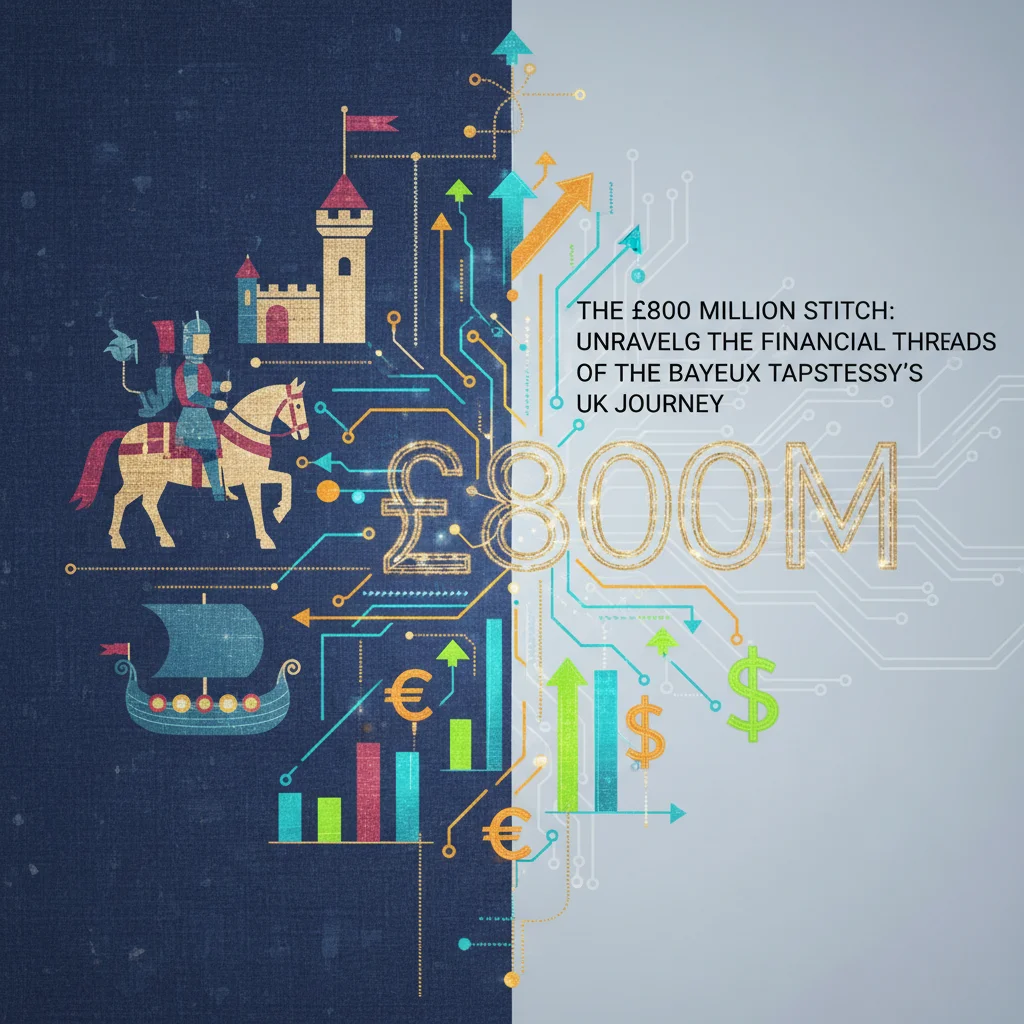
The £800 Million Stitch: Unraveling the Financial Threads of the Bayeux Tapestry’s UK Journey
A Tale of Two Eras: Medieval Art Meets Modern Finance
In the world of high finance and institutional investing, assets are typically measured in spreadsheets, stock market tickers, and quarterly reports. They are liquid, fungible, and subject to the relentless forces of supply and demand. But what happens when the asset in question is a 950-year-old, 70-meter-long embroidered cloth depicting one of the most pivotal moments in English history? The impending journey of the Bayeux Tapestry to the United Kingdom presents a fascinating intersection of cultural heritage and complex financial mechanisms, anchored by a staggering figure: an estimated £800 million indemnity cover from the UK Treasury.
This isn’t merely an art loan; it’s a sophisticated financial transaction that reveals deep truths about risk, value, and the role of the state in a modern economy. For investors, finance professionals, and business leaders, the story of the Tapestry’s insurance offers a compelling case study in the valuation of illiquid assets, sovereign risk management, and the powerful economic undercurrents of cultural exchange. It demonstrates that the principles governing our financial world—from banking and trading to the latest in financial technology—can be applied even to the most priceless and unique of treasures.
Valuing the Priceless: The Economics of Irreplaceable Assets
The first challenge in a transaction of this magnitude is valuation. How do you assign a monetary value to an object that is, by all definitions, priceless? The Bayeux Tapestry has no “market price” because it will never be sold. It’s a non-marketable, illiquid asset of the highest order. Unlike a share on the stock market, its value isn’t determined by daily trading but by its immense historical, cultural, and national significance.
In finance, valuation is the bedrock of investing and risk management. For this loan, the £800 million figure is not a sale price but an agreed-upon value for insurance purposes. This valuation is derived through a complex process involving art historians, conservation experts, and insurance actuaries. They consider factors such as:
- Historical Significance: Its unique status as a primary visual source for the Norman Conquest.
- Artistic Merit: Its craftsmanship and importance in the history of textile art.
- Replacement Cost: While impossible to truly “replace,” this metric considers the cost of creating a perfect replica and the loss of the original’s aura and historical fabric.
- Precedent: Valuations of other world-class artifacts that have been loaned internationally.
This process mirrors the challenges faced by investors dealing with alternative assets like fine art, vintage cars, or private equity, where liquidity is low and valuation is more of an art than a science. It’s a reminder that not all value in our economy can be captured by a simple ticker symbol.
A Canary in the Coal Mine? Why Australia's 0 Billion Pension Fund is Selling AI Stocks
The Government as Underwriter: A Deep Dive into Indemnity Schemes
Why isn’t a private insurer like Lloyd’s of London handling this? The answer lies in the sheer scale of the risk. The premium for a commercial insurance policy on an £800 million, fragile, one-of-a-kind object would be astronomically high, likely making the exhibition prohibitively expensive. This is a classic example of potential market failure, where the private sector cannot efficiently price or bear the risk.
Enter the Government Indemnity Scheme (GIS). This is a cornerstone of public finance, designed to facilitate cultural exchange that would otherwise be impossible. The GIS is essentially a promise from the government to cover the cost of loss or damage to an object on loan to a UK institution. Instead of paying a cash premium to an insurance company, the borrowing institution operates under the state’s sovereign guarantee. According to the UK’s Arts Council, the GIS is a vital tool that “provides an alternative to the cost of commercial insurance, enabling organisations to show works of art and other cultural objects to the public” (source). It’s a strategic use of the government’s balance sheet to generate immense public and economic value.
Below is a comparison of how this public finance mechanism stacks up against traditional private insurance in the context of high-value cultural assets.
| Feature | Government Indemnity Scheme (GIS) | Private Commercial Insurance |
|---|---|---|
| Underwriter | The UK Government (The Treasury) | Private insurance companies (e.g., syndicate at Lloyd’s, AXA Art) |
| Cost (Premium) | No direct premium; the “cost” is the risk exposure to the taxpayer. | Significant cash premium, often a percentage of the asset’s value. |
| Coverage Limit | Extremely high, capable of covering multi-billion-pound exhibitions. | Limited by the insurer’s capacity; may require multiple insurers (reinsurance). |
| Primary Goal | To facilitate cultural exchange and public access to art. | To generate profit from underwriting risk. |
| Typical Use Case | Loans of priceless artifacts to accredited national museums. | Private collections, commercial galleries, and lower-value institutional loans. |
It’s fascinating to juxtapose the Bayeux Tapestry—a profoundly physical, analog record of history—with the abstract, digital world of modern finance. While the government’s indemnity is a 20th-century solution, it makes one wonder what the 21st-century evolution will be. Could financial technology, or fintech, offer a new paradigm? Imagine a future where an object like the Tapestry has a unique digital twin on a blockchain. Its provenance, condition reports, and movements could be immutably recorded, accessible to all parties in real-time. Insurance policies could be written as smart contracts, automatically paying out if certain verifiable conditions (like damage detected by sensors) are met. While this may seem futuristic, the core principles of transparency, security, and efficiency that drive the fintech revolution could one day be applied to protecting our most treasured physical assets. The £800 million indemnity is a testament to current best practices, but it’s also a stepping stone toward a future where technology provides even greater security for our shared cultural economy.
The Economic Multiplier: An Investment in Cultural Capital
The £800 million indemnity isn’t an expense; it’s an enabling investment. The economic impact of bringing the Bayeux Tapestry to the UK will be substantial, creating a ripple effect across the economy. This is known as the “economic multiplier” effect, a core concept in economics where initial spending generates a far greater total economic benefit.
Think of the Tapestry as the anchor asset in a major economic event. Its arrival will trigger a cascade of financial activity:
- Tourism: A massive influx of domestic and international tourists will visit, spending money on hotels, food, and transportation. A 2019 report by the Arts Council England highlighted that arts and culture tourism in England generates over £11 billion in spending annually (source).
- Local Business Boost: Retailers, restaurants, and service providers in the host city will see a significant increase in revenue.
- Job Creation: The exhibition will require staff for curation, security, ticketing, and marketing, supporting jobs in the cultural sector and beyond.
- Banking and Payments: The entire ecosystem of transactions, from online ticket sales to tourist spending, relies on a robust banking and financial technology infrastructure.
In this light, the government’s decision to underwrite the risk is a strategic economic calculation. The potential tax revenue and GDP growth generated by the exhibition will likely far outweigh the statistical risk of a catastrophic loss. It’s a form of public venture capital, investing in cultural assets to yield tangible economic returns.
The Epstein Files: Unpacking the Financial Fallout and the High Cost of Complicity
Risk, Return, and the Geopolitics of Financial Instruments
At its heart, the indemnity is a tool for risk management. The risks associated with moving the 950-year-old textile are immense: accidental damage during transport, environmental fluctuations, security threats, and even fire. The financial instrument of indemnity doesn’t eliminate these risks, but it provides a backstop, making the endeavor possible.
This is a principle that resonates deeply with anyone involved in finance or investing. Every investment, from trading on the stock market to funding a tech startup, involves a careful balance of risk and potential return. The UK Treasury has assessed the risk of loss as extremely low and the potential cultural and economic return as extremely high. This is the same calculus a portfolio manager makes every day, albeit with a very different kind of asset.
Furthermore, the loan itself is an act of “soft power” and cultural diplomacy between the UK and France. Such gestures strengthen international relations, which can have positive, long-term impacts on trade and economic cooperation. The financial agreements that underpin these cultural exchanges are a quiet but crucial part of the global economic and political landscape.
Beyond the Headlines: The Economic Resonance of a National Tragedy in Australia
Conclusion: Weaving History into the Fabric of the Modern Economy
The journey of the Bayeux Tapestry, underwritten by an £800 million government guarantee, is far more than a historical curiosity. It is a powerful, real-world demonstration of sophisticated financial principles at work. It showcases how a modern economy uses tools of public finance to manage immense risk, how priceless cultural assets can generate tangible economic value, and how the age-old need to protect our heritage is now supported by complex valuation methods and risk models.
For those in the world of finance, investing, and business, it serves as a potent reminder that the most valuable assets aren’t always found on a balance sheet. Understanding the intricate financial and economic systems that allow us to share and protect these treasures provides a richer, more complete picture of the world in which we operate. The Bayeux Tapestry tells a story of a 1-th-century conquest, but its journey to the UK tells an equally compelling story about the power and ingenuity of 21st-century finance.

Related Posts

The Shelter Deficit: Poland’s Military Buildup and the Hidden Economic Gamble
The Narco-Dollar Economy: Decoding the Fall of a Drug Empire and Its Impact on Global Finance