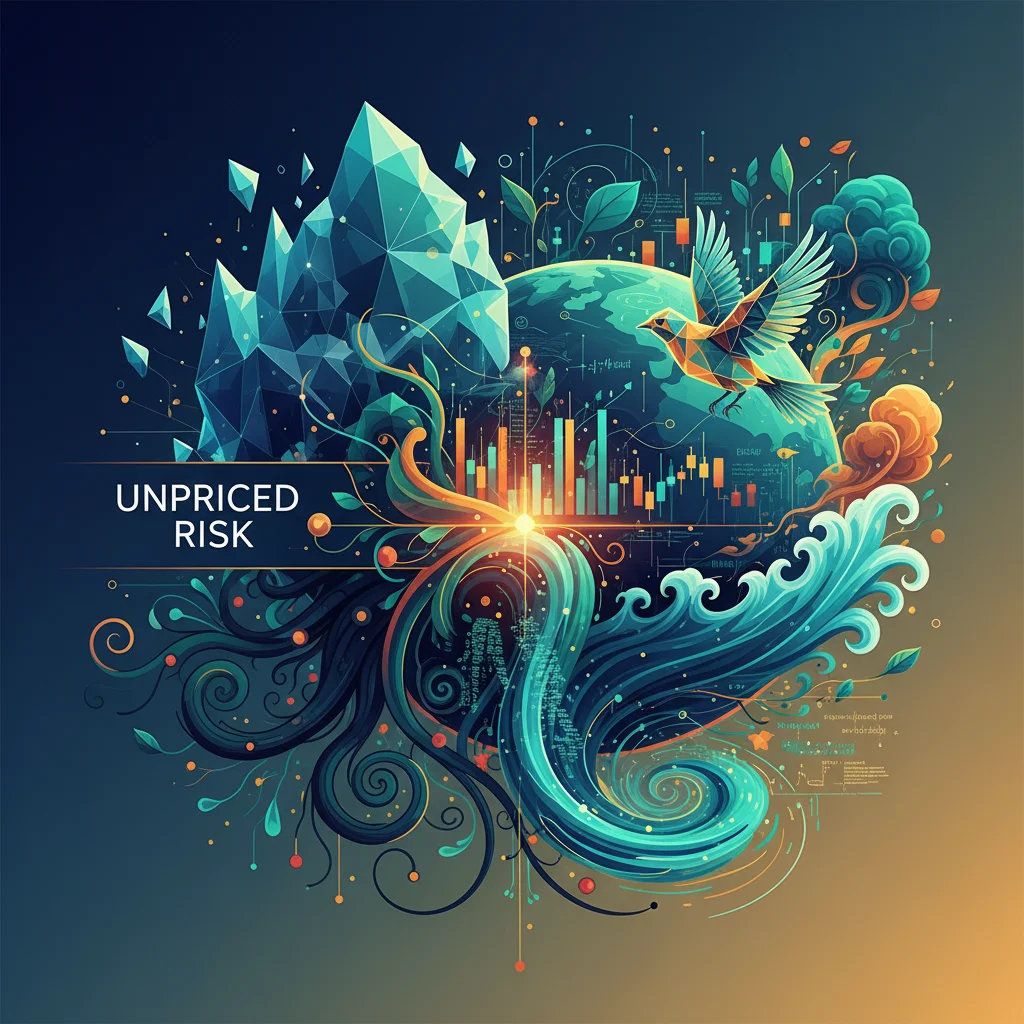
The Unpriced Risk: What Climate Fiction Teaches the World of Finance
The Canary in the Coal Mine: When Art Outpaces Economic Models
In a recent review for the Financial Times, Juhea Kim’s collection of short stories, “A Love Story from the End of the World,” is described as a “resonant, sometimes hopeful, addition to the field of climate fiction.” The tales, spanning from Seoul to California, paint vivid pictures of life amidst ecological catastrophe. For the average reader, this is powerful, speculative art. But for those in finance, investing, and business leadership, these narratives should be viewed as something more: qualitative risk reports from the future.
For decades, the worlds of literature and high finance have occupied separate universes. One deals in emotion, metaphor, and the human condition; the other in quantitative analysis, discounted cash flows, and market efficiency. Yet, as we confront systemic, non-linear risks like climate change, the tools of traditional economics are proving inadequate. Our models are excellent at pricing the probability of a tenth-of-a-percent interest rate hike. They are utterly blind to the cascading consequences of a melting ice shelf.
This is where the “cli-fi” genre, and works like Kim’s, becomes an unexpectedly crucial tool for the modern investor. It provides what our spreadsheets cannot: a visceral, human-scale understanding of tail risk. It helps us imagine the unimaginable and, in doing so, begin the critical work of pricing a risk that threatens the entire global economy.
From Narrative to Numbers: Quantifying Climate Catastrophe
The warnings are no longer just in fiction. The economic data is becoming starkly clear. A 2022 report from the Deloitte Economics Institute projected that unchecked climate change could cost the global economy a staggering $178 trillion over the next 50 years. This represents a 7.6% cut to global GDP in the year 2070 alone (source). These are not abstract figures; they represent destroyed infrastructure, disrupted supply chains, reduced agricultural yields, and immense human displacement—the very scenarios explored in climate fiction.
For investors, this translates into two primary categories of risk that must be managed:
- Physical Risk: This is the direct impact of climate events on assets. It includes damage to real estate from hurricanes and wildfires, disruption to manufacturing facilities due to flooding, and the impact of drought on agricultural commodities. A portfolio heavily weighted in coastal real estate or non-resilient agriculture is carrying a significant, and often underpriced, physical risk.
- Transition Risk: This is the financial risk associated with the transition to a low-carbon economy. As governments implement carbon taxes, consumers shift demand to sustainable products, and new, green technologies disrupt entire industries, companies that fail to adapt will face immense financial pressure. Think of it as the “Kodak moment” for the fossil fuel industry. Assets can become “stranded,” meaning their economic value plummets long before their physical utility is exhausted.
The challenge for the stock market is that these risks are long-term, complex, and fraught with uncertainty. Standard valuation models that project earnings a few years out are ill-equipped to handle them. This is why forward-thinking investors are increasingly looking beyond quarterly reports and turning towards more sophisticated ESG (Environmental, Social, and Governance) frameworks to build resilient portfolios.
The “Green Swan”: A New Class of Systemic Risk
The Bank for International Settlements (BIS), often called the central bank for central banks, has coined a new term for the unique threat posed by climate change: the “Green Swan.” Unlike Nassim Taleb’s “Black Swans”—rare, unpredictable events with massive impact—Green Swans have a key difference: they are largely predictable. The scientific consensus on climate change is overwhelming; we know the catastrophe is coming, even if we don’t know the precise timing or form of its financial manifestation (source).
The BIS warns that climate-related risks could trigger a systemic financial crisis. The complex, interconnected nature of our global banking and financial systems means that a climate-driven shock in one sector—like agriculture or insurance—could cascade catastrophically, much like the subprime mortgage crisis of 2008. To address this, we need to fundamentally rethink risk management.
Below is a comparison highlighting why climate risk breaks traditional financial modeling:
| Feature | Traditional Financial Risk (e.g., Market Risk) | Climate-Related Financial Risk (Green Swan) |
|---|---|---|
| Probability | Can be estimated from historical data (e.g., volatility) | Deep uncertainty; historical data is not a reliable guide |
| Time Horizon | Short to medium-term (quarters, years) | Long-term, but with imminent, non-linear tipping points |
| Reversibility | Often reversible (markets recover from downturns) | Potentially irreversible (ecosystem collapse, species extinction) |
| Scope | Typically confined to the financial system | System-wide impact on the entire economy and society |
| Data Source | Quantitative market data (prices, volumes) | Complex mix of climate science, policy, and social data |
This table illustrates the profound challenge facing regulators, banks, and asset managers. The tools that have underpinned modern finance for the last 50 years are simply not built for this new reality.
Beyond the Tinsel: A Strategic Guide to Holiday Spending in a Shifting Economy
The Trillion-Dollar Opportunity: Investing in the Transition
While the risks are daunting, the transition to a sustainable economy also represents one of the greatest investment opportunities in human history. Every sector, from energy and transportation to agriculture and construction, must be reimagined. This disruption creates enormous potential for growth and innovation, and financial technology is at the heart of funding this transformation.
The market for sustainable investing is already vast. A 2023 report from PwC estimates that ESG-focused assets under management are on track to soar to $33.9 trillion by 2026, making up over 21% of the total (source). This is not just a niche market; it is the future of capital allocation.
Several areas are seeing explosive growth, driven by innovative fintech solutions:
- Green Bonds & Climate Finance: Specialized debt instruments are being used to raise capital specifically for projects with positive environmental benefits, with fintech platforms making them more accessible to a wider range of investors.
- Blockchain for Carbon Markets: The transparency and immutability of blockchain technology offer a powerful solution for building trustworthy and efficient carbon credit trading markets. It can track and verify carbon offsets, reducing fraud and increasing confidence in the system.
- AI-Powered ESG Analytics: Startups are using artificial intelligence to scrape and analyze vast amounts of data—from satellite imagery of deforestation to corporate social media sentiment—to provide investors with more accurate and timely ESG ratings than ever before.
The Green Paradox: Why the West's ESG Retreat is Ceding the Future to China
Conclusion: The Ultimate Long-Term Investment
Juhea Kim’s “A Love Story from the End of the World” may seem far removed from the trading floors of Wall Street or the boardrooms of Silicon Valley. Yet, its fictional explorations of a world grappling with ecological breakdown are a vital piece of the mosaic of information that every serious investor and business leader must now consider.
The narrative of our economic future is being rewritten in real-time by the physics of our climate. To ignore the warnings, whether they come from an IPCC report or a work of fiction, is to engage in a form of willful financial blindness. The greatest returns of the 21st century will not go to those who can build the best discounted cash flow model based on the past, but to those who can best understand the profound risks and opportunities of the necessary transition to a sustainable future. The stories are telling us where the world is heading; the smart money will listen.