The ECB’s Playbook: Christine Lagarde on Navigating Europe’s “Existential Crisis”
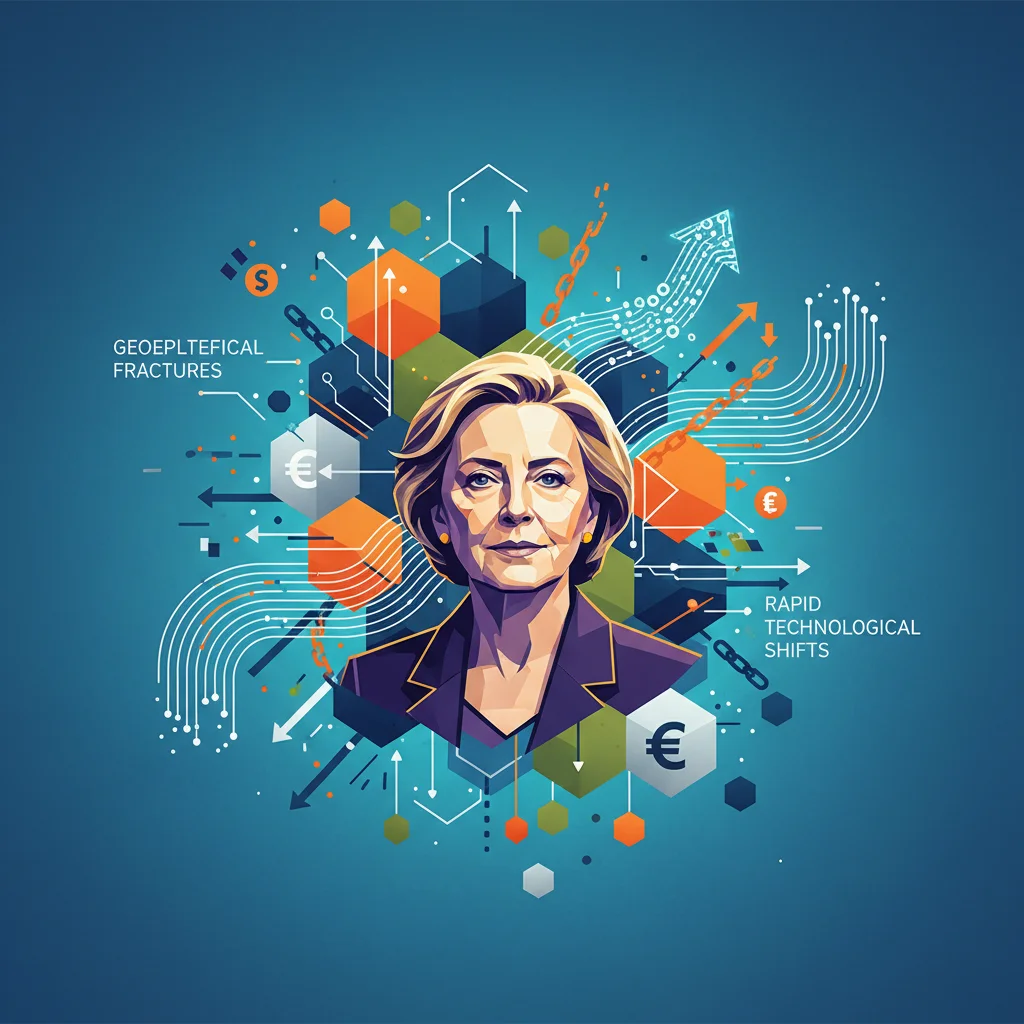
In a world grappling with geopolitical fractures, persistent inflation, and rapid technological shifts, Europe finds itself at a critical juncture. The intricate web of challenges facing the continent has been described as nothing short of an “existential crisis.” To navigate these turbulent waters, who better to hear from than the person at the helm of its monetary policy, European Central Bank (ECB) President Christine Lagarde? In a recent, wide-ranging discussion with the Financial Times’ Martin Wolf, Lagarde provided a candid and insightful look into the ECB’s strategy, the future of European finance, and the monumental tasks that lie ahead.
This conversation wasn’t just another economic update; it was a deep dive into the structural and philosophical shifts reshaping the global economy. For investors, business leaders, and anyone with a stake in the future of finance, Lagarde’s perspective offers an indispensable roadmap. Let’s unpack the key takeaways from this pivotal dialogue.
The Inflation Dragon: Taming a Persistent Threat
The primary battle for the ECB, and indeed for central banks worldwide, remains the fight against inflation. Lagarde was unequivocal about the bank’s commitment to its core mandate: returning inflation to the 2% medium-term target. She acknowledged the “long and difficult journey” and the significant progress made, but cautioned that the final leg of this journey may be the hardest.
Lagarde detailed the two primary drivers of the recent inflationary surge. First, the massive supply-side shocks stemming from the pandemic and Russia’s war in Ukraine, which massively inflated energy and food prices. Second, the subsequent demand-side pressures as economies reopened and governments provided fiscal support. The ECB’s response—a series of aggressive interest rate hikes—was designed to cool this demand and prevent inflation from becoming entrenched in wage-setting behavior.
She emphasized that the ECB is “data-dependent, not time-dependent,” meaning future policy moves will be guided by incoming economic indicators rather than a pre-set schedule. According to Lagarde, the bank is closely monitoring wage growth and corporate profit margins as key indicators of underlying price pressures. Her message to the market was clear: while the peak of the hiking cycle may be near, the era of higher interest rates is here to stay until the inflation beast is truly slain. As she stated, the goal is to bring rates to a level that is “sufficiently restrictive for a sufficiently long period of time” to ensure inflation returns to its target.
The Chip War's Ingenious Loophole: How China is Rewriting the Rules of AI and Global Finance
Geopolitics Reshaping the Global Economy
Beyond the immediate concern of inflation, Lagarde addressed the profound structural shifts occurring in the global economy. The era of hyper-globalization, she suggested, is giving way to a more fragmented world characterized by geopolitical competition. This “fragmentation” has massive implications for Europe’s economic model, which has long relied on open trade and integrated supply chains.
The war in Ukraine served as a brutal wake-up call, exposing Europe’s over-reliance on Russian energy. This has forced a rapid and costly transition, but the implications run deeper. Lagarde spoke of a strategic re-evaluation of dependencies, not just in energy but across critical sectors like technology and raw materials. This new paradigm, often termed “friend-shoring” or “strategic autonomy,” will inevitably impact productivity and could be inflationary in the short to medium term as companies re-shore production and diversify suppliers.
For those involved in international trading and investing, this signals a fundamental change in risk assessment. Geopolitical alignment is becoming as important as economic fundamentals, forcing a re-evaluation of long-term investment strategies and supply chain resilience.
Forging a More Resilient Europe: The Capital Markets Union Imperative
One of the most passionate points in Lagarde’s discussion was her forceful advocacy for a true Capital Markets Union (CMU). She described the current state of European finance as deeply fragmented, a “significant vulnerability” when compared to the deep, integrated capital market of the United States. This fragmentation hinders investment, stifles innovation, and limits the continent’s ability to finance major initiatives like the green and digital transitions.
A fully-fledged CMU would allow capital to flow more freely across the 27 member states, enabling companies to access a much larger pool of funding through the stock market and corporate bonds, rather than relying predominantly on traditional banking loans. This would not only fuel growth but also create a more robust financial system capable of absorbing shocks. The lack of a unified market, as Lagarde pointed out, means that European savings are often invested outside the EU, particularly in the US, depriving European businesses of vital capital.
To illustrate the disparity, consider the following comparison of the two markets:
| Feature | United States | European Union (Euro Area) |
|---|---|---|
| Market Structure | Deeply integrated, single set of rules, single clearing system. | Fragmented along national lines with varying insolvency laws and regulations. |
| Primary Source of Corporate Funding | Capital markets (stocks, bonds). | Bank loans. |
| Market Capitalization to GDP | Significantly higher (historically >150%). | Significantly lower (historically <100%). |
| Venture Capital & Fintech | World’s largest and most dynamic market for start-up funding. | Growing but smaller and fragmented, making scaling across borders difficult. |
Achieving a CMU requires harmonizing complex areas like insolvency laws and financial supervision—a politically challenging task. However, Lagarde’s urgency underscores its importance for Europe’s future competitiveness in the global economy.
The Investor's Crossword: Decoding the Puzzles of Modern Finance
The Future of Money: The Digital Euro and Financial Technology
The conversation also ventured into the cutting edge of finance: the rise of digital currencies. Lagarde provided a clear rationale for the ECB’s exploration of a Digital Euro. This is not about replacing cash, she stressed, but about complementing it and ensuring the monetary system remains anchored by a public institution in the digital age.
The primary motivations for a central bank digital currency (CBDC) are twofold. First, it’s about “monetary sovereignty.” In a world where a few large tech companies could potentially issue their own stablecoins and dominate the payments landscape, a Digital Euro ensures that a public, risk-free form of money remains available to all citizens. Second, it serves as a catalyst for innovation in the European fintech and banking sectors, creating a platform for new services in a controlled and secure environment.
Lagarde was careful to distinguish the Digital Euro from cryptocurrencies and even private stablecoins. Unlike assets on a permissionless blockchain, a Digital Euro would be a direct liability of the central bank, just like physical cash. She noted that while the underlying financial technology is important, the ECB’s focus is on ensuring privacy, security, and financial stability. The project is still in its “investigation phase,” with the ECB carefully weighing the technical design and policy implications before any decision to proceed is made.
The €300 Billion Dilemma: Using Frozen Russian Assets to Fund Ukraine
Conclusion: A Call for Unity and Action
Christine Lagarde’s conversation with Martin Wolf was a masterclass in central banking communication, blending technical economics with a broad strategic vision. The overarching message was one of resolve in the face of immense challenges. The ECB is committed to its inflation mandate, but it is also acutely aware of the tectonic plates shifting underneath the global economy.
For investors and business leaders, the key takeaway is that the environment of the last two decades—characterized by low inflation, low interest rates, and seamless globalization—is over. The new era demands a focus on resilience, strategic diversification, and a keen understanding of the interplay between economics and geopolitics. Lagarde’s urgent call for a deeper European integration, particularly through the Capital Markets Union, is not just a bureaucratic talking point; it is a prerequisite for the continent’s long-term economic health and a critical factor for anyone investing in the region. Europe may be facing an existential crisis, but in that crisis lies the opportunity—and the necessity—to build a stronger, more resilient, and more unified economic future.