Political Fault Lines & Market Tremors: Why Investors Can’t Ignore America’s Partisan Divide
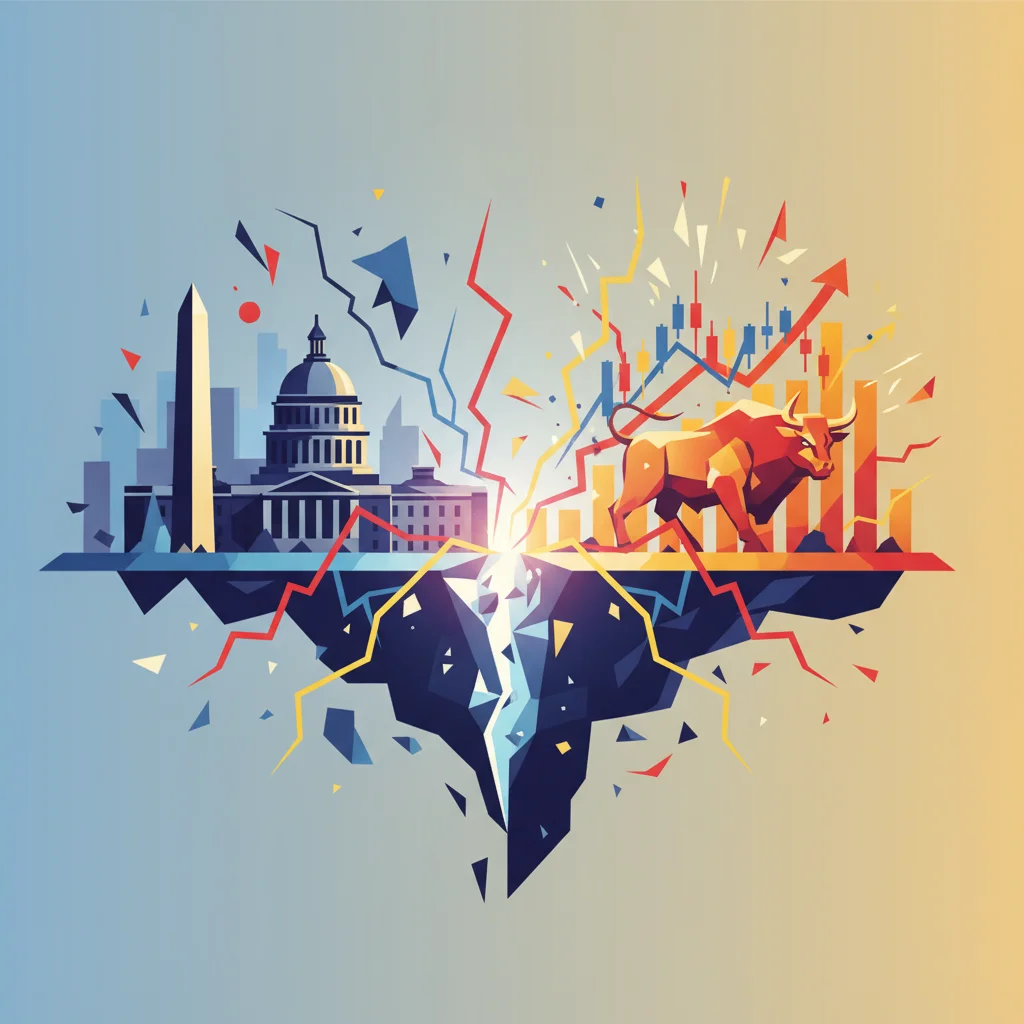
Washington D.C. and Wall Street have always shared a complex, intertwined relationship. Political decisions ripple through the financial markets, influencing everything from corporate earnings to the price of everyday goods. However, the nature of this relationship is undergoing a seismic shift. The political landscape is no longer just a backdrop for the economy; it has become one of its most potent and unpredictable drivers. At the heart of this transformation is a level of political polarization not seen in modern American history, a trend with profound implications for investors, business leaders, and the future of finance.
Recent analysis reveals a startling metric that quantifies this chasm. According to data highlighted by the Financial Times, Republicans in Congress have voted with the president this year at a higher rate than at any point since the 1950s (source). This isn’t merely a political statistic; it’s a flashing red light for anyone involved in the economy. It signals the erosion of bipartisan compromise and the rise of a winner-take-all legislative environment. When one party holds power, it can push through its agenda with little resistance. When power is divided, the result is often gridlock. For the stock market and long-term investing, both scenarios introduce a new, potent form of volatility.
The Data Behind the Division
The concept of “party-line voting” has become the defining characteristic of modern American governance. The days of centrist “Blue Dog” Democrats or “Rockefeller” Republicans who frequently crossed the aisle are largely gone. Today, party loyalty is paramount, and legislative success is often measured by the ability to unify one’s own caucus against the opposition.
To understand the magnitude of this shift, consider the historical context. The 1950s and 1960s, often viewed as a period of broad consensus-building, saw significant bipartisan cooperation on major initiatives like the Interstate Highway System. Today, even routine procedures like raising the debt ceiling or passing a federal budget become high-stakes partisan battles that can bring the government to the brink of shutdown and rattle global financial markets. This extreme cohesion within parties, and the corresponding chasm between them, creates an environment of legislative whiplash.
This table illustrates how legislative priorities can change dramatically depending on which party controls the government, creating uncertainty for key economic sectors.
| Policy Area | Unified Republican Government Priority | Unified Democratic Government Priority | Market Implication of Change |
|---|---|---|---|
| Taxation | Broad-based tax cuts, corporate tax reduction. | Increased taxes on corporations and high earners. | Volatility in corporate earnings projections and equity valuations. |
| Energy & Environment | Deregulation, promotion of fossil fuels. | Investment in renewable energy, stricter emissions standards. | Major shifts in capital allocation for energy and utility sectors. |
| Financial Regulation | Easing of Dodd-Frank and other banking regulations. | Strengthening consumer protection and banking oversight. | Uncertainty for the banking, finance, and fintech industries. |
| Healthcare | Repeal or reform of the Affordable Care Act (ACA). | Expansion of the ACA and public health options. | Significant disruption for insurance, pharmaceutical, and hospital stocks. |
As the data shows, the policy swings are not minor adjustments but fundamental reversals. This lack of a stable, predictable regulatory and fiscal framework makes long-term capital investment a far riskier proposition. A deeply polarised Congress means that the rules of the game for the entire economy can be rewritten every two to four years.
The £800m Pension Puzzle: Why Are UK MPs Avoiding the Stock Market?
From Political Gridlock to Economic Headwinds
For investors and financial professionals, this hyper-partisanship translates directly into quantifiable risk. The most obvious manifestation is the recurring threat of government shutdowns and debt ceiling standoffs. These events, once unthinkable, are now a regular feature of the political calendar. They inject pure, unadulterated uncertainty into the market, threatening the creditworthiness of the U.S. government and causing sharp, albeit often temporary, downturns in the stock market.
Beyond these headline-grabbing crises, the impact is more insidious:
- Regulatory Whiplash: Industries like banking, financial technology (fintech), and energy are particularly vulnerable. One administration may champion deregulation and innovation, creating opportunities for fintech and blockchain technologies. The next may impose stringent new rules, rendering entire business models unviable. This makes it incredibly difficult for companies to plan and for investors to make informed, long-term bets on a sector’s growth.
- Trade and Foreign Policy Instability: Partisanship also bleeds into international relations. Approaches to trade with major partners like China and the European Union can pivot 180 degrees with a change in leadership. This creates supply chain disruptions, tariff wars, and a volatile environment for multinational corporations, directly impacting the global economy and trading relationships.
- Stifled Innovation and Infrastructure: While a unified government can push its agenda, a divided one often leads to complete gridlock. This means crucial, long-term investments in areas with broad consensus, like upgrading national infrastructure or funding basic scientific research, can stall for years. This failure to invest in the future acts as a drag on long-term economic growth.
Navigating the New Investment Landscape
So, how can investors, traders, and business leaders adapt to this new reality? Ignoring it is not an option. Instead, a more sophisticated approach to political risk analysis is required.
1. Sector-Specific Analysis: It’s crucial to understand which sectors are most exposed to the political winds. Healthcare, green energy, and fossil fuels are on the front lines, with their fortunes directly tied to election outcomes. In contrast, sectors like consumer staples may offer more resilience. For those in the financial technology and blockchain space, the primary concern is the regulatory pendulum. A favorable SEC ruling under one administration could be reversed by the next, highlighting the need for diversification and a keen eye on Washington.
2. Focus on Durable Trends: Instead of betting on specific legislation, it may be wiser to invest in broader, more resilient trends that are likely to persist regardless of who is in power. These include demographic shifts (like the aging population), technological advancements in AI and automation, and the continued digitization of the economy. These forces may be more powerful than the short-term whims of politicians.
3. Hedging and Diversification: A polarized environment naturally leads to higher market volatility. This makes portfolio hedging strategies more important than ever. Diversification across asset classes and geographic regions can help mitigate the risks associated with U.S.-centric political events. For active traders, this volatility can present opportunities, but it requires a disciplined approach and a clear understanding of the political catalysts at play.
A second term for Donald Trump, as the source article suggests, would undoubtedly test this polarized environment to its limits, but the underlying issue transcends any single political figure. The trend of decreasing bipartisanship has been accelerating for decades.
Beyond the Tinsel: A Strategic Guide to Holiday Spending in a Shifting Economy
A Structural Shift, Not a Passing Storm
It’s tempting to view the current political climate as a temporary storm that will eventually pass. However, the data on voting patterns suggests this is a deep, structural shift. The forces driving this polarization—including gerrymandered congressional districts, a fragmented media landscape, and the nationalization of all politics—are not likely to reverse course anytime soon.
This reality demands a permanent change in how we assess the health and stability of the U.S. economy and its financial markets. The political discourse is no longer just noise that can be filtered out; it is the signal. Understanding the fault lines in Washington is now as critical to a sound investment thesis as understanding a company’s balance sheet or the Federal Reserve’s monetary policy.
Ultimately, the unprecedented party unity in Congress is a symptom of a divided nation. For those tasked with navigating the worlds of finance, investing, and business, this division represents the new fundamental risk. The challenge ahead is not to predict the political future but to build strategies and portfolios that are resilient enough to withstand the tremors that will inevitably emanate from it.