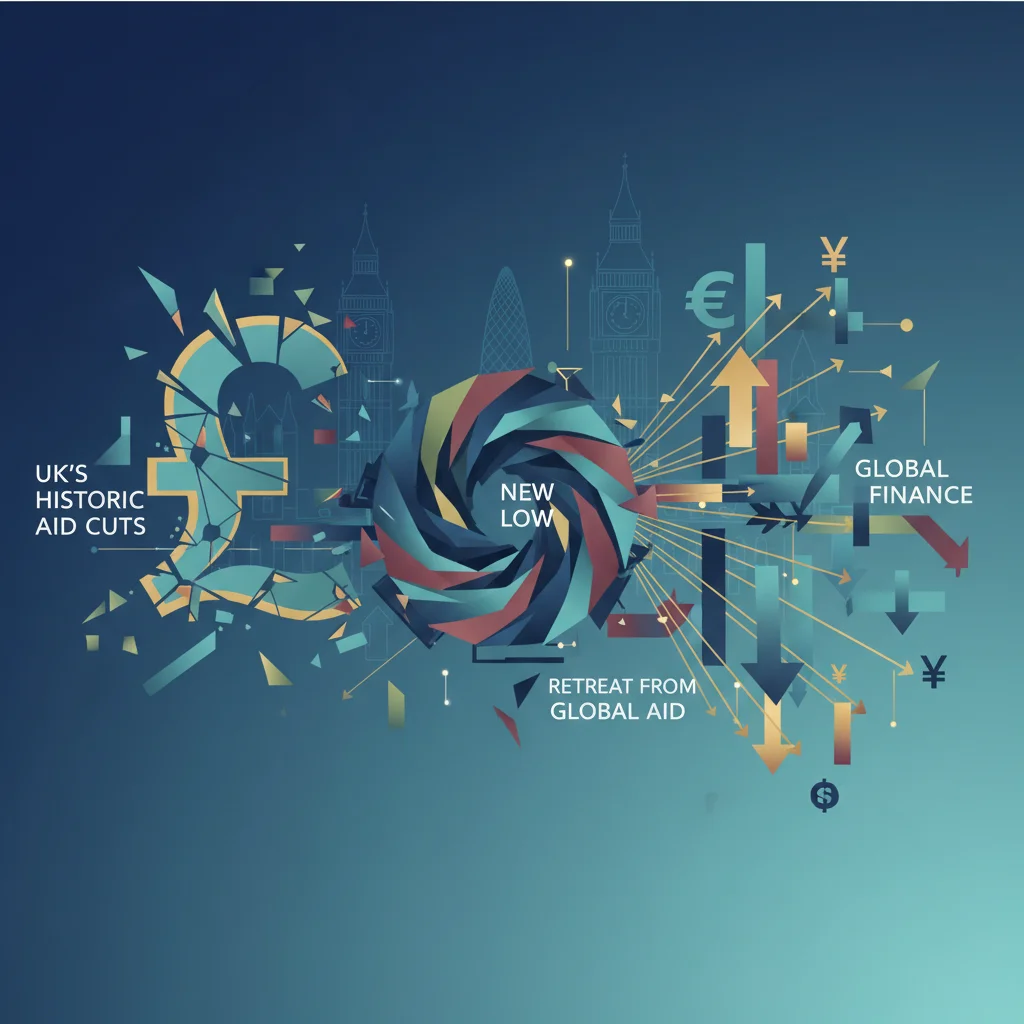
Beyond the Budget: Decoding the UK’s Historic Aid Cuts and What They Mean for Global Finance
A New Low: Unpacking the UK’s Retreat from Global Aid
In the quiet corridors of Whitehall and the bustling floors of the City of London, a significant shift is underway—one that redefines the UK’s role on the world stage. Recent projections reveal that the United Kingdom’s overseas aid spending is set to fall to its lowest level as a share of the economy in over a century. According to an analysis of official forecasts by the Financial Times, this spending will plummet from the long-held international commitment of 0.7% of gross national income (GNI) to a projected 0.46% by the 2028-29 fiscal year. This isn’t just a statistical adjustment; it’s a landmark moment reflecting deep-seated shifts in the UK’s domestic economy, its fiscal priorities, and its geopolitical posture.
For investors, finance professionals, and business leaders, this development warrants close attention. It transcends the realm of humanitarian concern and enters the core of strategic economics and international relations. The decision to curtail aid is a direct consequence of a strained domestic fiscal environment, but its ripple effects will be felt far beyond the national budget, influencing everything from the UK’s “soft power” to emerging market stability and the evolving landscape of global investing.
This article delves into the numbers behind the headlines, explores the economic rationale driving these cuts, and analyzes the profound implications for the UK’s financial standing and the future of global development finance.
The Anatomy of a Decline: From 0.7% to a Century Low
The UK was once a leader in international development, enshrining the United Nations’ target of spending 0.7% of GNI on official development assistance (ODA) into law in 2015. This commitment was a cornerstone of its foreign policy and a significant symbol of its global influence. However, the economic fallout from the COVID-19 pandemic prompted a “temporary” reduction to 0.5% in 2021, a move that is now set to become a long-term reality and even a ceiling for future spending.
The latest figures from the Office for Budget Responsibility, as highlighted by the FT, paint a stark picture of this continued decline. The government has stated it will only return to the 0.7% target when its fiscal situation allows, a condition that appears increasingly distant. The result is a steady erosion of one of the UK’s key foreign policy tools.
To put this into perspective, let’s look at the trajectory of UK aid spending as a percentage of GNI.
| Period | Aid Spending (% of GNI) | Status |
|---|---|---|
| 2015-2020 | 0.7% | Legally Mandated Target (Met) |
| 2021-Present | ~0.5% | “Temporary” Cut |
| 2028-29 (Projection) | 0.46% | Projected Historic Low (source) |
This decline is not just a number on a spreadsheet. It represents billions of pounds being redirected away from programs focused on health, education, and economic stability in developing nations. Furthermore, a growing portion of the remaining 0.5% budget is being spent within the UK on costs associated with housing refugees, particularly from Ukraine and Afghanistan. While a necessary expenditure, this means even less funding is reaching projects on the ground in the world’s poorest countries, a fact confirmed by a recent report from the Independent Commission for Aid Impact.
The Economic Rationale vs. The Geopolitical Cost
The government’s justification for these cuts is rooted firmly in domestic economics. With UK public sector net debt hovering close to 100% of GDP, high inflation, and immense pressure on public services like the NHS, the Treasury is in a fiscal straitjacket. From a purely budgetary standpoint, every department must contribute to fiscal consolidation, and the £12-13 billion aid budget is an obvious target.
However, this narrow economic lens ignores the wider financial and strategic implications:
- Impact on Global Stability: Aid helps foster stability in fragile regions. A retreat by a major donor like the UK can create power vacuums, potentially leading to conflicts and refugee crises that have far greater long-term economic and security costs.
- Decline in Diplomatic Leverage: Aid is a powerful diplomatic tool. It underpins trade negotiations, security partnerships, and efforts to tackle global challenges like climate change. Reducing it weakens the UK’s hand in international forums.
- Consequences for the Stock Market and ESG Investing: The global investing community is increasingly focused on Environmental, Social, and Governance (ESG) criteria. A nation seen as retreating from its global social responsibilities could face reputational damage, potentially affecting investor sentiment towards UK-based assets and the broader stock market.
This is a classic case of balancing short-term liabilities against long-term, less tangible assets. The immediate savings are clear, but the erosion of the UK’s global standing is a slow-burn issue that could have significant economic consequences down the line, affecting everything from international trading partnerships to the City of London’s status as a global financial hub.
Dawn of a New Era: Japan's Historic Interest Rate Hike and What It Means for the Global Economy
Can Financial Technology Fill the Void?
While the decline in public funding is a challenge, it also creates an imperative for innovation. The world of finance has been revolutionized by financial technology, and the development sector is ripe for disruption. If government funding is shrinking, efficiency and private sector involvement must grow. This is where concepts from fintech and modern finance can play a transformative role.
One of the most promising technologies is blockchain. A primary criticism of traditional aid has been the lack of transparency and the potential for corruption, where funds are lost in complex bureaucratic chains. Blockchain’s distributed ledger technology offers a potential solution:
- Transparency: Every transaction can be recorded on an immutable ledger, allowing donors (whether governments or private individuals) to track funds from the source all the way to the end recipient.
- Efficiency: Smart contracts can automate payments when certain conditions are met, cutting out costly intermediaries in the banking and administrative systems.
- Empowerment: It can facilitate direct cash transfers to individuals via digital identities, giving them more control and reducing overheads.
Beyond blockchain, the broader fintech ecosystem can mobilize private capital for development. Crowdfunding platforms for social enterprises, micro-lending apps, and new impact investing vehicles are making it easier for private investors to fund sustainable development goals. This shift from reliance on ODA to a blended finance model—combining public funds with private investment—is likely to accelerate. The UK, with its world-leading fintech sector, is uniquely positioned to lead this charge, potentially creating a new form of global influence based on financial innovation rather than just government cheques.
The Green Paradox: Why the West's ESG Retreat is Ceding the Future to China
The Future of Britain’s Global Financial Footprint
The UK is at a crossroads. The decision to drastically cut overseas aid signals a more inward-looking Britain, one preoccupied with its own economic challenges. This will fundamentally alter its relationships with developing nations and its standing among G7 peers.
For the finance and investment community, this presents both risks and opportunities. The risk is that a diminished global presence makes the UK a less influential and therefore less attractive place for international capital. The reputational damage could be significant in an era where ethical considerations are paramount.
The opportunity, however, lies in innovation. The gap left by the state creates a space for the private sector to step in. Impact investing, venture philanthropy, and technology-driven development finance are no longer niche concepts. They are becoming central to the future of how we tackle global poverty and inequality. The challenge for the UK’s formidable financial sector is to pioneer these new models, proving that influence can be wielded not just through government spending, but through the ingenuity and power of its capital markets.
Ultimately, the story of the UK’s aid cuts is a story about the changing nature of power and the evolving global economy. As the old model of state-led aid recedes, a new, more complex, and technology-driven paradigm of global finance is emerging. The UK’s ability to adapt and lead in this new world will determine its relevance for the century to come.

Related Posts
The Silent Crash: How Japan’s Demographic Crisis Will Reshape the Global Economy
The Great Pharma Migration: Why Europe is Losing Billions in Investment to the US