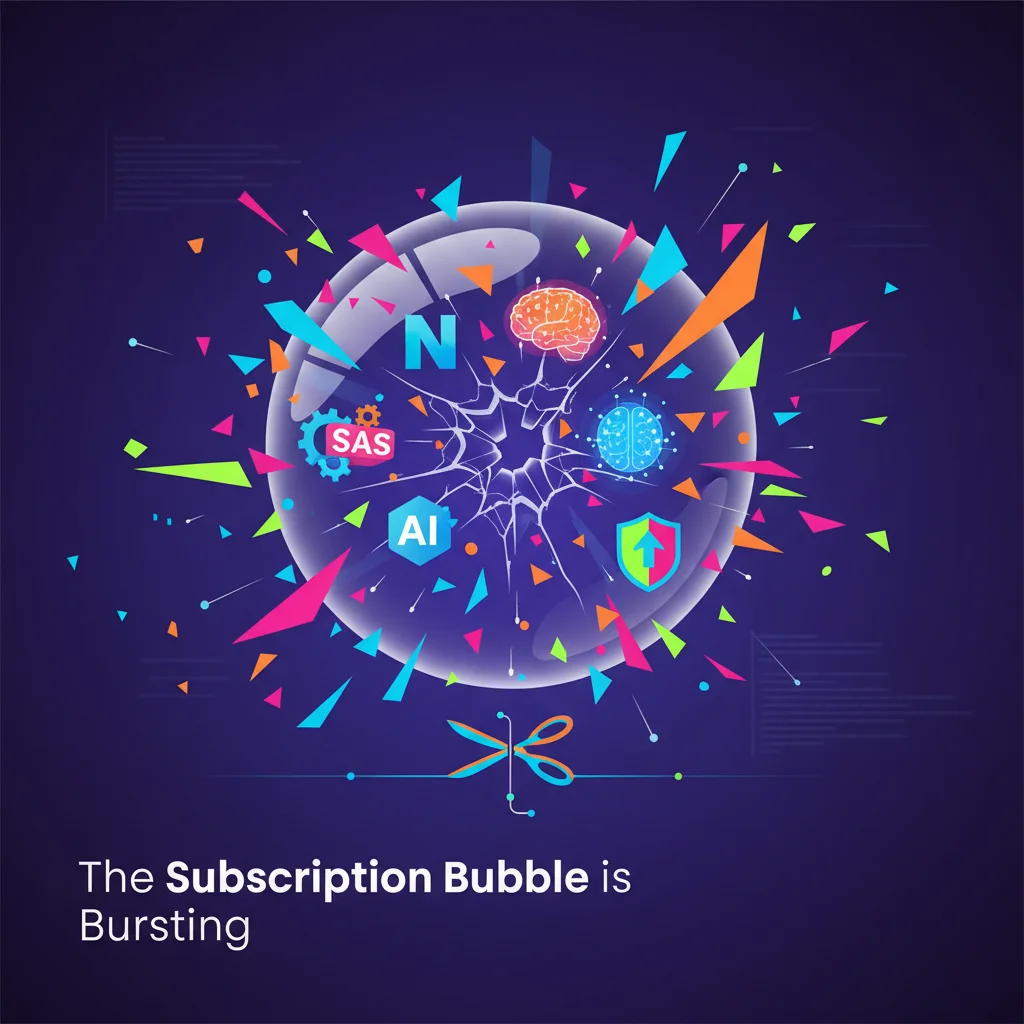
The Subscription Bubble is Bursting: What the Streaming Wars Teach Startups About SaaS, AI, and Survival
Remember the good old days? You know, when “cutting the cord” felt like a revolutionary act of consumer freedom. We gleefully ditched our bloated cable packages for a sleek, singular Netflix subscription. It was simple. It was liberating. It was… temporary.
Fast forward to today, and that feeling of freedom has been replaced by a nagging, low-grade anxiety. We’re drowning in a sea of subscriptions. Netflix, Disney+, Max, Hulu, Paramount+, Peacock, Apple TV+… the list goes on. Each service holds a few exclusive shows hostage, forcing us into a digital version of Whac-A-Mole with our credit cards. This isn’t just a feeling; it’s a documented phenomenon. The average American now juggles multiple streaming services, and the “subscription overload” is leading to widespread exhaustion and a serious re-evaluation of household budgets.
The recent rumblings of a potential mega-merger involving Warner Bros. Discovery, as reported by the Financial Times, could be the tipping point. But this story is bigger than just what to watch on a Friday night. It’s a flashing red warning light for the entire subscription economy. For startups, entrepreneurs, and developers building the next generation of SaaS products, the streaming wars offer a masterclass in market saturation, the double-edged sword of unbundling, and the desperate need for genuine innovation.
The Great Unbundling and the Chaos That Followed
The initial promise of the streaming revolution was choice. We broke free from the one-size-fits-all cable bundle and embraced an a la carte menu of content. In the beginning, it worked. But as every media giant launched its own platform, the dream of choice morphed into the nightmare of fragmentation. The content wasn’t unbundled; the *channels* were, and we were left to re-assemble our own, more expensive, and far more complicated bundle.
This cycle of unbundling and rebundling is a classic pattern in tech. We saw it with music (albums to singles, now back to curated playlists on Spotify), and we’re seeing it now with media. For startups, this serves as a crucial lesson: disrupting an incumbent by unbundling its services is a powerful entry strategy. However, without a long-term plan for value aggregation, you risk becoming just another fragmented piece of the puzzle, leaving customers fatigued and looking for a new, simpler solution.
The financial strain is real. While a single service might seem affordable, the costs quickly stack up. According to one analysis, the top streaming services can easily cost a consumer more than $100 per month combined, often surpassing the price of the original cable bundle they sought to escape (source).
Here’s a quick look at how the costs for just a handful of the top ad-free services can accumulate:
| Streaming Service | Estimated Monthly Cost (Ad-Free) | Key Exclusive Content/Franchise |
|---|---|---|
| Netflix (Premium) | $22.99 | Stranger Things, The Crown, Bridgerton |
| Max | $19.99 | HBO Originals (Game of Thrones), DC Universe, Warner Bros. Films |
| Disney+ (Premium) | $13.99 | Marvel Cinematic Universe, Star Wars, Pixar |
| Hulu (No Ads) | $17.99 | The Handmaid’s Tale, Only Murders in the Building, FX Content |
| Paramount+ with Showtime | $11.99 | Star Trek, Yellowstone Universe, Showtime Originals |
| Total Monthly Cost | $86.95+ | (Excludes many other services like Apple TV+, Peacock, etc.) |
This table only scratches the surface. The result? Churn. Consumers are becoming more ruthless, subscribing to a service for a single show and canceling immediately after. This “subscribe-and-bolt” behavior is a nightmare for companies focused on lifetime value (LTV) and recurring revenue.
The Transatlantic Tech Dream on Hold: Why the US-UK AI Pact Stalled and What It Means for Innovation
The Invisible Tech Powering the Streaming Giants
While we see the content, the real war is being fought on a battlefield of code, cloud infrastructure, and algorithms. The ability to deliver high-quality, buffer-free 4K video to millions of concurrent users is a monumental feat of engineering. This is where the tech stack becomes the ultimate differentiator.
AI and Machine Learning: The Retention Engine
Why do you stay on Netflix for hours, falling down a rabbit hole of recommendations? The answer is artificial intelligence. Every streaming service invests billions into sophisticated machine learning models that analyze your viewing habits, time of day, preferred genres, and even how long you hover over a title card. This isn’t just about suggesting another movie; it’s about creating a personalized experience so compelling that the thought of canceling feels like losing a part of your entertainment DNA. The goal of this AI isn’t just user experience; it’s churn reduction. By predicting what you want to watch next, they keep you engaged and, more importantly, subscribed.
Cloud, Automation, and Cybersecurity
The sheer scale of these operations is only possible because of the cloud. Providers like AWS, Azure, and Google Cloud supply the elastic infrastructure needed to handle massive global traffic spikes, like the premiere of a new season of Stranger Things. Behind the scenes, sophisticated automation pipelines handle everything from video transcoding to content delivery network (CDN) management. And with millions of user accounts and payment details on file, cybersecurity is a paramount concern. A single major breach could not only result in massive fines but also shatter consumer trust, causing a catastrophic exodus of subscribers.
Critical Lessons for Every SaaS Startup
The drama unfolding in Hollywood’s streaming wars provides a treasure trove of insights for any business built on a recurring revenue model. Whether you’re selling project management software or a niche developer tool, these lessons are directly applicable.
1. The Red Ocean of “Me-Too” Solutions
The streaming market is a textbook example of a “red ocean”—a market saturated with competitors fighting over the same customer pool. Every new streaming service was, at its core, a “me-too” product with a different content library. For startups, the lesson is clear: entering a crowded market requires radical differentiation. Simply offering a slightly better or cheaper version of an existing product is a recipe for a high-cost, low-margin struggle. You need a unique value proposition that solves a core problem in a fundamentally new way.
2. Churn is the Silent Killer
The streaming giants are bleeding subscribers who jump from service to service. This highlights a critical truth for any SaaS business: customer acquisition is only half the battle. If your churn rate is high, you’re constantly refilling a leaky bucket. The focus must shift from purely acquiring new users to obsessively engaging and retaining existing ones. This involves more than just a good product; it requires proactive customer support, community building, and continuous feature innovation based on user feedback. Using automation to identify at-risk users and engage them with targeted content or offers can be a game-changer.
The AI Alliance on Hold: Why the Landmark US-UK Tech Deal Hit a Wall
3. The Evolving Business Model
The “pure” subscription model is under pressure. Notice how nearly every major streamer has now introduced a cheaper, ad-supported tier? This pivot to a hybrid model is a direct response to consumer price sensitivity. SaaS startups should take note. A rigid, one-size-fits-all pricing strategy may not be sustainable. Exploring flexible models—freemium, usage-based, ad-supported, or tiered pricing—can open up new market segments and create more resilient revenue streams. The key is to align your pricing with the value your customers receive.
The underlying programming and architectural challenge of supporting these varied models is non-trivial, requiring robust and flexible billing systems that can handle complexity without failing.
Waymo's 0 Billion Gambit: Is the Robotaxi Revolution Finally Hitting the Streets?
The End of an Era, The Dawn of a New Challenge
The golden age of carefree streaming is over. We’ve reached a saturation point where the value proposition is becoming increasingly blurry for cash-strapped consumers. The potential consolidation in the market, with giants like Warner Bros. Discovery possibly being acquired, signals an end to the era of infinite expansion (source).
This isn’t just a media story. It’s a poignant lesson about the lifecycle of a business model. The subscription economy, powered by incredible advances in cloud computing, AI, and software development, has fundamentally changed how we consume digital goods. But it is not immune to the basic laws of economics and human psychology. As we move forward, the survivors won’t be the ones who simply have a product to sell, but those who can deliver clear, consolidated, and indispensable value in an increasingly noisy world. The challenge for the next wave of innovators is not to build another silo, but to build the bridges between them.