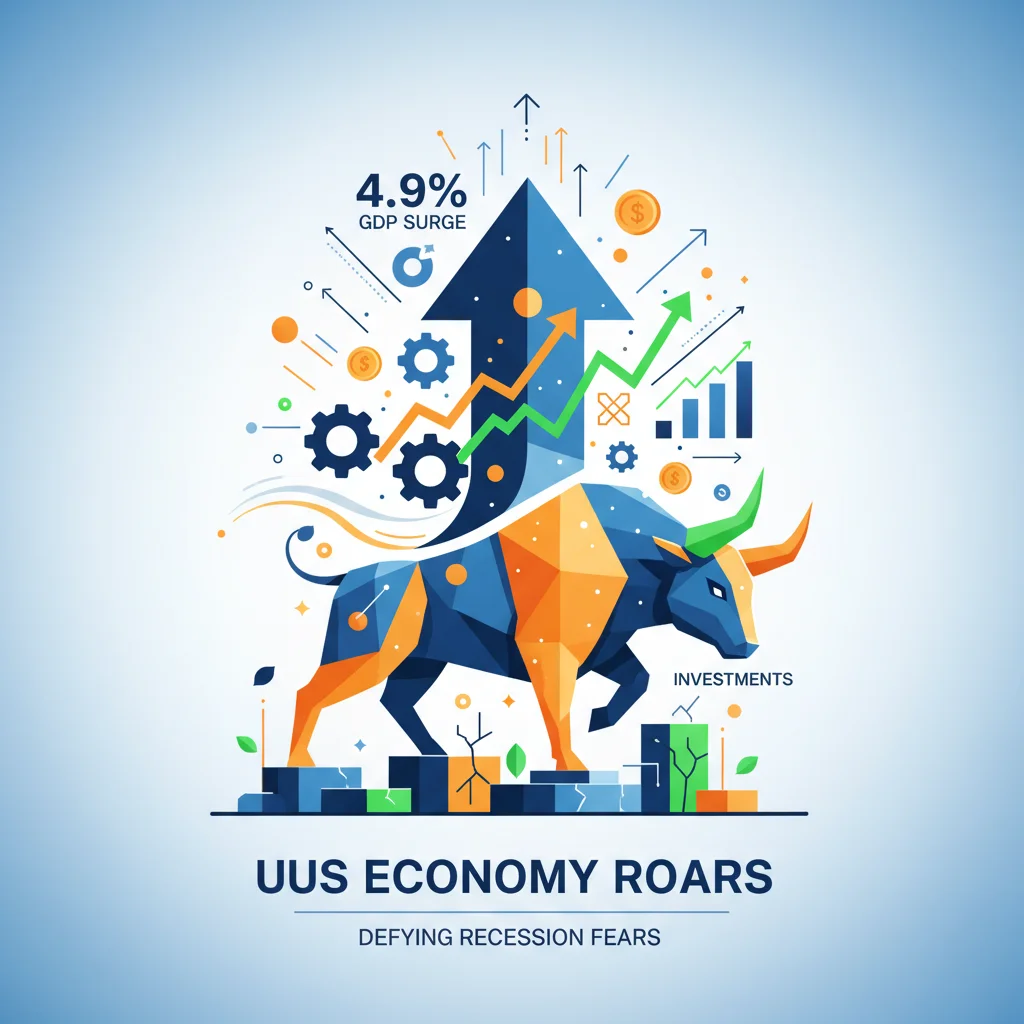
US Economy Roars: Unpacking the 4.9% GDP Surge and What It Means for Your Investments
The Economy’s Unexpected Overdrive: Defying Recession Fears
In a landscape recently dominated by whispers of recession and economic slowdown, the latest figures on the U.S. economy have delivered a resounding plot twist. Against a backdrop of persistent inflation and the most aggressive interest rate hiking cycle in decades, the nation’s Gross Domestic Product (GDP) didn’t just grow; it surged. The U.S. economy expanded at an annualized rate of 4.9% in the third quarter of 2023, marking its most robust performance in nearly two years. This figure comfortably surpassed economists’ expectations and painted a picture of remarkable economic resilience.
This surprising strength, largely powered by the relentless American consumer, raises critical questions for everyone from Main Street to Wall Street. Is this a sign of a sustainable “soft landing,” or is it a final burst of energy before the effects of monetary tightening take hold? In this deep dive, we will dissect the components of this explosive growth, analyze the complex role of the Federal Reserve, and explore the profound implications for the stock market, your investment portfolio, and the future of finance.
Deconstructing the 4.9% Surge: A Look Under the Hood
To truly understand this economic headline, we must first appreciate what GDP represents. Gross Domestic Product is the broadest measure of an economy’s health, representing the total monetary value of all goods and services produced within a country’s borders over a specific period. A 4.9% annualized growth rate is significant, especially when compared to the more moderate growth of recent quarters.
To put this surge into perspective, let’s compare the Q3 2023 performance with previous quarters. The data clearly illustrates an accelerating trend leading into the latter half of the year.
| Quarter | Annualized GDP Growth (%) |
|---|---|
| Q3 2023 | 4.9% |
| Q2 2023 | 2.1% |
| Q1 2023 | 2.2% |
| Q4 2022 | 2.6% |
| Q3 2022 | 2.7% |
The primary driver behind this remarkable acceleration was strong consumer spending, which accounts for roughly two-thirds of U.S. economic activity. According to the initial report, spending grew at a 4% annual rate, the strongest since 2021. Consumers opened their wallets for both goods (like recreational vehicles and electronics) and services (like the “Barbenheimer” box office phenomenon and international travel). Other key contributors to the GDP figure included a rise in private inventory investment, an increase in exports, and robust government spending at the federal, state, and local levels.
UK's Economic Tightrope: Decoding the Mixed Signals from the Latest Jobs Report
The Consumer Engine: Resilient or Running on Fumes?
The resilience of the American consumer has been the defining story of the post-pandemic economy. Despite facing high inflation and borrowing costs, households have continued to spend, buoyed by a few key factors:
- Strong Labor Market: A low unemployment rate and steady wage gains have provided many Americans with the financial confidence to keep spending.
- Pandemic-Era Savings: While dwindling, the excess savings buffer built up during the pandemic has continued to fuel consumption for many households.
- Shift in Spending Habits: A notable pivot from goods to experiences continues, with significant spending on travel, dining, and entertainment.
However, this consumer strength is not without its vulnerabilities. Credit card debt has surpassed $1 trillion for the first time, and delinquency rates are beginning to tick up. The question for the future of economics and policy is whether this spending momentum is sustainable as savings are depleted and the full impact of higher interest rates filters through the system.
On the surface, a 4.9% GDP print is fantastic news, and it is. It showcases the dynamism and adaptability of the U.S. economy. However, as analysts and investors, we have to look past the headline and ask the tough questions. The current strength feels like a paradox. We’re seeing robust growth in an environment where the Federal Reserve is actively trying to *cool* the economy.
My primary concern is the sustainability of the consumer spending spree. It’s been fueled by a unique cocktail of post-pandemic savings, a tight job market, and a “revenge spending” mentality on services. But savings are finite, the job market is showing early signs of softening, and student loan repayments have resumed. It’s plausible that this Q3 report represents a peak, a final hurrah before consumers are forced to tighten their belts. The risk is that the “soft landing” everyone is hoping for could still hit some turbulence in the coming quarters. This report complicates the Fed’s job immensely and adds a layer of uncertainty that the stock market will have to digest. Don’t be surprised if the narrative shifts from “recession fears” to “stagflation fears” if growth slows while inflation remains stubborn.
The Federal Reserve’s Dilemma: To Hike or To Hold?
This blockbuster GDP report lands squarely on the desk of the Federal Reserve, presenting a complex challenge. The central bank’s primary mandate is to maintain price stability (i.e., control inflation) and maximize employment. For over a year, its strategy has been to raise interest rates to slow down economic activity and, consequently, curb inflation.
A report showing the economy is heating up, not cooling down, complicates this mission. It could suggest that monetary policy is not yet restrictive enough to bring inflation back to the Fed’s 2% target. This stronger-than-expected growth could fuel further wage pressures and demand-side inflation, forcing the Fed to consider another rate hike or at least hold rates higher for longer than previously anticipated. The reaction in the bond market, with Treasury yields rising in response to strong economic data, reflects this very concern. For the world of banking and lending, this means the era of cheap money remains firmly in the rearview mirror.
Conversely, some argue that inflation has been steadily declining despite this growth and that the lag effects of previous rate hikes have yet to be fully realized. Proponents of this view urge the Fed to pause and assess, warning that another hike could be an overcorrection that tips a resilient economy into an unnecessary recession. This delicate balancing act will be the central focus of financial markets for months to come. A statement from the Fed following its next meeting will be one of the most closely watched economic indicators.
The Billion-Dollar Question: Should the UK Pay Whistleblowers to Expose Financial Crime?
Implications for Investors: Navigating the New Landscape
For those involved in investing and trading, a strong economy is generally positive news, as it supports corporate earnings and revenue growth. However, the nuances matter immensely.
- Sector Rotation: A robust, consumer-driven economy tends to benefit cyclical sectors. Companies in Consumer Discretionary (think travel, retail, and automotive), Industrials, and Materials may see improved performance as economic activity remains high.
- Interest Rate Sensitivity: The prospect of “higher for longer” interest rates creates headwinds for certain areas. Growth-oriented technology stocks, whose valuations are often based on future earnings, can be particularly sensitive to higher discount rates. Conversely, the financial technology (Fintech) sector could see mixed results; while higher rates can boost net interest margins for lending platforms, they can also stifle loan demand and transaction volumes.
- The Bond Market Signal: Rising Treasury yields in response to strong growth can make bonds a more attractive alternative to stocks, potentially drawing capital away from equities. Investors must now weigh the potential returns of a strong stock market against the relatively safer, higher yields offered by fixed-income assets.
The key takeaway is that the investment landscape is shifting from a focus on avoiding a recession to one of positioning for sustained, higher-than-expected growth in a high-rate environment. This requires a re-evaluation of portfolio allocations and risk tolerance.
The Road Ahead: Technology, Innovation, and Economic Outlook
Looking forward, the intersection of technology and the economy will continue to shape trends. The boom in e-commerce and digital payments, core components of the Fintech revolution, has undeniably contributed to the efficiency and resilience of consumer spending. Innovations in financial technology continue to democratize access to credit and investment, further empowering economic participants.
While more speculative, technologies like blockchain promise to reshape fundamental economic infrastructure in the long term, from supply chain management to cross-border payments. Though not a direct driver of this quarter’s GDP, the ongoing investment in these foundational technologies represents a bet on future productivity and economic growth.
Economists are now busy revising their forecasts. While the 4.9% pace is unlikely to be sustained, the report has forced many to push back their timelines for a potential slowdown. The key variables to watch will be the monthly inflation data (CPI), employment reports, and, most importantly, consumer spending trends during the crucial holiday season.
The UK's Economic Puzzle: Rising Unemployment, Resilient Wages, and What It Means for Your Finances
Conclusion: A Cautiously Optimistic Horizon
The U.S. economy’s third-quarter performance was a powerful testament to its underlying strength, driven by the unwavering American consumer. It has, for now, silenced the loudest recession alarms and bolstered the case for a “soft landing.” However, this strength creates a complex puzzle for the Federal Reserve and a nuanced environment for investors. The battle against inflation is not yet won, and the sustainability of this consumer-led boom remains a critical question mark.
For investors, business leaders, and finance professionals, the message is clear: the economic narrative is more resilient and complicated than anticipated. Navigating the path forward requires a deep understanding of these crosscurrents—from monetary policy to consumer behavior—and a strategy that is both agile and informed.

Related Posts
The Blackpool Food Bank and the Canary in the Coal Mine: What a £9,000 Donation Reveals About Our Economy
The Four-Day Week on Trial: Why the UK Government is Pushing Back and What It Means for the Economy