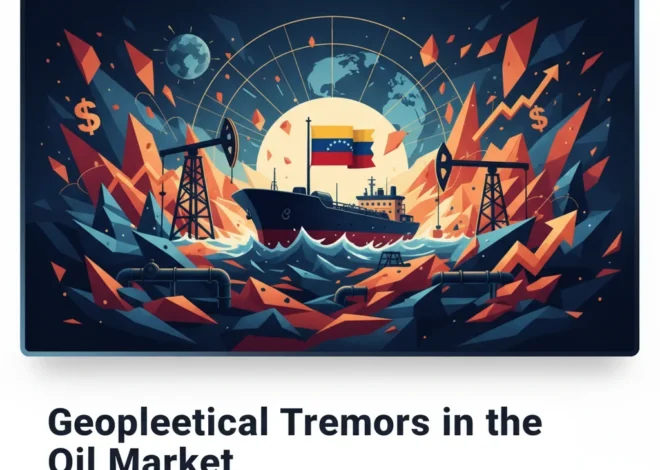
Beyond the Blockade: How a Venezuelan Oil Tanker is Sending Ripples Through the Global Economy
In the high-stakes world of international relations and global finance, sometimes the most significant events don’t unfold in a boardroom or on a stock exchange floor, but on the open ocean. A recent announcement that the United States is actively pursuing a third oil tanker linked to Venezuela is one such event. This move, following a declaration of a blockade on sanctioned tankers, is far more than a simple maritime operation; it’s a critical inflection point with profound implications for the global economy, energy markets, and investment strategies worldwide.
For investors, finance professionals, and business leaders, understanding the undercurrents of this geopolitical chess match is essential. What may seem like a distant regional conflict is, in fact, a powerful force capable of influencing oil prices, rattling the stock market, and reshaping the landscape of international banking and trade. This single action against one vessel is a microcosm of a larger economic struggle, highlighting the intricate connections between political sanctions, commodity markets, and your investment portfolio.
The Sanctions Labyrinth: Deconstructing the US-Venezuela Economic Standoff
To grasp the significance of the tanker pursuit, one must first understand the complex web of sanctions the U.S. has imposed on Venezuela. This economic pressure campaign, primarily administered by the Treasury Department’s Office of Foreign Assets Control (OFAC), is not a recent development. It’s the culmination of years of deteriorating relations, targeting Venezuela’s state-owned oil and gas company, Petróleos de Venezuela, S.A. (PDVSA), its government, and associated entities.
The stated goal of these sanctions is to restrict the revenue streams of the current Venezuelan government. As the U.S. Department of the Treasury outlines, these measures prohibit a wide range of financial transactions and dealings with designated entities. For the global finance industry, this creates a treacherous compliance environment. Any bank, investor, or company that facilitates transactions with sanctioned entities—even inadvertently—risks severe penalties, effectively cutting them off from the U.S. financial system.
The impact on Venezuela’s economy has been stark. Once a powerhouse in oil production, the nation’s output has plummeted. The combination of sanctions, mismanagement, and decaying infrastructure has crippled its primary source of income, accelerating a devastating economic and humanitarian crisis.
The Billion Media War: Analyzing the Financial Shockwaves of Trump's Lawsuit Against the BBC
Gauging the Tremors in Global Energy Markets
Venezuela sits on one of the world’s largest proven oil reserves, but its ability to bring that oil to market has been severely curtailed. Each time the U.S. tightens its enforcement, as with the recent blockade, it sends a signal to the global energy market. While Venezuela’s current output is a fraction of its former peak, any disruption to supply—or even the threat of one—can introduce volatility into oil price calculations.
For those involved in energy trading and investing, this geopolitical tension adds another layer of risk. The price of Brent and WTI crude is influenced by a delicate balance of supply, demand, and sentiment. An aggressive U.S. posture could theoretically remove more barrels from the market, putting upward pressure on prices. Conversely, it could also be seen as a sign of desperation, with minimal real-world impact on a market already accustomed to Venezuela’s diminished role. The U.S. Energy Information Administration (EIA) data paints a clear picture of this decline.
Below is a simplified overview of the dramatic change in Venezuela’s crude oil production, illustrating its shrinking influence on global supply.
| Year | Average Crude Oil Production (Million Barrels Per Day) |
|---|---|
| 2013 | 2.68 |
| 2015 | 2.65 |
| 2017 | 2.03 |
| 2019 | 0.91 |
| 2021 | 0.65 |
| 2023 (Est.) | 0.75 |
Data sourced from analysis by the U.S. Energy Information Administration (EIA).
This data shows that while production has slightly recovered from its absolute lows, it remains far below its historical capacity. Therefore, the direct impact of seizing a single tanker on global supply is minimal. The real impact is on market psychology and the escalating risks for shippers, insurers, and financiers involved in any trade touching Venezuela.
The Wider Shockwaves: From Banking Compliance to Your Portfolio
The implications of this heightened enforcement extend far beyond the energy sector. They permeate the entire global financial ecosystem, forcing institutions to re-evaluate their risk exposure and compliance protocols.
1. Increased Compliance Burden on Financial Institutions
International banks and financial services firms are on the front lines. They must invest heavily in sophisticated compliance systems—a key area of fintech innovation—to screen transactions and clients for any links to sanctioned entities. The cost of failure is astronomical, not just in fines but in reputational damage. This event serves as a stark reminder that geopolitical risk translates directly into operational and regulatory risk for the banking sector.
2. Geopolitical Risk as a Key Investment Factor
For decades, investors have primarily focused on economic fundamentals. Today, geopolitics is an equally critical variable. Events like the Venezuelan blockade can inject sudden volatility into the stock market, impacting sectors from energy and shipping to industrials and finance. A sound investing strategy must now include a framework for assessing and hedging against geopolitical risk. This is no longer a niche concern for emerging market specialists; it is a mainstream factor for every diversified portfolio.
Fentanyl as a WMD: The Economic Fallout of a Geopolitical Gambit
3. The Future of Global Trade and Economics
The weaponization of economic policy, through tariffs and sanctions, is reshaping global trade. This trend forces businesses to build more resilient—and often more expensive—supply chains. From an economics perspective, this can lead to inefficiencies and contribute to inflationary pressures. The pursuit of a single tanker is a symbol of this broader shift towards a more fragmented and contentious global economic order. As a report from the Council on Foreign Relations notes, the crisis has deep roots and its resolution will have long-term consequences for regional stability and trade patterns.
The Human and Political Calculus
While we analyze the financial and economic fallout, it’s crucial to remember the human element. The economic collapse in Venezuela has led to a severe humanitarian crisis, with millions fleeing the country. There is an ongoing and vigorous debate about the efficacy of broad economic sanctions, with critics arguing they disproportionately harm the civilian population while failing to achieve their political objectives. This ethical dimension adds another layer of complexity for businesses and investors focused on ESG (Environmental, Social, and Governance) principles.
Ultimately, the decision to blockade and pursue tankers is a political one, designed to exert maximum pressure. Whether it succeeds or merely deepens the stalemate remains to be seen. But for the global markets, the action itself is the signal—a signal of heightened risk, continued uncertainty, and the undeniable power of geopolitics to move markets.
Conclusion: Navigating the Murky Waters Ahead
The story of the U.S. pursuing a Venezuelan oil tanker is a powerful illustration of our interconnected world. It demonstrates how a naval action in the Caribbean can influence trading decisions in London, compliance policies in New York, and the price of fuel for consumers everywhere. It underscores that in modern finance, one cannot separate market analysis from geopolitical intelligence.
For every investor, executive, and financial professional, the key takeaway is the need for vigilance. The global economic landscape is no longer shaped by market forces alone; it is a dynamic arena where political decisions can create tidal waves. By understanding the deeper context behind the headlines, we can better navigate the murky waters ahead and make more informed, resilient, and strategic financial decisions.

Related Posts
High-Stakes on the High Seas: The Economic Fallout of the Latest US-Venezuela Tanker Seizure
The Other Side of Victory: Why a Forgotten History of VE Day Shapes Today’s Global Economy