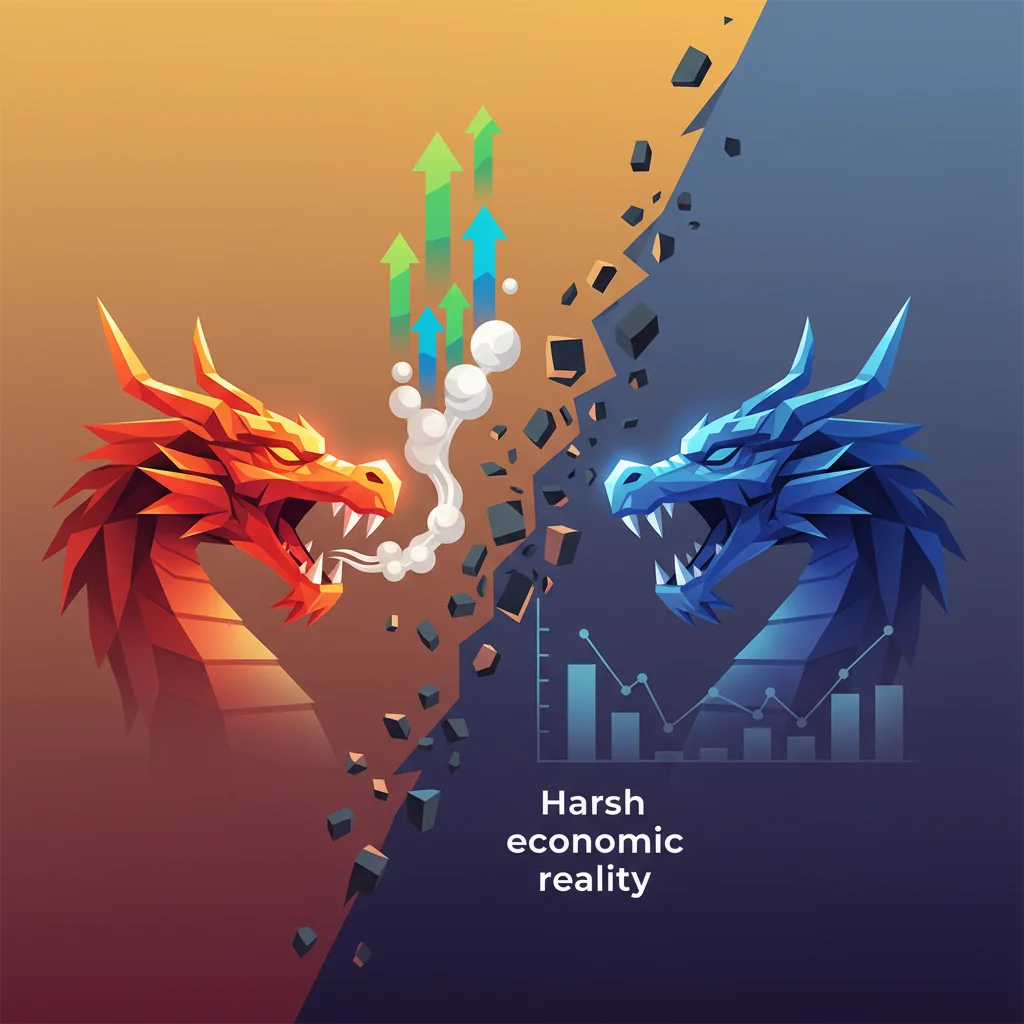
The Dragon Takes a Breath: Why China’s Stock Market Rally Is Facing a Harsh Economic Reality
For a few exhilarating months, it seemed the dragon was roaring back to life. After a prolonged slump, Chinese equities staged a powerful rally, capturing the attention of global investors eager for a comeback story. The Hang Seng and CSI 300 indices surged, fueled by government support and the alluring prospect of bargain-hunting in the world’s second-largest economy. But as the seasons change, so too does market sentiment. The music has quieted, and the once-unstoppable rally is now showing signs of fatigue. A wave of profit-taking, spurred by a drumbeat of weak economic data, has brought this year’s steep ascent to a halt (source).
This cooling-off period is more than just a minor market correction; it’s a critical moment of truth. It forces us to look past the policy-driven euphoria and confront the complex, underlying challenges plaguing China’s economy. For investors, finance professionals, and business leaders, understanding this dynamic is crucial. Is this a temporary pause before the next leg up, or is it a sign that the fundamental issues—from a deep-rooted property crisis to sluggish consumer demand—are finally catching up to the market? In this analysis, we will dissect the anatomy of the recent rally, examine the troubling economic indicators, and explore the implications for the future of investing in China and the broader global economy.
The Anatomy of a Policy-Driven Rally
To understand why the market is stalling, we must first appreciate what ignited its fire. The rally that began earlier this year wasn’t born from a sudden surge in corporate earnings or a miraculous economic turnaround. Instead, it was largely engineered by Beijing. Facing a confidence crisis in its stock market, the Chinese government unleashed a series of measures designed to prop up share prices and lure back investors.
This intervention included direct market support from state-backed funds, often referred to as the “National Team,” which were instructed to buy up shares in major companies. Regulators also imposed restrictions on short-selling and encouraged companies to engage in share buybacks. These moves sent a powerful signal: the government would not let the market collapse. As noted by analysts, this state intervention was a key catalyst, creating an artificial floor for stock prices and giving traders the confidence to re-enter the market. According to reports from Reuters, these state funds significantly increased their purchases of blue-chip ETFs, providing much-needed liquidity and stability.
The second major driver was valuation. After years of underperformance, Chinese stocks were, by many metrics, cheap compared to their global peers. This attracted value investors and hedge funds who saw an opportunity for a tactical, short-term trade. They weren’t necessarily betting on a long-term economic renaissance but on a short-term rebound from deeply oversold levels, amplified by government action. This combination of state support and low valuations created a potent, albeit fragile, foundation for a rally.
The Bo Diddley Beat: Rock's Original Blockchain and the Economics of a Foundational Rhythm
The Reality Check: A Wall of Worrying Data
A market rally can run on sentiment for only so long. Eventually, it must be sustained by economic fundamentals, and this is where China’s comeback story begins to unravel. Recent economic data has painted a picture not of a robust recovery, but of a persistent and worrying slowdown that policy tweaks have failed to resolve.
The persistent crisis in the property sector remains the largest cloud hanging over the economy. This sector, which once accounted for nearly a quarter of China’s GDP, is mired in debt and defaults, with major developers like Evergrande and Country Garden becoming cautionary tales. Despite government efforts to support the housing market, data on new home prices and property investment continues to disappoint, creating a negative wealth effect that stifles consumer spending.
Beyond property, other key indicators reveal systemic weakness. Consumer confidence is low, and retail sales figures, while not in collapse, show a reluctance among households to spend on big-ticket items. The manufacturing sector, the engine of China’s export machine, is also struggling. The official Purchasing Managers’ Index (PMI) has been hovering around the 50-point mark, which separates expansion from contraction, signaling a lack of momentum. A recent release from the National Bureau of Statistics of China showed the manufacturing PMI unexpectedly falling to 49.5 in May, indicating a contraction and raising serious concerns about industrial demand.
Below is a snapshot of some of the key economic indicators that are giving investors pause:
| Economic Indicator | Recent Trend | Implication for the Stock Market |
|---|---|---|
| Manufacturing PMI | Unexpectedly fell into contraction (below 50) in May. | Suggests weakening factory activity and lower demand for industrial goods, impacting corporate earnings. |
| Retail Sales Growth | Slower than expected growth. | Indicates sluggish domestic consumption, a key engine for sustainable economic growth. |
| New Home Prices | Continuing a year-on-year decline in major cities. | Reflects the ongoing property crisis, dampening consumer wealth and confidence. |
| Credit Growth / New Loans | Fell to a record low recently. | Shows weak borrowing demand from both businesses and households, signaling a lack of investment and spending appetite. |
This collection of data points creates a formidable headwind. It suggests that the structural issues within China’s economy are deep-seated and that the recent market rally was built on a foundation of hope rather than concrete evidence of a turnaround.
Profit-Taking and the Psychology of a Fragile Market
With a backdrop of weak fundamentals, the rally became increasingly fragile. This set the stage for the inevitable wave of profit-taking. In the world of trading and investing, profit-taking is a natural part of any market cycle. It occurs when investors who bought assets at lower prices decide to sell them to lock in their gains. In China’s case, the traders who correctly bet on a short-term, policy-driven bounce are now cashing out.
This isn’t just a mechanical process; it’s deeply psychological. As the weak economic data began to pile up, the narrative shifted. The fear of being caught in a “bull trap”—a temporary rally that reverses into a new downturn—began to outweigh the fear of missing out. The initial buyers, seeing their profits, decided it was better to secure their gains than to risk losing them in a potential reversal. This selling pressure creates a self-fulfilling prophecy: as more people sell, prices fall, which in turn encourages even more investors to take profits, accelerating the cooldown.
This dynamic highlights the difference between a fundamentally-driven bull market and a sentiment-driven rally. The former is resilient, capable of absorbing profit-taking because a new wave of buyers is always ready to step in, confident in the long-term outlook. The latter is brittle, and once the initial momentum fades, there are few fundamental reasons for new capital to take its place.
Phoenix of the Bubble Era: How One Bank's IPO Could Reshape Japanese Finance
Broader Implications for the Global Economy and Financial Technology
The slowdown in China’s stock market and its underlying economy is not a localized event. In our interconnected world of global finance, its ripples are felt far and wide. For international corporations, a weaker Chinese consumer means lower sales for everything from luxury goods to automobiles. For commodity-exporting nations, it means reduced demand for iron ore, copper, and oil, impacting their economies.
This environment also presents new challenges and opportunities in the realm of financial technology. The Chinese government is keenly aware that it needs to stimulate its domestic economy, and fintech will play a pivotal role. The ongoing rollout of the digital yuan (e-CBDC) could become a key tool for implementing targeted stimulus, allowing the central banking authority to deliver funds directly to consumers with specific instructions on how and where to spend them. This represents a significant evolution in monetary policy, powered by cutting-edge financial technology.
Furthermore, while the traditional banking sector struggles with bad loans tied to the property market, innovative fintech platforms are finding new ways to serve consumers and small businesses. From digital payment systems to AI-driven wealth management apps, technology continues to reshape China’s financial landscape. While not a direct solution to the macroeconomic woes, a vibrant fintech sector can improve capital allocation and create new efficiencies within the economy. The potential for blockchain technology to improve transparency in supply chains and financial transactions also remains a long-term area of interest, though its immediate impact on the current economic slowdown is limited.
Conclusion: Navigating the Path Forward
The recent cooling of Chinese stocks serves as a stark reminder that market sentiment and economic reality are two different things. While government intervention can spark a rally, only a genuine, sustainable recovery in the real economy can sustain it. The profit-taking we’re witnessing is a rational response to a growing body of evidence that China’s structural problems—a troubled property sector, weak consumer confidence, and slowing global demand—are not yet solved.
For investors, the path forward requires a blend of caution and vigilance. Chasing short-term, policy-driven rallies is a high-risk game. A more prudent approach involves focusing on companies with strong balance sheets, global revenue streams, and insulation from the domestic economy’s weakest sectors. The key signposts to watch for will not be found in stock market charts, but in macroeconomic reports. A meaningful and sustained rise in consumer confidence, a stabilization of the property market, and a rebound in private sector investment are the true signals that the dragon is ready for its next enduring flight. Until then, navigating the Chinese market will require a steady hand and a clear-eyed view of the fundamental challenges that lie ahead.

Related Posts

The “Merry Christmas Baby” Portfolio: Timeless Lessons on Investing, Economics, and Enduring Value

The Paycheck Rebellion: Why Fidelity’s War on Executive Pay Is a Game-Changer for Every Investor