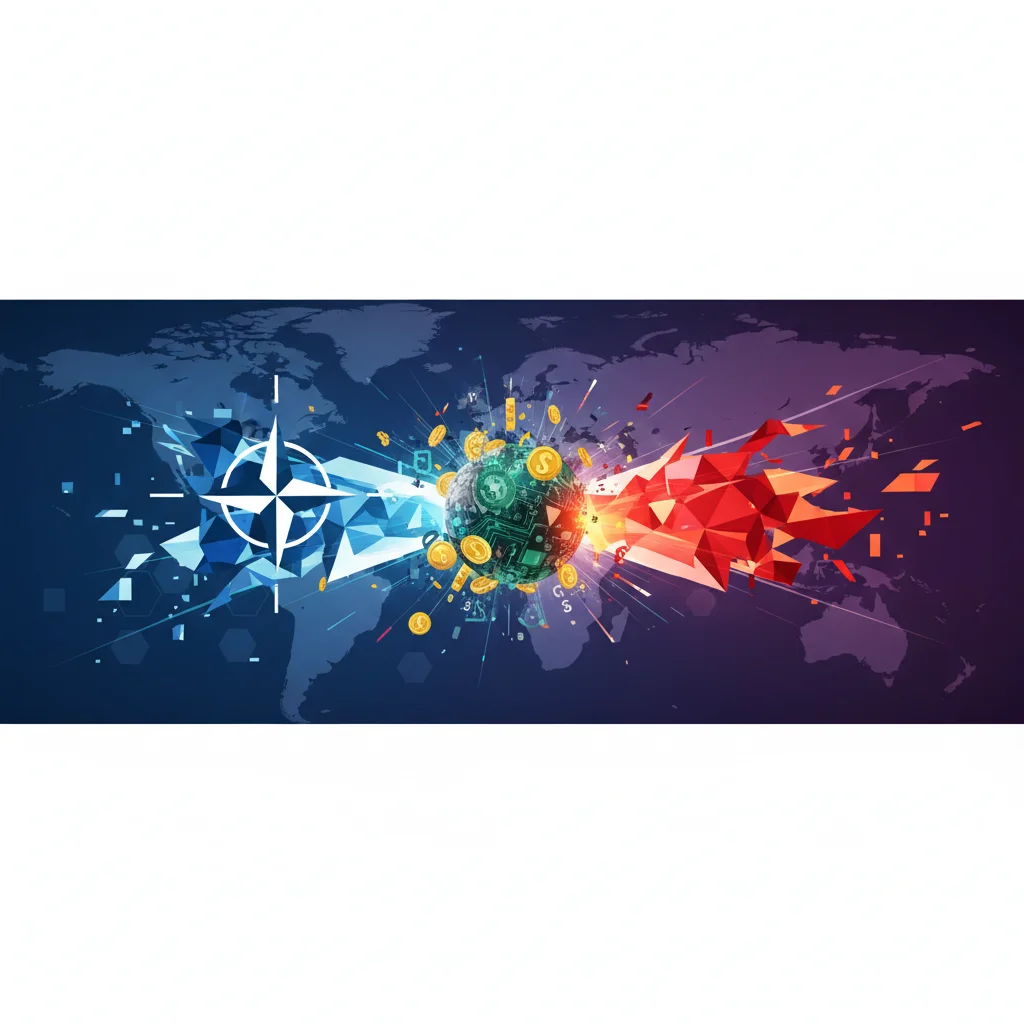
The Narva Gambit: Why a NATO Border Crisis Could Trigger a Global Financial Meltdown
In the quiet corners of geopolitical strategy, there are thought experiments known as “wargames.” These aren’t about fantasy; they are about stress-testing the very foundations of global stability. One such scenario, recently highlighted in a letter to the Financial Times by Reiner Jaakson, focuses on a small Estonian city that could become the epicenter of the next global crisis: Narva.
At first glance, a localized conflict on the Russo-Estonian border might seem distant to the world of finance and investing. But this view is dangerously myopic. The “Narva scenario” is not just a test of military resolve; it’s a direct challenge to the post-World War II economic order. The response to such a crisis would send shockwaves through the stock market, redefine the global economy, and accelerate profound shifts in everything from banking to financial technology. Understanding this gambit is crucial for any investor, business leader, or finance professional navigating today’s volatile landscape.
Deconstructing the Flashpoint: What is the “Narva Scenario”?
To grasp the financial implications, we must first understand the geopolitical chessboard. Narva is an Estonian city located directly on the border with Russia. Critically, its population is overwhelmingly ethnically Russian and Russian-speaking. This demographic fault line makes it a prime target for a “hybrid warfare” playbook—a strategy designed to create ambiguity and paralyze an opponent’s decision-making process.
The scenario unfolds like this:
- Incitement: Pro-Russian separatists, perhaps covertly supported by Russian operatives (“little green men”), stir unrest in Narva, claiming persecution by the Estonian government.
- Incursion: These forces seize local government buildings, creating a de facto breakaway region. Russia denies official involvement but vows to “protect” the ethnic Russians.
- The Test: The move is deliberately limited and ambiguous. It’s not a full-scale invasion with tanks rolling across the border. Instead, it’s a calculated probe designed to ask one terrifying question of the NATO alliance: “What will you do?”
This question is aimed squarely at NATO’s bedrock principle: Article 5 of the North Atlantic Treaty. This clause states that an attack on one member is an attack on all. It has only been invoked once in history—by the United States after the 9/11 attacks (source: NATO). A Russian-backed incursion in Narva would force NATO’s 32 members to decide if this ambiguous, deniable aggression constitutes an “armed attack” worthy of a collective military response.
Cracking the Code: How to Solve the Global Economy's Most Complex Crossword Puzzle
The Two Paths: A “Graduated Response” vs. Decisive Action
As Reiner Jaakson argues, NATO’s response would likely fall into one of two categories, each with vastly different consequences for the global economy.
Path 1: The “Graduated Response” – A Recipe for Economic Chaos
Faced with ambiguity and the terrifying risk of nuclear escalation, the path of least resistance for many NATO capitals would be a “graduated response.” This would involve:
- Strong diplomatic condemnation.
- Emergency UN Security Council meetings (likely vetoed by Russia).
- A new wave of economic sanctions.
- Increased military deployments to neighboring countries, but no direct military action to reclaim Narva.
From a purely political standpoint, this might seem prudent. But from a strategic and economic perspective, it would be a catastrophe. A failure to act decisively would signal that Article 5 is a paper tiger. This loss of credibility would not be a quiet, academic affair; it would instantly and violently reprice risk across the entire global financial system. The prolonged uncertainty would be poison for markets, leading to a grinding bear market, frozen capital investment, and a deep, systemic crisis far worse than the initial shock of the incursion itself.
Path 2: Decisive Action – The High-Stakes Economic Reset
The alternative, as advocated by strategic hardliners, is a swift and decisive military response. This would mean NATO forces, under the Article 5 mandate, acting immediately to isolate and neutralize the aggressors in Narva, restoring Estonian sovereignty within hours or days.
The risks are immense and obvious: the potential for direct conflict between NATO and Russian forces. The immediate market reaction would be brutal—a sharp, violent sell-off in the stock market as algorithms and traders react to headlines of direct confrontation. However, the argument is that this short-term pain is preferable to the long-term cancer of uncertainty. By demonstrating that Article 5 is ironclad, NATO would restore deterrence, quash the crisis quickly, and allow markets to find a floor and begin a recovery. A successful, rapid operation would ultimately reinforce stability, even if the initial shock is severe.
The following table illustrates the potential economic and market consequences of these two divergent paths, based on lessons learned from previous geopolitical crises.
| Metric | Scenario 1: Graduated Response (Prolonged Crisis) | Scenario 2: Decisive Action (Short, Sharp Shock) |
|---|---|---|
| Stock Market Impact | Sustained bear market; high volatility for months/years; deep recession priced in. | Sharp initial crash (-15-20%), followed by a potential V-shaped recovery upon successful resolution. |
| Energy Prices (Oil/Gas) | Prolonged price spikes due to uncertainty over Russian supply and potential for wider conflict. Sustained inflation. | Massive initial spike, but prices could stabilize faster if the conflict is contained quickly. |
| Global GDP Impact | Significant negative impact. A 2022 analysis suggested the Ukraine war could reduce global economic growth by over 1 percentage point, costing over $1 trillion (source: OECD). A prolonged NATO crisis would be worse. | Sharp but potentially smaller overall GDP impact if stability is restored quickly, preventing a global investment freeze. |
| Banking & Credit | Credit markets freeze; high risk of a European banking crisis due to counterparty risk and economic collapse. | Immediate liquidity stress, but central bank intervention could stabilize the system once the military outcome is clear. |
| Capital Investment | Corporate investment freezes globally due to extreme uncertainty about the future security and economic order. | Investment pauses, but could resume relatively quickly once the “rules of the game” are re-established. |
The £1,000 Ski Trip: How Currency Headwinds are Reshaping European Travel and Investment
The Ripples: How a Border Skirmish Floods the Financial World
The consequences of the Narva scenario extend far beyond traditional market metrics. The crisis would act as a powerful catalyst, accelerating trends across the entire financial landscape.
Banking and Finance: A major European conflict would immediately test the resilience of the global banking system. Central banks would be forced to inject massive amounts of liquidity to prevent a credit crunch. The focus would shift to counterparty risk, and financial institutions with heavy exposure to the affected regions would face intense scrutiny. The era of coordinated, predictable central bank policy would end, replaced by emergency measures dictated by military events.
Investing and Trading: The playbook for investing would be rewritten overnight. Defense, cybersecurity, and energy stocks would likely soar, while consumer discretionary, travel, and financials would plummet. Volatility in trading would reach levels not seen since the 2008 financial crisis. Portfolio allocation would shift dramatically towards safe-haven assets like U.S. Treasury bonds and gold, reflecting a fundamental reassessment of global risk.
Fintech and Blockchain: Modern financial technology would be on the front lines. A new, far more severe sanctions regime would be implemented against Russia, and the fintech industry would be instrumental in enforcing it at speed and scale. Simultaneously, we would see an aggressive push by state and non-state actors to use blockchain and cryptocurrencies to evade these sanctions. This would trigger a massive regulatory and cybersecurity battle, forcing governments to accelerate their development of Central Bank Digital Currencies (CBDCs) as a tool of financial control.
The Chip War's New Frontline: Is Nvidia's H200 a Loophole for China's AI Ambitions?
Conclusion: Pricing in the Unthinkable
The “Narva scenario” serves as a stark reminder that geopolitical risk is the ultimate variable in the equation of the global economy. It demonstrates that the stability which underpins our financial models, investment theses, and economic forecasts is not a given; it is a construct, guaranteed by security alliances that must prove their credibility when tested.
For investors and business leaders, the key takeaway is not to predict the outcome of a hypothetical battle. It is to recognize that the interconnectedness of our world means a spark in a small, distant city can ignite a fire that consumes global markets. The response to that spark—whether it is a hesitant, “graduated” appeasement or a swift, decisive action—will determine whether we face a contained fire or a global conflagration. Building resilience in portfolios, supply chains, and business strategies requires an understanding that in the 21st century, the study of economics cannot be separated from the study of security.

Related Posts

A Canary in the Coal Mine? Why Australia’s $200 Billion Pension Fund is Selling AI Stocks

The New Geopolitical Playbook: Decoding Trump’s Foreign Policy and Its Impact on Your Portfolio