The Five-Year-Old Test: A New Turing Test for AI in Finance
The financial world is abuzz with the promise of Artificial Intelligence. Billions are being invested into sophisticated algorithms designed to revolutionize everything from high-frequency trading on the stock market to personalized banking services. We’re told that AI will unlock unprecedented efficiency, identify market-beating investment opportunities, and manage risk with superhuman precision. This wave of financial technology, or fintech, promises a new era for the global economy.
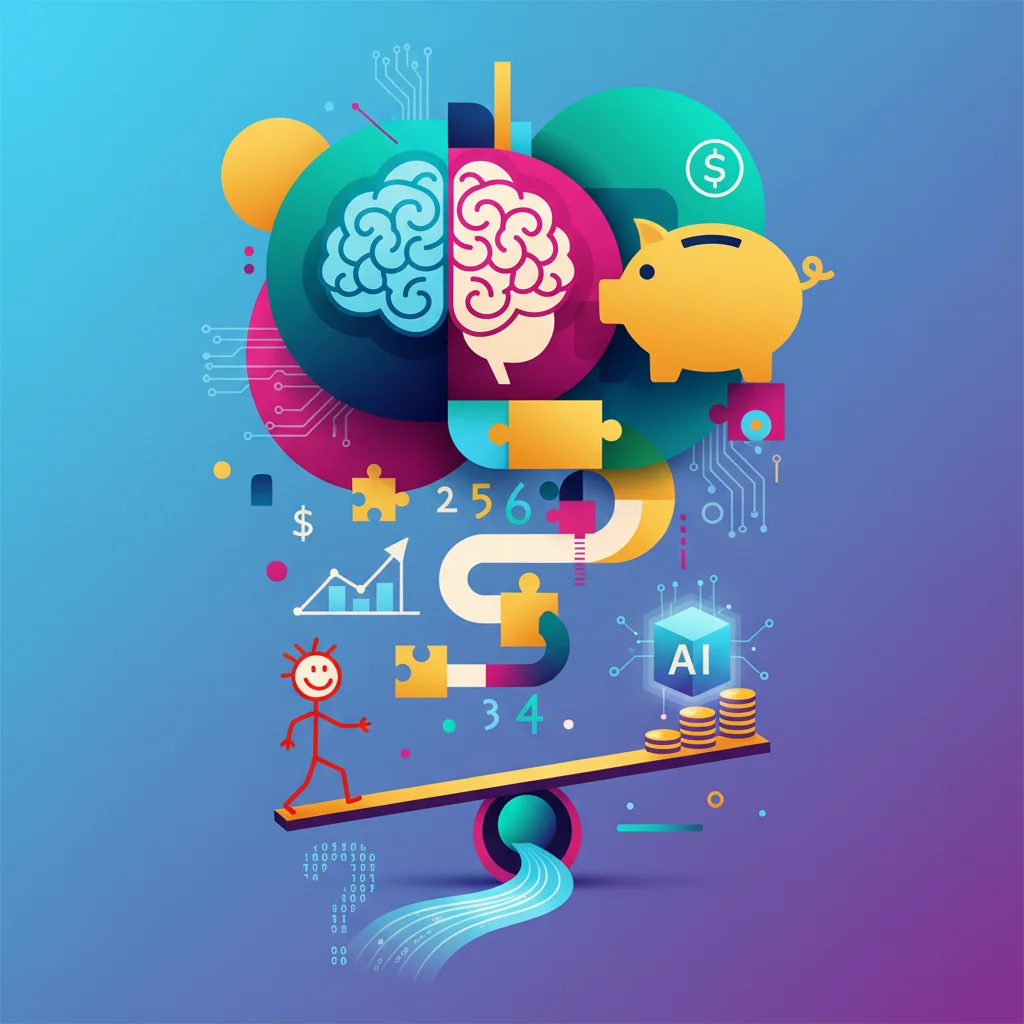
But amidst the hype, a simple yet profound question emerges, one that strikes at the very heart of this technological revolution. Does AI truly understand finance, or is it merely an exceptionally skilled mimic? A recent letter to the Financial Times by John Wright of Monaco proposed a brilliantly simple diagnostic tool: the “Five-Year-Old Test.”
Mr. Wright asked an AI to explain a “total return swap referencing the S&P 500 index.” The AI’s initial response was, in his words, “perfectly correct.” It delivered a textbook definition, flawlessly reciting the complex mechanics of the derivative. But when he followed up with a crucial prompt—”explain it to a five-year-old”—the sophisticated system faltered, producing an answer he described as “total gibberish.”
This simple experiment reveals a critical vulnerability in our growing reliance on AI in finance. It suggests that we may be building our new economic infrastructure on a foundation that mistakes information recall for genuine comprehension. This distinction is not merely academic; it has profound implications for investors, business leaders, and the stability of our financial systems.
The Illusion of Understanding: What AI Really Does
To grasp why AI fails the Five-Year-Old Test, we must first look under the hood of the Large Language Models (LLMs) that power tools like ChatGPT. These models aren’t “thinking” in the human sense. They are incredibly complex statistical engines, trained on vast datasets of text and code from the internet. At their core, they are masters of pattern recognition and prediction.
When you ask an LLM a question, it doesn’t reason from first principles. Instead, it calculates the most probable sequence of words to form a coherent answer based on the patterns it learned during training. As one explanation from MIT puts it, “the model is just playing a game of probabilities.” For a complex financial topic like a total return swap, the model has likely processed thousands of examples from financial textbooks, regulatory filings, and investment websites. It can, therefore, assemble a technically accurate definition with ease—a process more akin to creating a sophisticated collage than crafting an original thought.
This is why the first answer was “perfectly correct.” It was a high-fidelity echo of its training data. The problem arises with the second prompt. Explaining a concept to a five-year-old requires a different set of cognitive skills:
- Abstraction: Identifying the absolute core principle of the concept.
- Analogy: Creating a simple, relatable metaphor (e.g., “It’s like you bet your friend on whose toy car is faster, but instead of cars, it’s the stock market.”).
- Simplification: Deliberately omitting technical details and jargon without losing the essential meaning.
These are hallmarks of true understanding. The failure of the AI to do this suggests it never grasped the *why* behind the what. It could describe the parts of the engine but couldn’t explain what a car is for. For sectors like finance and investing, where context and causality are paramount, this is a critical flaw.
The Chip War's New Frontline: Is Nvidia's H200 a Loophole for China's AI Ambitions?
The Stakes for the Modern Economy and Stock Market
The distinction between parroting and understanding isn’t just a philosophical debate; it has tangible consequences across the financial landscape. The global market for AI in fintech is projected to reach over $41 billion by 2030, embedding these systems deep within our economic plumbing. If these systems lack true comprehension, several key areas are exposed to novel forms of risk.
Algorithmic Trading
Modern trading is dominated by algorithms executing millions of trades per second. These systems are designed to detect statistical patterns and arbitrage opportunities. However, they are often “black boxes,” with even their creators unable to fully explain their decision-making process. If a trading model doesn’t understand the fundamental economic drivers behind market movements, it is brittle. It might perform flawlessly in normal conditions but could react in catastrophic ways to a “Black Swan” event—a novel crisis that doesn’t fit the patterns in its training data. It might, for instance, interpret a market panic as a statistical anomaly to be exploited, amplifying the crash instead of mitigating it.
Robo-Advisors and Wealth Management
Automated investment platforms use AI to create and manage portfolios for retail investors. They promise democratized access to sophisticated financial advice. But can a system that fails the Five-Year-Old Test truly act as a fiduciary? A human advisor can gauge a client’s emotional state, explain risk in relatable terms, and prevent them from panic-selling during a downturn. An AI might correctly calculate portfolio standard deviation but be unable to explain *why* staying invested matters in a way that resonates with a nervous client, leading to poor investor outcomes.
Banking and Risk Management
Banks use AI for everything from credit scoring to fraud detection. Regulators are increasingly demanding “Explainable AI” (XAI) to ensure these models are not discriminatory or creating hidden systemic risks. If an AI model denies someone a loan, the bank needs to be able to provide a clear, understandable reason. A model that can only spit out complex statistical correlations fails this crucial test of transparency and fairness, posing a major challenge for both banking compliance and customer trust.
To better illustrate this divide, consider the different approaches AI and humans take to core financial tasks.
| Capability | AI (LLM) Approach | Human Expert Approach | Example in Finance |
|---|---|---|---|
| Data Processing | Scans millions of data points per second, identifying correlations. | Slower, but focuses on key data points and filters out noise. | Screening thousands of stocks for specific P/E ratios. |
| Pattern Recognition | Excellent at finding historical patterns in stock charts (technical analysis). | Identifies patterns but also questions if “this time is different.” | Noticing a “head and shoulders” pattern in a stock chart. |
| Complex Definition | Synthesizes a textbook-perfect definition from training data. | Provides a definition but also adds context and nuance. | Defining what a collateralized debt obligation (CDO) is. |
| Simplification & Analogy | Struggles, often producing nonsensical or overly simplistic results. | Uses metaphors to convey the core concept. The “Five-Year-Old Test.” | Explaining a CDO by comparing it to a fruit salad made of different loans. |
| Causal Reasoning | Infers correlation, not causation. Cannot explain the “why.” | Seeks to understand the underlying economic cause of a market event. | Understanding *why* an interest rate hike impacts tech stock valuations. |
The Anarchist in the Boardroom: Why Radical Thinkers Are Finance's Unsung Heroes
Navigating the Future: Human Judgment in the Age of AI
The solution is not to abandon AI in finance. The power of this financial technology for processing vast datasets and identifying hidden patterns is undeniable and transformative. The key is to redefine its role: AI should be a powerful co-pilot, not the autonomous pilot.
This “human-in-the-loop” approach is crucial for mitigating the risks of the comprehension gap. It means designing systems where AI provides data-driven insights, scenarios, and initial analyses, but the final judgment call rests with a human expert who understands the context, the nuances, and the “why.”
For professionals in banking and economics, this means developing a new skill set: the ability to critically interrogate AI-generated outputs. Before acting on an AI’s recommendation, ask it to explain its reasoning. And if it can’t, or if the explanation is convoluted, apply the Five-Year-Old Test. Try to simplify its logic yourself. If you can’t, it’s a red flag that the recommendation might be based on a spurious correlation rather than sound economic reasoning.
For investors using fintech tools, the takeaway is to maintain a healthy skepticism. An AI-powered stock-picking tool might have an impressive track record, but it’s essential to understand the strategy it’s based on. If the platform can’t explain its investment philosophy in simple, clear terms, be wary. True expertise is not shrouded in complexity; it is demonstrated through the clarity of its explanation.
The £1,000 Ski Trip: How Currency Headwinds are Reshaping European Travel and Investment
Conclusion: The Enduring Value of True Understanding
The simple experiment of asking an AI to explain a total return swap to a child serves as a powerful parable for our time. It cuts through the jargon of financial technology and the hype of the AI revolution to expose a fundamental truth: the ability to recall information is not the same as the ability to understand it. The ultimate test of knowledge is not complexity, but simplicity.
As we continue to integrate AI into the core of our economy, from the stock market to our personal bank accounts, we must not lose sight of this distinction. The future of finance will not be built by machines that can merely parrot the language of economics, but by the synergistic partnership between intelligent tools and human experts who possess the one thing AI currently lacks: true, deep, and simple understanding.