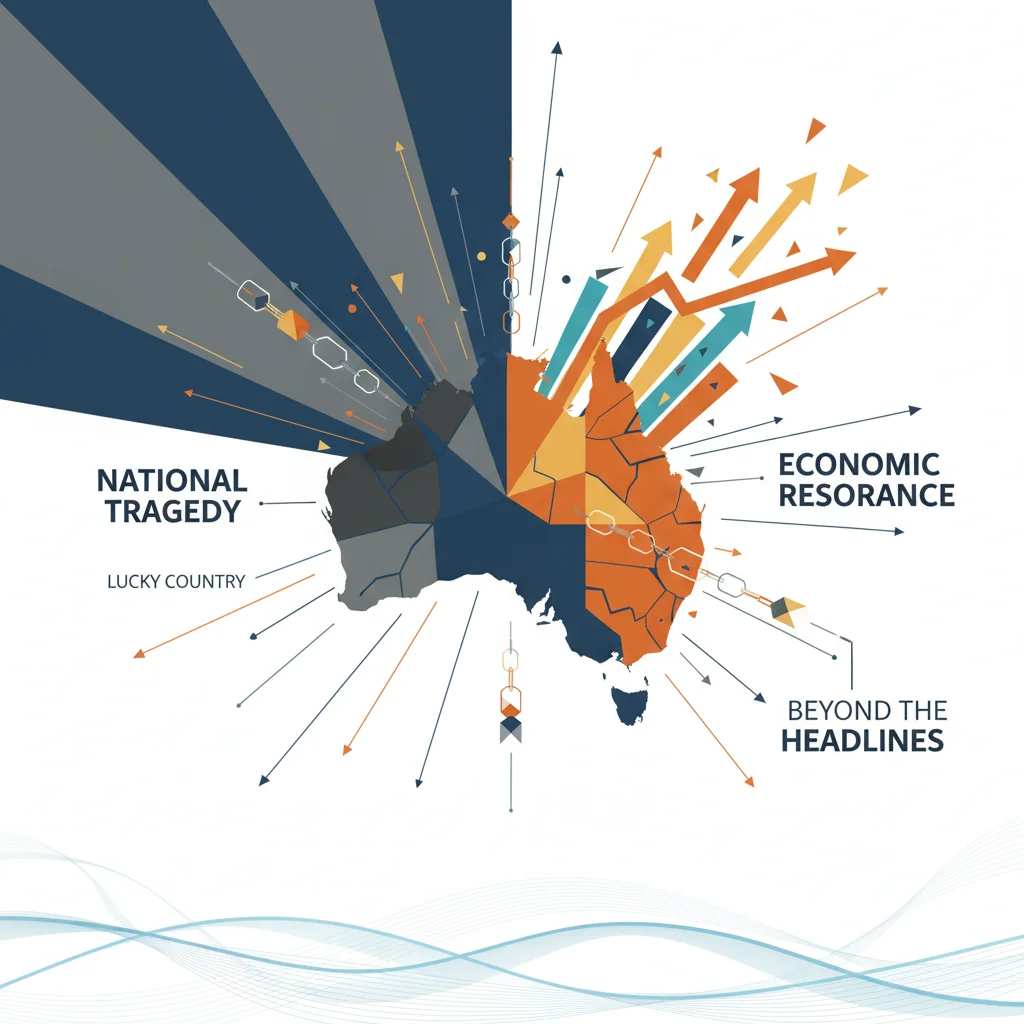
Beyond the Headlines: The Economic Resonance of a National Tragedy in Australia
In the aftermath of the horrific Bondi Junction massacre, Australia, often dubbed the “lucky country,” finds itself grappling with a profound sense of grief and a disquieting challenge to its long-held sense of security. The attack, which claimed six lives and injured many more in a bustling Sydney shopping centre, was the nation’s worst mass killing in years. As the country mourns, leaders, investors, and the public are forced to confront not only the human cost but also the subtle yet significant tremors that such an event sends through the nation’s social and economic foundations.
While the immediate focus is rightly on the victims and their families, for those in the worlds of finance, business, and economics, it is crucial to understand the broader implications. A nation’s resilience is not just a measure of its social cohesion but also a key indicator of its long-term economic stability and attractiveness for investment. This tragedy, while an isolated act, serves as a stark stress test for the Australian model—a model built on safety, stability, and a robust economy.
The Immediate Aftermath: A Test of Leadership and Social Cohesion
The response from Australia’s leadership was swift and aimed at unity. Prime Minister Anthony Albanese lauded the heroism of first responders and ordinary citizens, emphasizing a message of collective strength. “This is a country that has a social cohesion that is so important,” he stated, highlighting the national character that has historically underpinned its economic success (source). For investors, such displays of stable governance and social unity are critical non-financial indicators. They signal that the country’s leadership can navigate crises effectively, minimizing the political risk that can destabilize markets and deter foreign capital.
However, the event also exposed underlying social tensions. The initial, and incorrect, speculation about the attacker’s motives on social media platforms revealed a society quick to fracture along ideological lines. This digital discord stands in contrast to the physical-world unity seen in the floral tributes and community vigils. This dichotomy is a modern challenge for any advanced economy; managing misinformation is now as critical to maintaining stability as managing monetary policy.
Cracking the Code: How to Solve the Global Economy's Most Complex Crossword Puzzle
Analyzing the Economic Ripple Effects of a Societal Shock
Direct market shocks from such isolated tragedies are typically minimal and short-lived. The Australian stock market is unlikely to see a sustained downturn based on this single event. However, the indirect economic consequences are more complex and warrant careful analysis by business leaders and finance professionals.
These impacts can be categorized into short-term and long-term considerations, affecting everything from consumer behavior to public finance.
Here is a breakdown of the potential economic reverberations:
| Impact Area | Short-Term Effects (Weeks to Months) | Long-Term Implications (Months to Years) |
|---|---|---|
| Consumer Confidence & Retail | A temporary decline in foot traffic at public venues and shopping centers, impacting retail and hospitality sectors. A shift towards online commerce. | Increased investment by retailers in security infrastructure. Potential changes in consumer habits and perceptions of safety, influencing urban planning and retail design. |
| Government Spending & Public Finance | Immediate allocation of funds for victim support, mental health services, and increased police presence. | Debates over long-term funding for mental healthcare and security. Potential for new regulations that could increase the cost of doing business, impacting the national economy. |
| Investor Sentiment & “Brand Australia” | Minimal direct impact on the stock market, but increased monitoring of social stability by international investors. | A test of Australia’s reputation as a safe, stable destination for investment and tourism. A sustained period of social unrest could begin to affect its risk premium. |
| Insurance & Risk Management | Processing of claims related to business interruption and personal injury. | Re-evaluation of risk models and potential adjustments in premiums for public liability and business insurance policies. |
The attacker, identified as 40-year-old Joel Cauchi with a history of mental illness, acted alone, a fact that police were quick to establish. This swift clarification was crucial in preventing a wider panic and containing the potential for prolonged economic disruption. As reported, authorities ruled out terrorism, a determination that has significant implications for how the event is processed by both the public and the global investing community (source). A terror designation would have triggered a far more severe and sustained risk-off sentiment.
The Anarchist in the Boardroom: Why Radical Thinkers Are Finance's Unsung Heroes
Australia’s Economic Fortitude: A History of Resilience
Despite the shock, Australia’s economy is fundamentally well-positioned to absorb such an event. The nation’s resilience is built on several key pillars:
- Strong Gun Control: Following the 1996 Port Arthur massacre, Australia implemented some of the world’s strictest gun laws. This has resulted in a dramatic decrease in mass shootings and gun violence, a fact that underpins the country’s reputation for safety. Albanese himself noted that the Bondi incident was a “very raw event” precisely because such violence is so rare in Australia (source). This legal framework is a core asset, reducing a major source of volatility seen in other developed nations.
- Robust Institutions: Australia boasts a stable political system, a transparent regulatory environment, and a world-class banking sector. These institutions are designed to withstand shocks, whether they are financial, like the 2008 crisis, or social, like the current tragedy. This institutional strength is a primary reason why Australia remains a top destination for global capital.
- A Diversified Economy: While historically reliant on commodities, the Australian economy has diversified significantly. Strengths in financial services, technology (including a burgeoning fintech scene), and education provide multiple engines for growth, making it less vulnerable to sector-specific shocks.
The challenge for policymakers and business leaders will be to reinforce these strengths. The conversation will inevitably turn to mental health funding, the role of social media in spreading misinformation, and the security of public spaces. How the government navigates these issues will send a strong signal to the international investing community about Australia’s ability to adapt and strengthen its social contract.
The Path Forward: From Grief to Renewed Strength
The Bondi Junction massacre is a profound human tragedy that has deeply scarred the Australian psyche. The path forward involves mourning, healing, and a national conversation about the issues it has laid bare. For the financial and business community, it is also a moment for reflection on the intricate links between social well-being and economic prosperity.
The key takeaway is that a nation’s greatest asset is its people and the social fabric that binds them. While metrics like GDP growth, stock market performance, and trading volumes are essential, they rest on a foundation of public safety, trust, and collective resilience. The “lucky country” has been reminded that its luck is not a given; it is something that must be continually nurtured and protected.
In the coming months, the world will be watching how Australia responds. A successful navigation of this crisis—one that reinforces unity, addresses systemic issues like mental health, and strengthens community bonds—will ultimately reaffirm the nation’s status as a stable and attractive place to live, work, and invest. The true test of an economy’s strength is not the absence of tragedy, but its capacity to recover and grow stronger from it.