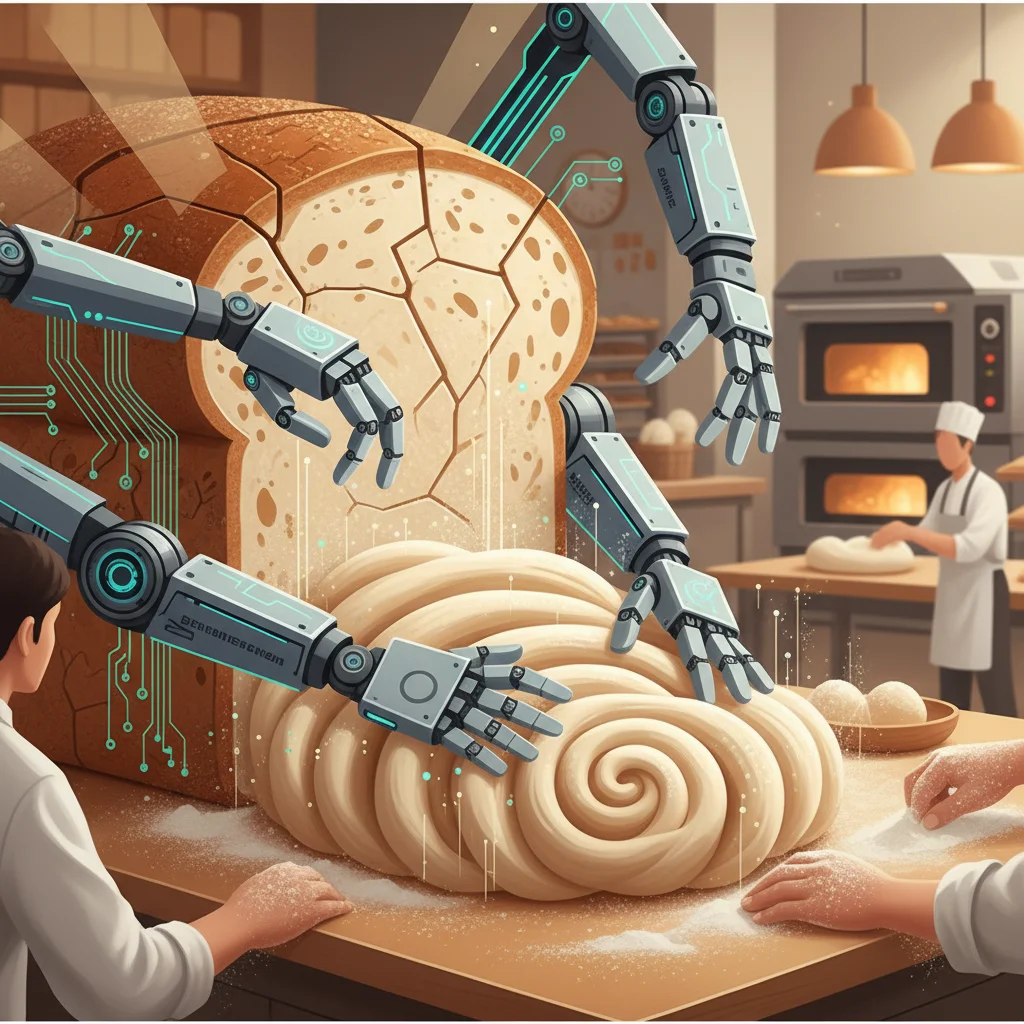
Cracking the Crust: How AI and Robots are Kneading the Future of Baking
Picture the perfect bakery. The air is thick with the warm, comforting scent of freshly baked bread. You see bakers, hands dusted with flour, skillfully kneading dough in a rhythm perfected over generations. It’s a scene of tradition, craft, and human touch. Now, picture a robot arm, gleaming under fluorescent lights, precisely measuring ingredients and placing trays into a smart oven. It feels different, doesn’t it? Cold, maybe. Efficient, certainly. But can it ever replicate the soul of baking?
This isn’t a scene from a sci-fi movie; it’s the reality unfolding in bakeries and food manufacturing plants worldwide. The food industry, particularly the world of baking, is at a fascinating crossroads where ancient traditions are meeting cutting-edge technology. But as a recent BBC article highlights, introducing automation and artificial intelligence into the kitchen isn’t as simple as swapping a baker for a bot. The process is fraught with unique challenges that are pushing the boundaries of robotics, software development, and machine learning.
For developers, entrepreneurs, and tech professionals, this intersection is more than just a novelty—it’s a goldmine of complex problems waiting for innovative solutions. Let’s slice into the layers of this transformation and explore why making a perfect loaf of bread is one of the toughest challenges for modern technology.
The “Sticky” Problem: Why Baking is a Robotics Nightmare
In most automated industries, like automotive manufacturing, robots deal with predictability. A car door is always the same shape, a screw is always the same size. The environment is controlled, and the materials are uniform. Now, consider dough.
Dough is alive. It’s a sticky, elastic, and frustratingly inconsistent organic material. Its properties change based on humidity, temperature, the specific protein content of the flour, and even the time of day. A human baker instinctively adapts to these changes. They can feel when the dough needs a little more flour or a few more minutes of kneading. For a robot, this is a monumental challenge.
This variability is the central hurdle for automation in baking. Standard robotic grippers, designed for rigid objects, get gummed up. Vision systems struggle to assess the dough’s “readiness.” This is where the synergy of hardware and intelligent software becomes critical. It’s not just about programming a robot to repeat a motion; it’s about creating a system that can sense, learn, and adapt in real-time. This requires sophisticated sensors, powerful data processing—often managed in the cloud—and advanced machine learning algorithms that can predict how the dough will behave.
Think of the programming complexity. You’re not just coding `if-then` statements; you’re developing a model that can interpret a dozen variables simultaneously to make a decision that a human makes by feel. This is a frontier of applied AI that has immense potential for growth.
Disney's New Magic: How a Billion OpenAI Deal is Rewriting the Story of Entertainment
The Rise of Cobots and AI-Powered Ovens
Despite the challenges, innovation is rising to the occasion. Companies are developing specialized solutions that blend robotics with intelligent software to tackle specific parts of the baking process. For example, UK firm Brillopak has developed robotic systems that can carefully pack notoriously delicate items like cakes and biscuits without crushing them—a task that requires a surprisingly gentle touch (source).
But the real game-changer is the integration of artificial intelligence directly into the cooking process. A startup called Intelligent Layer is pioneering this with its AI-powered ovens. Instead of relying on fixed timers and temperatures, their system uses sensors and machine vision to monitor the food as it bakes. The AI analyzes the color, size, and texture of the product in real-time, making micro-adjustments to the oven’s settings to ensure a perfect, consistent result every single time. This not only improves quality but also dramatically reduces energy consumption and food waste.
This is a perfect example of a modern tech stack in an unexpected place. Data from sensors is collected, sent to the cloud for processing by a machine learning model, and the resulting commands are sent back to the oven. For many businesses, this kind of capability is delivered as a SaaS (Software as a Service) product, allowing them to benefit from cutting-edge AI without needing an in-house data science team.
More Than a Labor-Saver: The Business Case for Automation
The push towards automation isn’t just about technological novelty; it’s driven by pressing economic realities. The food and drink manufacturing sector is facing a severe labor shortage, with tens of thousands of unfilled vacancies in the UK alone. Repetitive tasks in a hot, demanding factory environment are becoming harder to fill. Automation offers a solution, not by replacing workers wholesale, but by taking over the most strenuous and monotonous jobs, freeing up human staff for more skilled roles like quality control, machine maintenance, and product development.
To better understand the shift, let’s compare the traditional and automated approaches across several key business aspects.
| Aspect | Traditional Approach | Automated Approach |
|---|---|---|
| Consistency | Reliant on individual skill; can vary between bakers and shifts. | Extremely high and repeatable; AI-driven systems ensure every product meets exact specifications. |
| Scalability | Limited by labor availability and physical space. Scaling up is slow and costly. | High. Robots can work 24/7, allowing for rapid production increases to meet demand. |
| Upfront Cost | Lower initial investment, but high ongoing labor costs. | Significant capital expenditure, though SaaS/RaaS models are reducing this barrier. |
| Flexibility | High. A skilled baker can easily switch between different recipes and products. | Traditionally low, but modern AI and software-defined robotics are making systems more adaptable. |
| Data & Insights | Based on experience and anecdotal evidence. | Every step is a data point. Provides deep insights into efficiency, waste, and quality for continuous improvement. |
The data-driven insights are perhaps the most underrated benefit. By tracking every variable, from ingredient temperature to baking time, companies can optimize their processes with a level of precision that was previously unimaginable, leading to significant cost savings and a more sustainable operation.
Think about it: if an AI can manage the tedious, repetitive tasks—mixing, kneading for precise times, monitoring ovens—it frees up the human expert to do what humans do best: innovate. They can focus on developing new recipes, experimenting with exotic ingredients, and perfecting the final presentation. In the future, the most successful bakeries might be those that master this human-machine partnership. The “art” of baking won’t disappear; it will simply be supported by the “science” of intelligent automation. We might even see AI suggesting new flavor pairings or creating personalized nutritional profiles for baked goods on demand. The future isn’t a factory churning out soulless bread; it’s a smart kitchen where technology empowers human creativity.
The Cybersecurity Conundrum in the Connected Kitchen
As bakeries transform into smart factories, they inherit the challenges of the digital world, chief among them being cybersecurity. When your ovens, mixers, and robotic arms are all connected to the internet and controlled by sophisticated software, they become potential targets for malicious actors.
The threat isn’t just about stealing a secret recipe. A hacker could manipulate oven temperatures to ruin entire batches of product, alter ingredient measurements to cause health and safety issues, or deploy ransomware that shuts down an entire production line. This is the world of Industrial IoT (IIoT), and the stakes are incredibly high. For startups and established tech companies entering this space, building robust cybersecurity measures into their products from day one is not an option—it’s a necessity. This includes secure code, encrypted communications, regular vulnerability assessments, and secure access controls for all connected devices.
The Future is Baked In: Opportunities for Tech Innovators
The journey to fully automate the bakery is just beginning, and it’s ripe with opportunities for tech professionals, entrepreneurs, and startups. The challenges of handling organic materials, ensuring food safety, and creating flexible systems are exactly the kind of complex problems that drive progress.
Here are just a few areas where innovation is desperately needed:
- AI for Predictive Maintenance: Developing machine learning models that can predict when a mixer or oven is about to fail, preventing costly downtime.
- Advanced Vision Systems: Creating smarter AI that can assess dough proofing levels or identify subtle imperfections in finished products with greater-than-human accuracy.
- Robotics-as-a-Service (RaaS): Building affordable, subscription-based automation solutions that allow small and medium-sized bakeries to compete with industrial giants.
- Sustainable Tech: Using AI to optimize energy and water usage, reduce food waste, and create more sustainable supply chains.
The key will be interdisciplinary collaboration. Success will require experts in robotics, AI programming, and cloud architecture working alongside food scientists and experienced bakers. The startups that can bridge this gap between the tech world and the traditional kitchen will be the ones to watch.
Oracle's AI Paradox: Why a Revenue Miss Sparked a Debate About the Future of Cloud
Conclusion: A New Recipe for Success
The clash between tradition and technology in the baking industry isn’t a zero-sum game. The goal of automation isn’t to erase the human element but to enhance it, making the process more efficient, consistent, and sustainable. While the challenges are as complex as a perfect sourdough starter, the solutions being developed are pushing the boundaries of what’s possible in robotics and artificial intelligence.
The baker of the future may have a very different set of tools—a tablet and a data dashboard instead of just a rolling pin and a peel. But the passion for creating delicious, high-quality food will remain the core ingredient. By embracing intelligent automation, the baking industry isn’t losing its soul; it’s simply writing a new, more efficient, and data-rich recipe for the future.