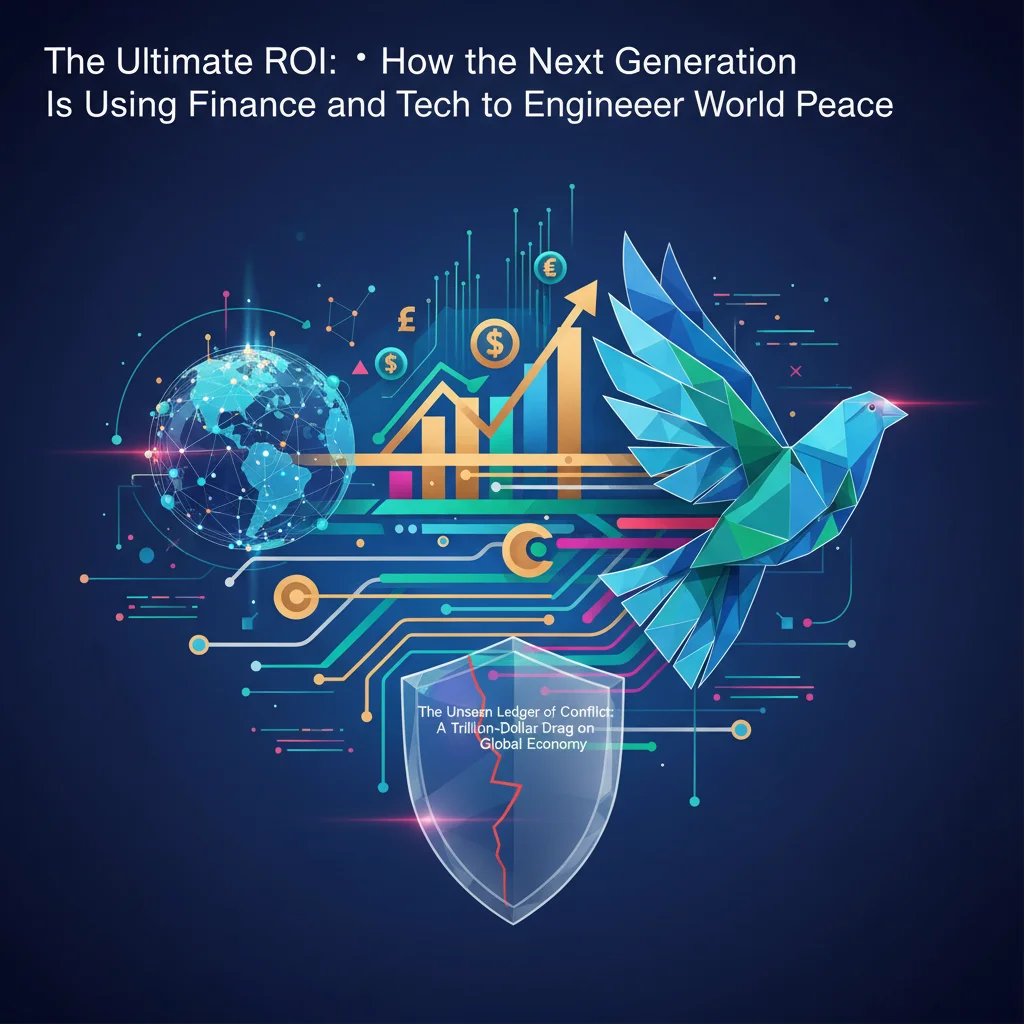
The Ultimate ROI: How the Next Generation Is Using Finance and Tech to Engineer World Peace
The Unseen Ledger of Conflict: A Trillion-Dollar Drag on the Global Economy
In the world of finance, we are experts at quantifying risk, modeling future returns, and scrutinizing balance sheets. We analyze P/E ratios, track stock market fluctuations, and debate the finer points of monetary policy. Yet, one of the largest, most persistent drags on the global economy often goes under-analyzed in our financial models: the staggering economic cost of conflict. It’s an externality that ripples through every sector, disrupting supply chains, erasing wealth, and creating volatility that impacts every investor’s portfolio.
The numbers are staggering. In 2023, the global economic impact of violence was estimated to be $19.1 trillion in purchasing power parity terms, according to the Institute for Economics & Peace. This represents 13.5% of the world’s total economic activity, or $2,380 for every person on the planet. This isn’t just a humanitarian crisis; it’s a profound economic one. Capital that could be fueling innovation, building infrastructure, or funding new ventures is instead diverted to managing and containing violence. For business leaders and finance professionals, this isn’t a distant problem; it’s a direct threat to sustainable growth, market stability, and long-term prosperity.
But what if we could reframe this challenge? What if the tools of modern finance, economics, and technology could be actively deployed not just to mitigate the risks of conflict, but to build the foundations of lasting peace? A recent initiative by the Financial Times and the Crimson Global Foundation has illuminated a path forward, revealing how the next generation of leaders is already thinking along these lines. The student competition on conflict resolution has become a crucible for groundbreaking ideas, demonstrating that the future of peacemaking may lie in the innovative application of financial technology, data analytics, and economic principles.
From Theory to Practice: A New Generation’s Blueprint for Peace
The competition challenged young minds from around the world to devise practical, scalable solutions to complex conflicts. The winning and shortlisted proposals were not vague appeals for harmony; they were sophisticated, tech-infused strategies that a venture capitalist or a fintech incubator would recognize. They represent a paradigm shift—viewing peace not as a passive state, but as an actively engineered system supported by modern tools.
The proposals showcased a remarkable understanding of how technology can address the root causes and logistical nightmares of conflict and post-conflict recovery. Let’s examine the leading ideas that emerged from this intellectual proving ground.
The Fed's Divided House: Why the Latest Rate Cut Signals Deeper Economic Uncertainty
Below is a summary of the top proposals, highlighting their innovative approaches:
| Team/Project | Core Concept | Key Technology/Methodology | Relevance to Finance & Economics |
|---|---|---|---|
| Team Athena (Winner) | An AI-powered platform to analyze peace agreements, identify potential failure points, and suggest improvements based on historical data. | Artificial Intelligence, Natural Language Processing (NLP), Big Data Analytics | De-risks post-conflict investment, provides data for geopolitical risk models, enhances due diligence for international banking and development funds. |
| Team Kintsugi (Runner-up) | A blockchain-based system for transparent and efficient distribution of humanitarian aid, combating corruption. | Blockchain, Distributed Ledger Technology (DLT), Smart Contracts | Creates trusted financial infrastructure, revolutionizes aid-sector banking, and introduces new applications for financial technology in fragile states. |
| Other Finalists | Proposals focused on educational reform, digital platforms for cultural exchange, and youth entrepreneurship programs in conflict zones. | EdTech, Social Platforms, Micro-finance Models | Fosters human capital development, builds sustainable local economies, and creates new markets for investment and trade. |
The Investor’s Lens on “Peace-Tech”
Team Athena’s winning idea is a perfect example of this new “Peace-Tech” approach. For decades, investors and multinational corporations have been hesitant to enter post-conflict regions, deterred by the high risk of instability and the opaque nature of peace deals. An AI tool that can stress-test a peace agreement like a financial model could be revolutionary. It transforms a qualitative political risk into a quantifiable metric. Imagine a future where a World Bank loan or a private equity investment in a rebuilding nation is contingent on the peace agreement scoring above a certain threshold on this AI platform. This is where financial technology intersects with diplomacy, creating a powerful incentive for durable peace.
Similarly, Team Kintsugi’s blockchain proposal directly addresses a massive inefficiency in the global economic system: aid corruption. Billions of dollars in aid are lost annually, undermining recovery efforts and investor confidence. A transparent, immutable ledger for aid distribution isn’t just a social good; it’s a powerful piece of financial infrastructure. It could restore trust for donor nations, unlock private sector investment in humanitarian bonds, and create a secure platform for a new generation of digital banking services in developing economies. This is the essence of fintech: using technology to solve deep-seated problems of trust and transparency in the flow of capital.
The Peace Dividend: A Tangible Return on Investment
The concepts of “Peace-Tech” and impact investing in conflict resolution are not merely altruistic. They are rooted in a well-established economic principle: the “peace dividend.” The term, popularized after the Cold War, refers to the economic benefit derived from a reduction in defense spending, which can then be reallocated to other productive areas of the economy. But the dividend is far broader than just government budgets.
A stable, peaceful environment unlocks immense economic potential:
- Increased Foreign Direct Investment (FDI): Predictability and rule of law are magnets for capital. Peace encourages multinational corporations to build factories, open offices, and invest for the long term.
- Stock Market Growth: Reduced geopolitical risk lowers market volatility. Domestic stock markets in post-conflict nations often experience significant growth as their economies stabilize and rebuild.
- Thriving Local Economies: Peace allows small businesses to flourish, entrepreneurs to innovate, and a consumer class to emerge, creating a virtuous cycle of growth.
- Resilient Supply Chains: Global conflicts disrupt the flow of goods, from energy to microchips. Peace and stability are the ultimate guarantors of efficient global trading networks.
Investing in the technologies and frameworks that support peace is, therefore, one of the highest-yield investments a society can make. The student proposals are, in essence, seed-stage pitches for ventures that could unlock trillions of dollars in global economic value. This reframes the conversation from aid as a cost to peace as an investment with a tangible, if long-term, ROI.
Your Bank Wants to Be Your Financial Advisor: What New UK Rules Mean for Your Money
The Future Role of Finance in a Turbulent World
The FT/Crimson challenge serves as a powerful reminder that the finance industry holds a unique position and responsibility. The flow of capital shapes the world, and by directing it with intention, the sector can be a formidable force for positive change. This goes beyond traditional ESG metrics and into a more proactive stance on global stability.
The path forward involves a multi-pronged approach where different facets of the financial world play a role:
- Venture Capital & Private Equity: Actively seeking out and funding “Peace-Tech” startups like the ones conceptualized in the competition. This means creating funds dedicated to technology that enhances transparency, governance, and security in fragile states.
- Investment Banking: Developing new financial instruments, such as “peace bonds” or social impact bonds, that directly finance reconciliation and reconstruction projects, with returns tied to measurable outcomes like reduced violence or increased school enrollment.
- Asset Management: Integrating more sophisticated geopolitical risk analysis—perhaps using AI tools like the one Team Athena proposed—into portfolio construction. This moves beyond simple country-risk ratings to a more nuanced understanding of conflict dynamics.
- Fintech & Banking: Deploying financial technology to provide essential services in post-conflict zones. Mobile banking, for example, can restore economic activity far more quickly than rebuilding physical bank branches, giving people a secure way to save, transact, and access credit. A 2021 World Bank report highlights how mobile money has become a key enabler of financial inclusion, a critical component of economic stability.
The Fed's Triple Play: Decoding the Latest Interest Rate Cut and What It Means for Your Money
Conclusion: Investing in a New Currency of Stability
The ideas born from the FT/Crimson student competition are more than just clever proposals; they are signals of a profound shift. They show that the intersection of finance, technology, and diplomacy is not a theoretical concept but an emerging reality. The future of conflict resolution will not only be forged in negotiating rooms by diplomats but also coded in labs by software engineers and funded in boardrooms by forward-thinking investors.
For the leaders of today’s economy, the key takeaway is this: the greatest risks to our portfolios and businesses are often systemic and global in nature. By the same token, the greatest opportunities lie in solving these immense challenges. Investing in the architecture of peace—through technology, innovative financial products, and support for the next generation of leaders—is not charity. It is the most critical long-term investment we can make in the stability and prosperity of the global stock market, economy, and society itself.