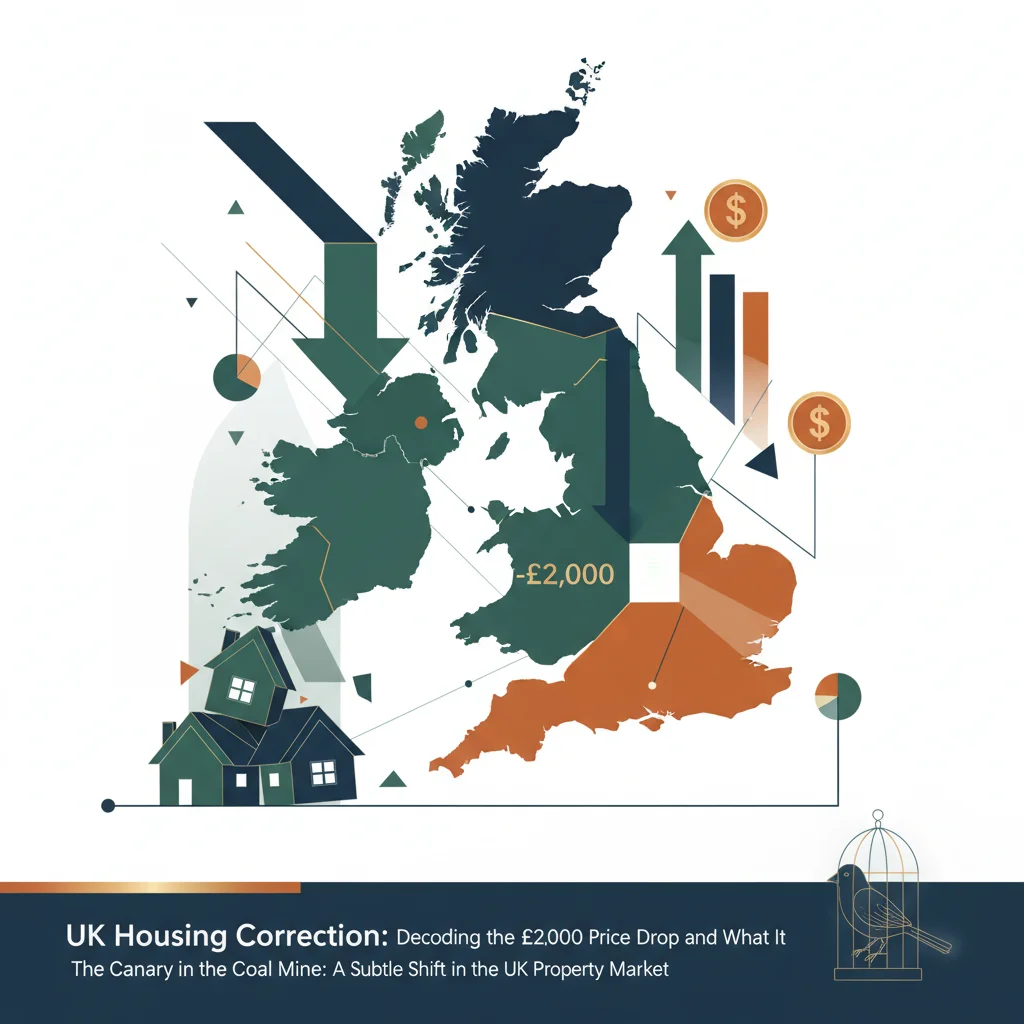
UK Housing Correction: Decoding the £2,000 Price Drop and What It Means for Your Investments
The Canary in the Coal Mine: A Subtle Shift in the UK Property Market
In the complex theatre of the UK economy, the property market often plays the leading role. Its performance is a barometer of consumer confidence, a reflection of monetary policy, and a cornerstone of household wealth. Recently, that barometer flickered. According to data from the property portal Rightmove, the average asking price for a home in the UK fell by approximately £2,000 in the year leading up to early December, settling at £358,138 (source). While a sub-1% dip might not sound like a cataclysm, for savvy investors and financial professionals, it’s a critical signal—a whisper of change that demands closer inspection.
This isn’t just a headline figure; it’s a data point that encapsulates a year of profound economic recalibration. After the post-pandemic frenzy of soaring prices and frantic bidding wars, the market is finally catching its breath. But is this a momentary pause or the beginning of a more significant downturn? This article will dissect the macroeconomic forces driving this trend, explore the shifting power dynamics between buyers and sellers, and provide an expert perspective on how to navigate this new terrain, whether you’re a homeowner, an investor, or a leader in the world of finance.
Anatomy of the Price Adjustment: Beyond the Headline Number
To truly understand the market’s direction, we must look beyond the £2,000 figure. The Rightmove data specifically tracks “asking prices,” which is the initial price set by sellers. This makes it a powerful leading indicator of market sentiment. When sellers begin to temper their expectations, it signals a recognition that the balance of power is shifting. The frenzy has subsided, replaced by a more cautious, price-sensitive buyer.
Several factors contribute to this adjustment:
- The End of Unrealistic Expectations: The double-digit price growth seen in 2021 and early 2022 was unsustainable, fuelled by stamp duty holidays and record-low borrowing costs. The current trend is a natural and, many would argue, healthy correction back toward fundamentals.
- Seasonal Slowdown: It’s important to note that the property market typically experiences a slowdown in the run-up to Christmas. The data, covering the four weeks to December 6th, falls squarely within this period. However, the year-on-year decline indicates a force greater than seasonality is at play.
- Increased Supply: As the market has cooled, the number of available properties has gradually increased. This gives buyers more choice and, crucially, more negotiating power, compelling sellers to price more competitively from the outset.
The Macroeconomic Vise: Interest Rates and Affordability
The primary catalyst for this market shift is not sentiment alone, but the hard reality of macroeconomic policy. For over a year, the Bank of England has been engaged in a determined battle against inflation, with its primary weapon being the base interest rate. This has had a direct and dramatic impact on the banking sector and, consequently, on mortgage affordability.
After years of hovering near zero, the Bank of England’s base rate has seen a steep ascent. As of late 2023, the rate stood at 5.25%, a level unseen for over 15 years (source). This isn’t just an abstract number for the financial markets; it translates directly into higher monthly payments for millions of homeowners and prospective buyers. A household that could comfortably afford a £300,000 mortgage at 1.5% now finds the same loan prohibitively expensive at 5% or 6%.
This affordability squeeze is the single most significant headwind for the housing market. It has priced many first-time buyers out of the market and forced existing homeowners looking to move to reassess their budgets. The era of cheap money that supercharged the market is definitively over, and property prices are now adjusting to this new reality of modern economics.
From Seller’s Paradise to Buyer’s Market: A Power Shift
The consequence of these economic pressures is a clear and decisive shift in market dynamics. For the past few years, sellers held all the cards. Now, the advantage is tilting firmly in favour of buyers, particularly those who are chain-free or cash-rich.
Below is a table illustrating the changing market conditions, comparing the peak of the post-pandemic boom with the current environment.
| Market Indicator | Peak Market (e.g., Mid-2022) | Current Market (e.g., Late 2023) |
|---|---|---|
| Buyer Demand | Extremely High | Subdued / Cautious |
| Property Supply | Severely Limited | Increasing / Normalising |
| Average Time to Sell | ~30 Days | ~60-70 Days |
| Seller Negotiating Power | Very Strong (Bidding Wars Common) | Weak (Discounts Expected) |
| Typical 5-Year Fixed Mortgage Rate | 1.5% – 2.5% | 4.5% – 5.5% |
This new environment demands a complete change in strategy. Sellers must embrace realism, understanding that the price their neighbour achieved a year ago is no longer attainable. For buyers, it’s a time of opportunity. There is less competition, more time to conduct due diligence, and a greater willingness from sellers to negotiate on price—a stark contrast to the sealed bids and over-asking-price offers that defined the previous era.
The Investor’s Playbook: Navigating a Correcting Market
For those involved in investing and asset management, this market shift presents both challenges and opportunities. The era of easy capital appreciation from residential property is on hold. So, how does real estate stack up against other asset classes, like the stock market?
While property price growth has stalled, the UK’s rental market remains incredibly robust, driven by high demand and insufficient supply. According to the Office for National Statistics, private rental prices grew by 6.1% in the 12 months to October 2023 (source). For buy-to-let investors, this creates an interesting dynamic. While the prospect of short-term capital growth has diminished, rental yields (annual rental income as a percentage of property value) are becoming more attractive as property prices soften. This transforms property from a short-term growth asset into a longer-term, income-generating one.
Strategic investors may find opportunities in:
- Negotiating Hard: Cash buyers or those with pre-approved financing are in a prime position to secure significant discounts on asking prices.
- Targeting High-Yield Areas: Focusing on regions with strong rental demand but more modest price points can maximise income potential.
- Value-Add Projects: Purchasing properties that require renovation allows investors to force appreciation, creating value independent of broader market movements.
The key is to shift the mindset from speculative trading to long-term value creation, focusing on cash flow and fundamentals rather than chasing rapid price inflation.
The Bleeding Balance Sheet: Why the UK Doctors' Crisis is an Economic Red Flag for Investors
The Role of FinTech and Future Market Trends
This challenging market environment is also accelerating the adoption of technology within the property and finance sectors. The rise of fintech and “proptech” is creating new tools and efficiencies for all market participants.
Financial technology platforms are empowering buyers with greater transparency. Mortgage comparison sites, digital mortgage advisors, and open banking-powered affordability calculators allow consumers to navigate the complex lending landscape more effectively. For sellers and agents, data analytics tools provide real-time insights into local market conditions, enabling more accurate and competitive pricing strategies.
Looking further ahead, nascent technologies like blockchain could one day revolutionise property transactions. The concept of tokenized real estate—where a property is represented by digital tokens on a blockchain—could fractionalize ownership and create a liquid secondary market, making property trading as seamless as buying and selling stocks. While still in its infancy, this highlights a future where technology continues to democratize and streamline one of the world’s oldest asset classes.
Beyond the Handshake: The Economic Stakes of Germany's Diplomatic Dance with Israel
A Conclusion for a Cautious Era
The £2,000 drop in UK asking prices is not a harbinger of doom, but a symbol of a market in transition. It marks the end of a period of exuberance and the beginning of a necessary, if sometimes painful, return to economic reality. Driven by the Bank of England’s firm monetary policy, the market is rebalancing, shifting power from sellers to buyers and forcing a renewed focus on affordability and fundamental value.
For homeowners, this means a period of stagnant prices. For buyers, it opens a window of opportunity not seen in years. And for investors, it demands a strategic pivot from chasing capital growth to cultivating sustainable, income-driven returns. The UK property market is not crashing; it is correcting. Navigating this new landscape requires caution, realism, and a deep understanding of the powerful economic forces at play.

Related Posts

Solving the Market’s Matrix: A Crossword-Solver’s Guide to Modern Finance

Unlocking Digital Britain: How a New Property Law Could Supercharge the UK Economy and Your Investments