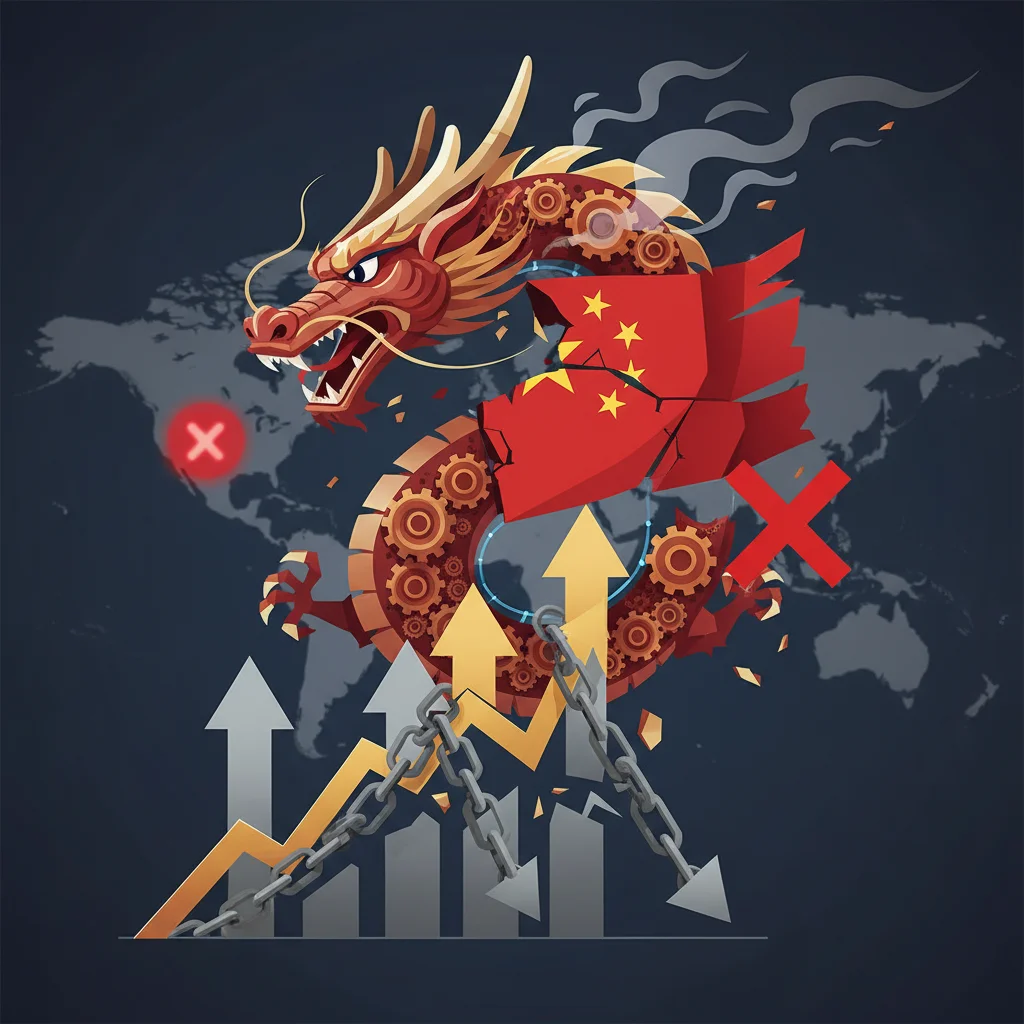
China’s Economic Engine Is Sputtering: A Red Flag for Global Investors?
For decades, the global economy has danced to the rhythm of China’s relentless growth. Its insatiable demand for raw materials, its manufacturing prowess, and its burgeoning middle class have been the bedrock of countless investment strategies and corporate expansion plans. But recent data suggests the rhythm is changing, and the beat is slowing to a worrying tempo. A cascade of disappointing economic figures, headlined by a third consecutive monthly fall in investment, is painting a picture of an economic giant grappling with deep-seated challenges. For anyone involved in global finance, investing, or business, the question is no longer *if* this slowdown will have an impact, but *how* profound that impact will be.
The latest numbers from Beijing are far from reassuring. They point to a multifaceted slowdown that goes beyond a simple post-pandemic blip, signaling potential structural weaknesses in the world’s second-largest economy. Understanding these signals is crucial for navigating the increasingly complex landscape of the global stock market and international trading.
The Data Doesn’t Lie: A Trifecta of Economic Weakness
The story of China’s current economic predicament can be told through three key indicators: fixed-asset investment, retail sales, and industrial production. Each metric, in its own way, reveals a crack in the foundation of the country’s growth model. While the government has set an ambitious GDP growth target of around 5% for the year, achieving it looks increasingly challenging without a significant and immediate turnaround.
Let’s break down the headline figures that are causing concern in financial circles worldwide.
Here is a snapshot of the key year-on-year growth figures that illustrate the cooling momentum:
| Economic Indicator | Recent Growth Rate | Significance |
|---|---|---|
| Fixed-Asset Investment (YTD) | 3.8% | Fell for the third straight month; indicates weak business confidence and a struggling property sector. |
| Retail Sales | 2.5% | Slowest pace in three years (source); highlights extremely cautious consumer sentiment. |
| Industrial Production | 3.7% | Missed analyst expectations; shows that the factory-led recovery is also losing steam. |
1. Faltering Investment: The Engine of Growth Stalls
Fixed-asset investment—spending on infrastructure, property, machinery, and equipment—has long been the primary driver of China’s economic miracle. However, this engine is now sputtering. The 3.8% year-to-date growth is a clear signal that private companies are hesitant to expand, spooked by an uncertain future and regulatory crackdowns. More critically, it reflects the ongoing crisis in the real estate sector, which accounts for a substantial portion of investment. With property developers defaulting and new construction projects grinding to a halt, a vital pillar of the economy is crumbling.
2. The Cautious Consumer: Retail’s Red Alert
Perhaps the most alarming figure is the dismal 2.5% growth in retail sales. This is the weakest performance in three years, a period that includes the height of the “zero-COVID” lockdowns. Beijing has been trying for years to pivot its economy from one driven by investment and exports to one powered by domestic consumption. This data suggests that pivot is failing. Chinese households, scarred by the pandemic’s uncertainty and worried about job security and falling property values, are saving rather than spending. This lack of domestic demand creates a vicious cycle, as weak sales discourage businesses from investing and hiring.
Unpacking the Root Causes: A Perfect Storm of Headwinds
This slowdown isn’t the result of a single issue but a convergence of several powerful headwinds, both domestic and international. The lingering psychological and economic scars of the zero-COVID policy cannot be overstated. It shattered consumer and business confidence in a way that a simple reopening couldn’t fix.
Internally, the property sector crisis remains the biggest elephant in the room. What began with Evergrande has spread, impacting the entire ecosystem of developers, suppliers, homeowners, and the banking system that finances them. This has had a chilling effect on household wealth and sentiment. Compounding this is a youth unemployment rate that has soared to record highs, further dampening the spending power of a key demographic.
Externally, China faces a challenging global environment. Weakening demand from the US and Europe for Chinese goods is putting pressure on its export-oriented manufacturing sector. Furthermore, escalating geopolitical tensions, particularly with the United States, are disrupting supply chains and leading many multinational corporations to adopt “China plus one” strategies, diversifying their investments away from the mainland. The world of international economics is shifting, and China is feeling the pressure.
The Trump Card: How Presidential Politics and Netflix Upended an Billion Media Mega-Deal
This is where the conversation gets interesting for those in financial technology. How can Beijing directly stimulate consumer spending? Traditional rate cuts are a blunt instrument, and their effectiveness is waning as people are more inclined to save any extra liquidity. Could we see China experiment with more innovative, targeted stimulus, perhaps through digital currency (e-CBDC) airdrops or consumption vouchers distributed via advanced fintech platforms? While speculative, such measures could bypass the traditional banking system to put money directly into consumers’ hands with stipulations that it must be spent.
For global investors, this period of uncertainty is a crucial test. It’s time to reassess the “growth at all costs” narrative that has long defined China. The risk is no longer just a cyclical downturn but a more prolonged period of stagnation, akin to Japan’s “lost decades.” This has massive implications for asset allocation, from global equities to commodities. The key takeaway is that the China of the next decade will not be the China of the last. Agility and a deep understanding of these structural shifts will be paramount for successful investing.
The Jacobethan Blueprint: What Victorian Architecture Can Teach Modern Investors
The Global Ripple Effect: Why China’s Cold Catches the World
A slowdown in an economy of China’s scale is never a localized event. The ripples are already being felt across the globe, and they are likely to intensify.
- Commodity Markets: As China’s construction and manufacturing sectors cool, its demand for raw materials like iron ore, copper, and oil will wane. This is already putting downward pressure on global commodity prices, affecting resource-rich economies from Australia to Brazil.
- Multinational Corporations: For decades, companies like Apple, Volkswagen, and Starbucks have relied on the Chinese consumer for a significant portion of their growth. With retail sales faltering, these companies are facing shrinking revenues and are being forced to rethink their growth forecasts. This will inevitably be reflected in their stock market valuations.
- Global Supply Chains: China remains the “world’s factory.” A slowdown can lead to deflationary pressures globally, as Chinese producers may cut prices to offload excess inventory. While this might seem good for consumers in the short term, it can be a dangerous symptom of a weakening global economy.
- Emerging Markets: Many developing nations are deeply integrated with China’s economy, either as suppliers of raw materials or as part of its manufacturing supply chain. A protracted Chinese slowdown could trigger financial instability in these more vulnerable economies.
The interconnected nature of modern finance means that instability in China’s property and banking sectors could have unforeseen contagion effects. Global financial institutions with exposure to Chinese debt will be watching these developments with extreme caution.
Robinhood's New Frontier: Why the Fintech Giant is Betting Big on Indonesia
Beijing’s Response: A Search for a New Stimulus Playbook
The Chinese government is not standing idle. The People’s Bank of China (PBoC) has already begun to act, cutting key interest rates in an attempt to spur lending and economic activity. A recent surprise cut to its medium-term lending facility rate was a clear signal of Beijing’s growing concern (source).
However, many analysts believe these monetary policy tweaks are insufficient to address the root problem: a lack of confidence. The effectiveness of rate cuts is limited when households and businesses are unwilling to borrow. What is truly needed is a robust fiscal response—direct support for consumers and small businesses to boost incomes and encourage spending. This could take the form of tax cuts, subsidies, or direct cash handouts.
The challenge for President Xi Jinping’s administration is that such a consumer-focused approach represents a significant ideological shift from its state-led, investment-heavy model. Whether Beijing is willing and able to make this pivot will be the defining question for China’s economic future and, by extension, the stability of the global economic order.
Conclusion: A New Chapter for the Global Economy
The era of predictable, double-digit growth in China is over. The current data is more than just a temporary slump; it’s a sign of a complex and painful transition. The country is grappling with a deflating property bubble, weak domestic demand, and a challenging international environment. Beijing’s policy responses in the coming months will be critical.
For investors, business leaders, and finance professionals, this is a moment for recalibration. The old assumptions about China’s role in the global economy must be questioned. Navigating this new era will require a nuanced understanding of the country’s internal challenges and a clear-eyed assessment of the risks and opportunities that lie ahead. The dragon’s slowdown is a red flag, and the world must pay attention.