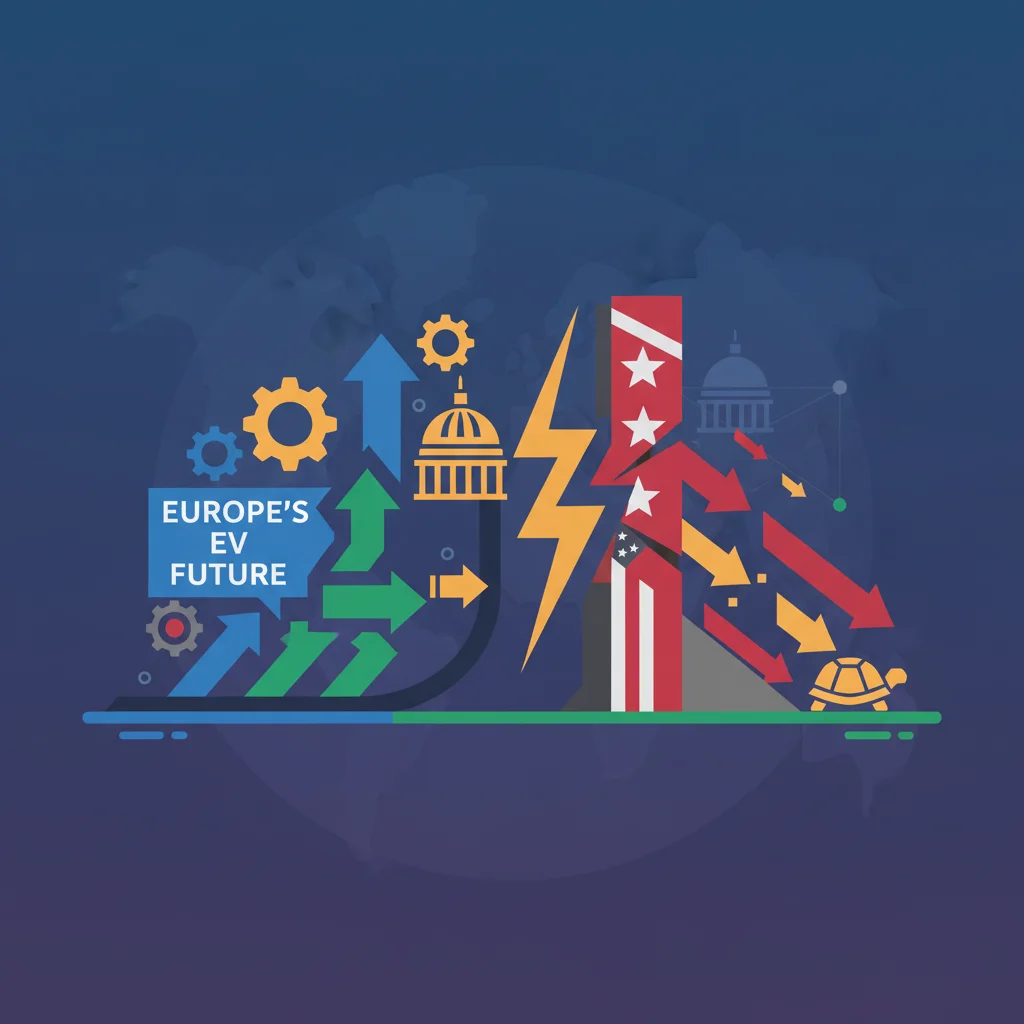
The Great Deceleration: How US Politics Puts Europe’s EV Future in the Slow Lane
The global race for electric vehicle (EV) dominance has always been more than a contest of engineering and design; it’s a high-stakes game of geopolitical strategy, economic policy, and industrial ambition. For years, the trajectory seemed clear: a steady, government-supported march towards an electric future. However, a potential political shift in the United States, spearheaded by Donald Trump, is threatening to slam the brakes on this transition, creating a ripple effect that could drown European automakers while handing a decisive victory to their Asian rivals. This isn’t just about cars; it’s about the future of global manufacturing, the stability of the European economy, and a multi-trillion-dollar shift in the stock market.
The American Political Detour and Its Global Consequences
At the heart of this brewing storm is the stark contrast in automotive policy between the current and potential future US administrations. The Biden administration’s Inflation Reduction Act (IRA) has been a powerful catalyst, pouring billions into domestic EV production and consumer incentives. This policy, while protectionist in nature, created a clear roadmap for American giants like General Motors and Ford to accelerate their EV investments.
However, the rhetoric from the Trump campaign signals a dramatic U-turn. A potential rollback of these green initiatives and a pivot back towards the internal combustion engine (ICE) offers a powerful “political cover” for US carmakers. Facing immense pressure from unions over the costly EV transition and grappling with slower-than-expected consumer adoption, these companies may see a political mandate to delay their ambitious electrification plans. According to the Financial Times, this slowdown is not just a possibility; it’s a strategic retreat that could have devastating consequences for their unprepared European counterparts.
For investors, this signals a critical moment of divergence. While a short-term focus on profitable ICE vehicles might temporarily boost the quarterly earnings of some US automakers, the long-term implications for their market position and innovation pipeline are profoundly negative. The global investing landscape is shifting, and clinging to legacy technology is a risky bet against the future.
The Price of a Whisper: Why the UK's Pre-Budget Leak Probe Matters for Every Investor
Europe’s Squeeze Play: Caught Between a Slowing Ally and a Surging Rival
European automakers like Volkswagen, Mercedes-Benz, and Stellantis are in an exceptionally precarious position. They have committed tens of billions of euros to the EV transition, banking on a synchronized global shift. A US deceleration leaves them strategically isolated. They are now caught in a pincer movement:
- A Faltering Western Alliance: The US was meant to be a key partner and market in the EV transition. If American automakers slow down, it weakens the entire Western bloc’s ability to create scale, standardize technology, and compete effectively.
- The Unstoppable Asian Juggernaut: This is where the real danger lies. While the West hesitates, Asian companies—led by China’s BYD and flanked by South Korea’s Hyundai and Kia—are not just maintaining momentum; they are hitting the accelerator.
These Asian manufacturers have achieved something their Western counterparts are still struggling with: producing high-quality, affordable EVs at a massive scale. Their dominance in battery technology and supply chain integration gives them a formidable cost advantage. As one industry executive noted, Chinese carmakers are poised to “eat our lunch and we are serving it to them,” a sentiment that highlights the growing anxiety in European boardrooms (source). The vacuum created by a hesitant US market will be eagerly filled by these aggressive, well-capitalized Asian players, who will use their scale to further drive down costs and seize market share in Europe and beyond.
The table below illustrates the starkly different strategic postures of major automotive players, highlighting the competitive gap that is set to widen.
| Region/Company | Current EV Strategy & Political Climate | Potential Strategic Shift | Key Competitive Factor |
|---|---|---|---|
| US Automakers (Ford, GM) | IRA-driven investment, but facing profitability and union pressures. | Potential policy rollback provides cover to delay EV targets and focus on profitable ICE/hybrids. | Strong domestic market for trucks and SUVs; legacy brand loyalty. |
| European Automakers (VW, Stellantis) | Heavily invested in “all-in” EV transition to meet stringent EU regulations. | Caught off-guard; may need to consider protectionist measures or re-evaluate investment pace. | Premium brand reputation; strong engineering heritage. |
| Asian Automakers (BYD, Hyundai/Kia) | Aggressive global expansion fueled by government support, scale, and vertical integration. | No change; continue to leverage Western hesitation as a strategic opportunity to gain market share. | Cost leadership; battery technology dominance; speed to market. |
The Ripple Effect: From Trade Wars to Financial Technology
The fallout from this great deceleration extends far beyond factory floors. It will reshape global economics and strain international relations. Europe, facing a flood of affordable and technologically advanced Asian EVs, will be forced to make a difficult choice: embrace free trade and risk the collapse of its cornerstone automotive industry, or enact steep tariffs and risk a retaliatory trade war with China.
This escalating complexity puts immense pressure on global supply chains. The need for transparency and traceability—to verify the origin of battery components and comply with shifting tariff regimes—is paramount. This is where modern financial technology and even blockchain solutions may play a crucial role. A distributed ledger could provide an immutable record of a battery’s journey from mine to vehicle, a critical tool for navigating the intricate web of international trade laws. The entire system of global trade finance and banking will need to adapt to this new era of geopolitical volatility and fragmented supply chains.
Ford’s recent decision to cut orders from its battery suppliers by a significant margin is a clear signal of this trend (source). Such moves don’t happen in a vacuum. They send shockwaves through the entire supply chain, impacting mining operations, chemical processors, and technology firms, altering investment flows and creating uncertainty in the commodities trading markets.
Beyond the Throne: A Modern Playbook for Family Business Succession
An Investor’s Roadmap Through the Reckoning
For investors and finance professionals, this shifting landscape presents both peril and opportunity. The narrative that all legacy automakers will successfully navigate the EV transition is now being severely tested. The key is to look beyond the headlines and analyze the fundamentals:
- Supply Chain Control: Companies that control their battery supply chain, like BYD, have a durable competitive advantage that cannot be easily replicated.
- Geographic Exposure: Automakers heavily reliant on the European and North American markets are more vulnerable to these political and competitive pressures.
- Technological Agility: The ability to innovate and scale new technologies, from battery management systems to software, will separate the winners from the losers.
The potential US policy shift is more than a political event; it’s an accelerant. It is fast-forwarding a reckoning that was always on the horizon for Europe’s auto industry. While American carmakers may gain a temporary reprieve, they risk sacrificing their long-term future. Meanwhile, Asian manufacturers, unburdened by such political vacillations, are seizing the opportunity to build an unassailable lead. The race is far from over, but the starting positions for the next leg are being redrawn right now, and Europe is being left dangerously behind.
The Uncalculated Cost: Why a Personal Tragedy Demands a New Economic Model for Safety
The coming years will be a crucial test of resilience, strategy, and political will. The decisions made in Washington, Brussels, and Beijing will not only determine which companies build the cars of tomorrow but will also shape the new world economic order for decades to come.