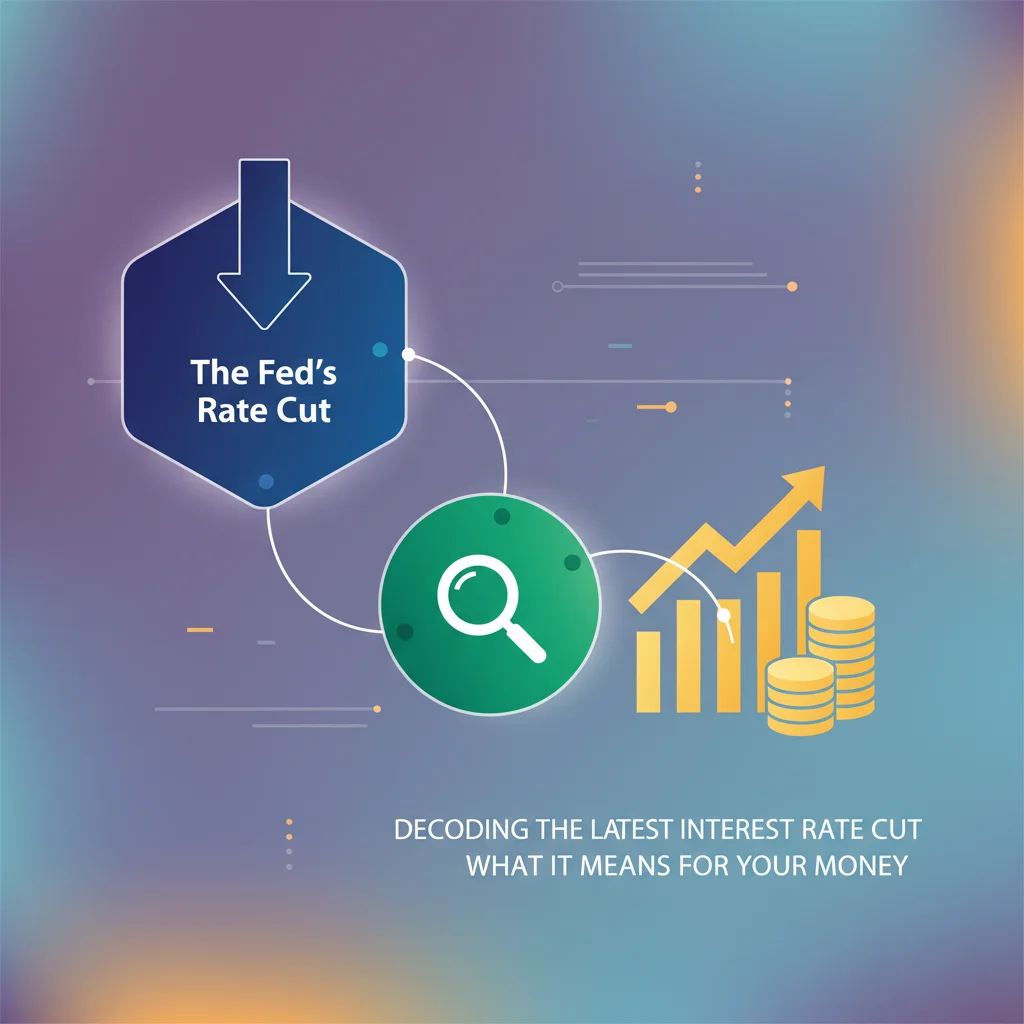
The Fed’s Triple Play: Decoding the Latest Interest Rate Cut and What It Means for Your Money
The world of finance held its collective breath, and the Federal Reserve delivered. For the third time this year, the U.S. central bank has cut its benchmark interest rate, a move designed to sustain the nation’s economic expansion. However, alongside the anticipated cut came a clear signal: don’t expect another one anytime soon. The Fed has pressed the pause button, leaving investors, business leaders, and the general public to navigate a complex and uncertain economic landscape.
This decision by the Federal Open Market Committee (FOMC) to lower the federal funds rate by a quarter-percentage point to a range of 1.5% to 1.75% was not a signal of panic, but rather a calculated move described as a “mid-cycle adjustment.” But what does that mean? And more importantly, what are the ripple effects for the stock market, the broader economy, and your personal finances? In this deep dive, we’ll unpack the Fed’s decision, explore its wide-ranging implications, and provide a roadmap for what to watch for in the months ahead.
Understanding the “Why”: The Rationale Behind the Rate Cut
The Federal Reserve operates under a dual mandate: to foster maximum employment and to maintain stable prices. Every decision it makes is a delicate balancing act aimed at achieving these two goals. This latest rate cut, while welcomed by many in the market, was a response to several persistent headwinds that threaten to derail the longest economic expansion in U.S. history.
The primary drivers behind the FOMC’s decision include:
- Global Economic Slowdown: Major economies in Europe and Asia have shown signs of significant cooling. As the world’s economies are deeply interconnected, a slowdown abroad can quickly impact U.S. exports and corporate earnings.
- Trade Policy Uncertainty: Ongoing trade disputes have created a cloud of uncertainty for businesses, causing many to delay investments and hiring decisions. The Fed has repeatedly cited these tensions as a key risk to the economic outlook.
- Muted Inflation: Despite a strong labor market, inflation has consistently run below the Fed’s 2% target. A rate cut is a classic tool to encourage spending and investment, which can help nudge inflation upward. As Federal Reserve Chairman Jerome Powell noted in the post-meeting press conference, the goal is to provide “some insurance against ongoing risks” (source).
By lowering the cost of borrowing, the Fed aims to stimulate economic activity. It makes it cheaper for businesses to borrow for expansion and for consumers to take out loans for big-ticket items like homes and cars. However, the accompanying language from the Fed suggests they believe these three cuts may be sufficient for now, shifting the institution into a data-dependent, “wait-and-see” mode.
The Contrarian Signal: Why Bitcoin Might Be at Its Best Value Since the 2020 Crash
The Ripple Effect: How the Fed’s Decision Impacts Your Finances
A change in the federal funds rate might seem like a high-level event, but its effects cascade throughout the entire financial system, impacting everything from your savings account to your investment portfolio. Understanding these channels is crucial for making informed decisions in this evolving economic environment.
For Consumers and Savers
For the average person, the most immediate impact is on borrowing and saving. The prime rate, which banks use for many consumer loan products, typically moves in lockstep with the Fed’s rate. This means lower interest rates on credit cards, home equity lines of credit (HELOCs), and variable-rate mortgages. However, it’s a double-edged sword. For savers, this environment means yields on savings accounts, money market accounts, and certificates of deposit (CDs) will likely fall or remain disappointingly low, making it harder to generate risk-free returns.
For Businesses and the Economy
For corporations, lower rates reduce the cost of capital. This can incentivize businesses to invest in new equipment, expand operations, and hire more workers, providing a boost to the overall economy. However, the signal a rate cut sends is just as important. Some business leaders may interpret the Fed’s proactive cuts as a sign of underlying weakness, causing them to remain cautious despite the cheaper borrowing costs. The success of the policy hinges on whether businesses view it as a preventative measure or a reaction to impending trouble.
For Investors and the Stock Market
The stock market often reacts positively to interest rate cuts, and this time was no exception. Lower rates can boost corporate profits by reducing debt-servicing costs. They also make stocks more attractive relative to lower-yielding bonds, potentially driving more capital into the equity markets. However, seasoned investors know that the long-term impact is more nuanced. The market’s future performance will depend less on this single cut and more on whether the Fed’s “insurance” policy successfully wards off a significant economic downturn. According to the initial reporting, the outlook for further easing remains murky, which is a key factor for future investment strategy.
Here’s a simplified breakdown of the potential impacts across different financial areas:
| Financial Area | Potential Impact of the Rate Cut |
|---|---|
| Mortgage Rates | Variable-rate mortgages will see lower payments. Fixed-rate mortgages may also trend lower, making refinancing an attractive option for some homeowners. |
| Savings & CDs | Expect lower Annual Percentage Yields (APYs). Savers will find it more challenging to earn meaningful interest. |
| Stock Market | Generally positive in the short-term. Growth-oriented sectors like technology and consumer discretionary may benefit, while financial sector profits could be squeezed. |
| Business Loans | Lower borrowing costs make it cheaper for companies to fund expansion, research, and development. |
| Bond Market | Existing bond prices tend to rise as their fixed yields become more attractive compared to new, lower-yield bonds. |
A Murky Horizon: Why the Fed is Signaling a Pause
Perhaps the most critical part of the Fed’s announcement wasn’t the cut itself, but the change in language that accompanied it. The FOMC removed a key phrase from its statement that had pledged to “act as appropriate to sustain the expansion.” This was a deliberate signal to the markets that the bar for another rate cut is now significantly higher. The Fed has shifted from a proactive easing stance to a neutral, data-watching position.
This pivot reflects a few key realities:
- A Divided Committee: The decision was not unanimous. Two of the 10 voting members dissented, preferring to keep rates unchanged (source). This internal division highlights the complexity of the current economic picture and suggests a strong consensus for further cuts will be hard to achieve.
- Resilient Economic Data: While risks remain, core aspects of the U.S. economy, particularly consumer spending and the labor market, have remained strong. The Fed needs to see a “material reassessment” of its outlook—meaning a significant downturn in the data—before it will consider cutting again.
- The Lag Effect: Monetary policy works with a lag. The full effects of the three cuts made this year have yet to filter through the economy. The Fed now wants to pause and assess the impact of its actions before administering more medicine.
The Dollar's Dominance: Why the US Currency Holds the Key to Bitcoin's Next Move
The New Frontier: Monetary Policy in the Age of Fintech and Blockchain
This traditional lever of monetary policy—adjusting a benchmark interest rate—is being deployed in an era of unprecedented financial innovation. The world of `financial technology`, or `fintech`, is fundamentally altering the landscape in which central `banking` operates.
A prolonged low-interest-rate environment, for instance, acts as an accelerant for `fintech` innovation. As traditional savings vehicles offer paltry returns, both retail and institutional investors are pushed further out on the risk spectrum, seeking yield in alternative assets. This fuels the growth of peer-to-peer lending platforms, robo-advisors offering diversified `trading` strategies, and other tech-driven investment solutions.
Furthermore, the rise of `blockchain` and decentralized finance (DeFi) presents a fascinating, if nascent, alternative to the centralized financial system. DeFi protocols aim to replicate traditional financial services—like lending, borrowing, and trading—on a decentralized, permissionless network. While still in its early stages, this technology operates entirely outside the direct control of central banks like the Fed. The long-term implications of a parallel financial system that is not subject to traditional monetary policy tools are profound and represent a key area of study for modern `economics`.
Conclusion: Charting Your Course in an Uncertain Environment
The Federal Reserve’s third rate cut of the year provides a welcome cushion for the U.S. economy, but the accompanying signal of a pause ushers in a new phase of uncertainty. The training wheels are off, and the market must now stand on the strength of underlying economic data. So, what are the key takeaways for navigating this period?
- For Investors: Volatility may persist. A disciplined, long-term approach is more critical than ever. Focus on high-quality companies with strong balance sheets that can thrive even in a slower-growth environment. Rebalancing your portfolio and ensuring proper diversification can help mitigate risks associated with policy uncertainty.
- For Business Leaders: This is an opportune moment to strategically review your capital structure. Lower borrowing costs may make it a good time to refinance debt or fund high-ROI projects. However, remain prudent and base investment decisions on solid fundamentals, not just the availability of cheap capital.
- For Individuals: Conduct a personal finance review. If you have high-interest variable debt, look for opportunities to pay it down or consolidate. If you’re a homeowner, explore whether refinancing your mortgage could lower your monthly payments. For savers, it may be time to explore higher-yield savings accounts or short-term bond funds, while understanding the associated risks.
The Fed has played its hand for now. The focus now shifts to incoming data on jobs, inflation, and global growth. By understanding the forces at play and taking proactive steps, you can position yourself to not just weather the uncertainty, but to find opportunity within it.