Hacking Immortality: How AI and Software Are Engineering the End of Aging
For decades, the tech industry has been obsessed with solving complex problems—optimizing supply chains, connecting the world, and even creating new realities. But what if the ultimate engineering challenge isn’t made of silicon and code, but of cells and DNA? What if the final frontier for innovation isn’t in the cloud, but in our own biology?
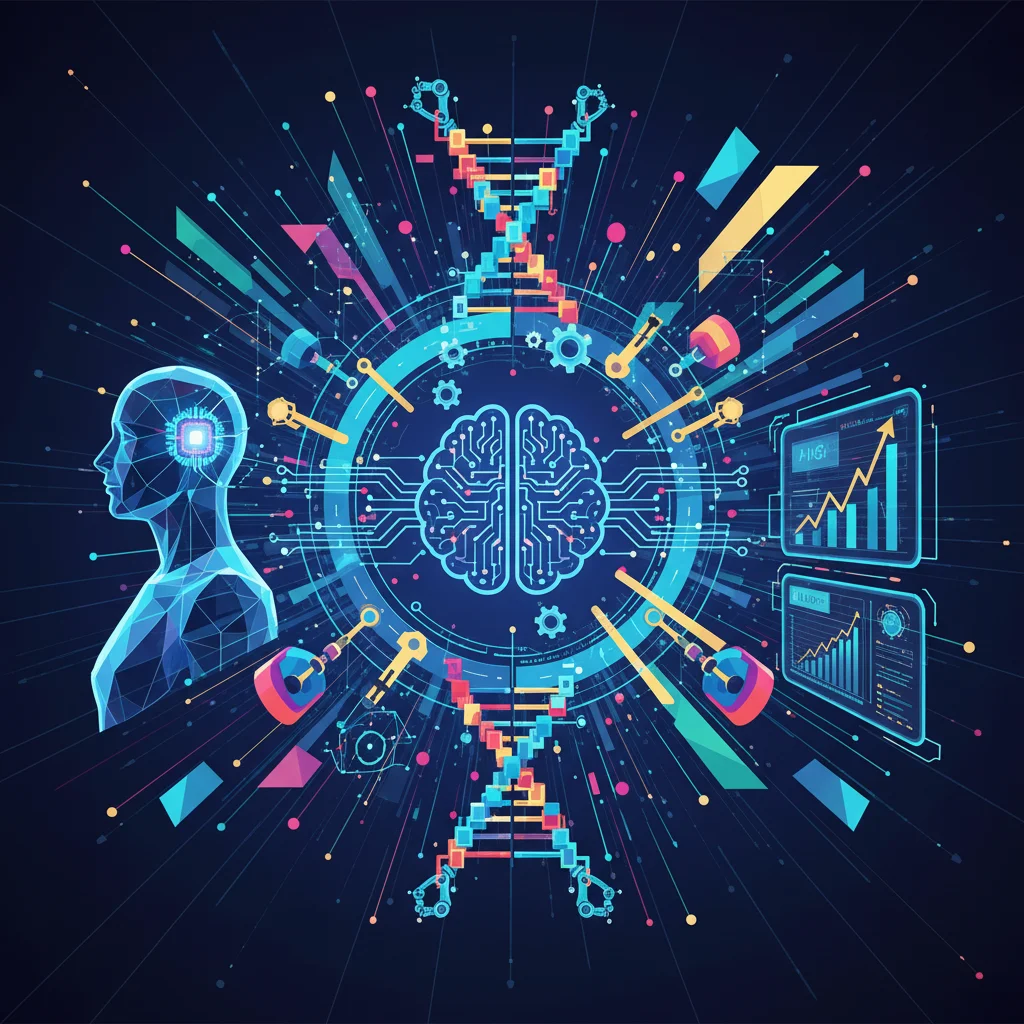
Welcome to the age of longevity, where tech titans, visionary startups, and brilliant scientists are treating aging not as an inevitability, but as a technical problem to be solved. They’re pouring billions into a single, audacious goal: to extend human healthspan and, just maybe, defy death itself. This isn’t science fiction anymore. This is the next great tech revolution, and it’s powered by the tools you work with every day: artificial intelligence, machine learning, and massive-scale cloud computing.
Let’s unpack the code behind this biological revolution and explore what it means for the future of technology, business, and humanity itself.
The New Gold Rush: Why Tech Billionaires Are Investing in Immortality
The quest for eternal youth is as old as civilization, but today’s approach is radically different. Instead of searching for a mythical fountain, Silicon Valley’s elite are funding state-of-the-art labs. Jeff Bezos, through Altos Labs, and Google co-founder Larry Page, via Calico Labs, are among the high-profile investors betting big on cracking the aging code. They see biology as the most complex system we’ve ever encountered, and they’re bringing a tech mindset to debug it.
This isn’t just about living longer; it’s about living better for longer. The industry’s key metric is “healthspan”—the number of years we live free from disease and disability. The global longevity market is already a multi-billion dollar industry, but its potential is astronomical. As Andrew Steele, author of Ageless, notes, a drug that slows aging would be “the most valuable drug ever” (source). For entrepreneurs and startups, this represents a monumental opportunity to build the platforms and tools that will support this new era of medicine.
The fundamental shift is philosophical: moving from reactively treating the diseases of old age (cancer, dementia, heart disease) to proactively targeting the aging process itself. This is where the real innovation lies.
Decoding Biology: How AI is Rewriting the Rules of Aging
At its core, aging is a data problem. Our bodies generate an unfathomable amount of biological data every second. For centuries, this complexity was a black box. But now, with the power of AI and machine learning, we can finally start to make sense of it.
Scientists have identified several key “hallmarks of aging”—the fundamental processes that go wrong in our cells over time. Think of them as bugs accumulating in a system’s codebase:
- Genomic Instability: Errors (mutations) accumulating in our DNA.
- Cellular Senescence: “Zombie” cells that stop dividing but refuse to die, causing inflammation.
- Mitochondrial Dysfunction: The cell’s power plants start to fail.
- Epigenetic Alterations: Changes in how our genes are expressed, like faulty configuration files.
This is where tech professionals can see the parallels. We’re not just treating the symptoms (the “404 errors” of disease); we’re using advanced software and algorithms to find and fix the bugs in the underlying source code.
Here’s a look at how the approach to health is being re-engineered:
| Feature | Traditional Geriatrics (20th Century) | Longevity Science (21st Century) |
|---|---|---|
| Primary Goal | Manage age-related diseases (e.g., heart disease, cancer) | Target the root causes of aging itself |
| Core Strategy | Reactive treatment of symptoms and conditions | Proactive intervention in cellular processes |
| Key Technologies | Pharmaceuticals, surgery, diagnostics | Cellular reprogramming, senolytics, gene editing |
| Role of AI/Software | Data management, diagnostics support | Predictive modeling, drug discovery, personalization |
| Desired Outcome | Increased lifespan | Increased healthspan (healthy, active years) |
Two of the most promising frontiers are cellular reprogramming and senolytics. Cellular reprogramming, inspired by Nobel Prize-winning research, involves “rebooting” adult cells back to a youthful, stem-cell-like state. Senolytics are drugs designed to seek and destroy those “zombie” senescent cells. Developing these treatments requires sifting through millions of potential chemical compounds—a task tailor-made for AI-driven drug discovery platforms running on the cloud.
Riding the Data Wave: How AI is Reshaping Our Fight Against Sea Level Rise
The Ultimate SaaS Model: Longevity as a Service?
As these therapies move from the lab to the clinic, a new generation of business models will emerge. Forget one-time pills; think “Longevity as a Service” (LaaS). Imagine a subscription platform that continuously monitors your biological markers using wearables and at-home tests, with an AI engine on the backend personalizing your regimen of supplements, drugs, and lifestyle changes.
This model is a perfect fit for the modern tech stack:
- Data Collection: IoT devices and biosensors.
- Data Storage & Processing: Scalable cloud infrastructure.
- Personalization Engine: Machine learning algorithms analyzing your unique data.
- Delivery: A slick SaaS platform providing insights and recommendations to you and your doctor.
For entrepreneurs, the opportunities are endless. We’ll need new platforms for managing biological data, automation tools for personalized treatment manufacturing, and secure systems to protect the most sensitive data imaginable. According to some estimates, the value of just one extra year of healthy life is worth trillions to the global economy (source), making the potential market for these services almost limitless.
The AI Gold Rush Goes Public: Anthropic's IPO Move Ignites a High-Stakes Race with OpenAI
The Social & Ethical Stack Overflow
While the technological possibilities are exhilarating, the societal implications are staggering. Extending human life on a massive scale could trigger a cascade of problems that make our current global challenges look simple. If we solve the “bug” of aging, do we create a system-wide crash?
The most immediate concern is inequality. Will these revolutionary treatments be accessible only to the wealthy, creating a biological divide between the long-lived “haves” and the mortal “have-nots”? The prospect of a “gerontocracy”—where an ultra-wealthy, ultra-old elite holds power for centuries—is a dystopian scenario we can’t ignore.
Beyond equity, there are profound logistical and philosophical questions:
- Resources: Can our planet support a population where no one retires and birth rates may not decline?
- Careers & Society: What does a 150-year career look like? How do family structures change? When do you have children if you have a century of adulthood ahead of you?
– Meaning: Does a finite lifespan give our lives urgency and meaning? What happens to our sense of purpose when the finish line is pushed back indefinitely?
These aren’t just questions for philosophers; they are system design problems. As the architects of the future, the tech community has a responsibility to consider the societal impact of the tools we build.
The Developer’s Dilemma: Are We Ready to Write This Code?
The convergence of biology and technology is the most exciting field of our lifetime. For developers, data scientists, and engineers, it offers a chance to work on problems that truly matter, with the potential to alleviate immense human suffering.
But this power comes with immense responsibility. The same programming skills used to build a recommendation engine can be applied to designing a personalized cancer therapy. The AI that powers facial recognition can be used to identify genetic markers for Alzheimer’s. The cybersecurity principles we use to protect financial data must be adapted to safeguard the human genome.
From Fusion Dreams to Cancer Cures: How a Google-Backed Startup is Shipping the Future, Today
The quest to end aging is no longer a matter of *if*, but *when* and *how*. The code is being written right now in labs around the world. The challenge for us—the builders, the innovators, the dreamers—is to ensure that the future we engineer is one that is not only longer, but also more equitable, sustainable, and profoundly human.