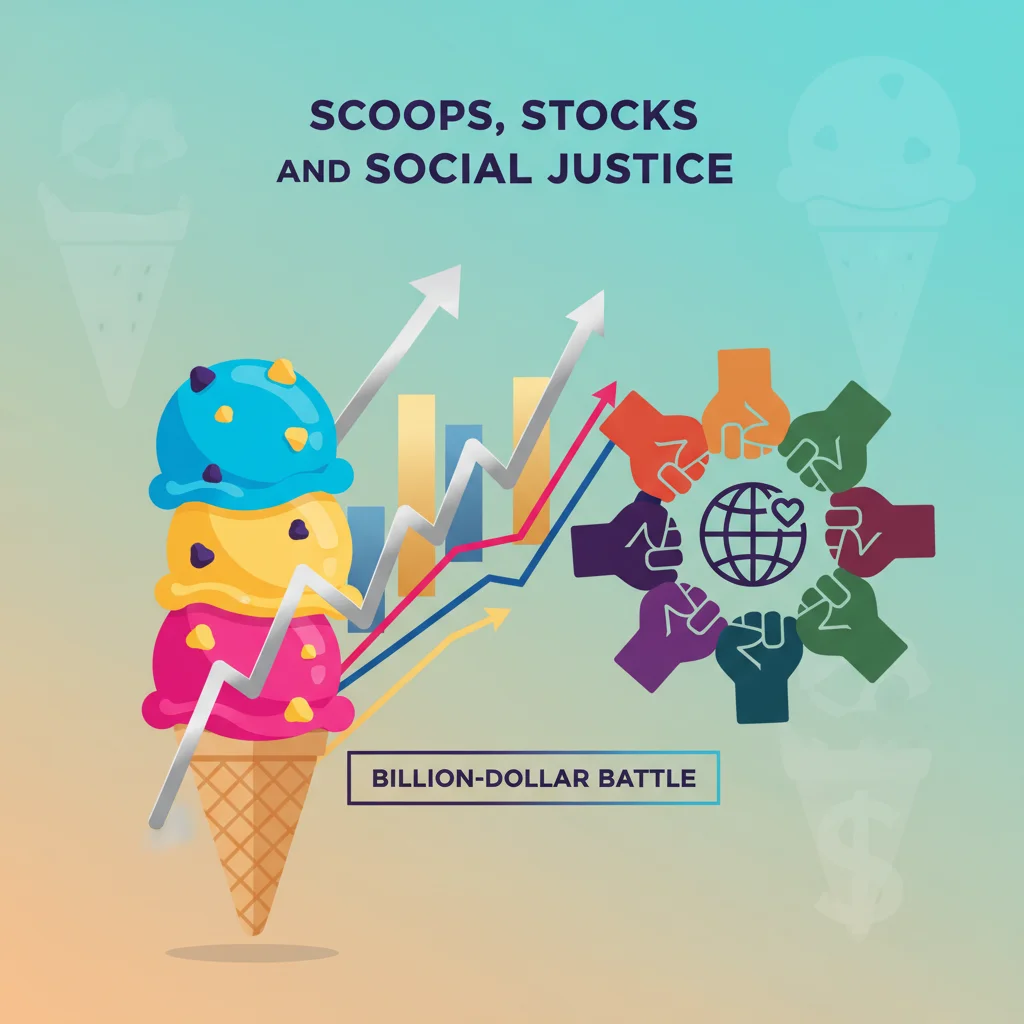
Scoops, Stocks, and Social Justice: The Billion-Dollar Battle for Ben & Jerry’s Soul
It’s a brand synonymous with quirky flavor names, chunky ingredients, and a long-standing commitment to social activism. For decades, Ben & Jerry’s has masterfully blended premium ice cream with progressive politics. But a storm is brewing in the freezer aisle, and it centers on a fundamental question shaking the foundations of modern finance and corporate governance: Can a company truly serve two masters—profit and purpose?
The latest salvo comes directly from co-founder Ben Cohen, who recently voiced grave concerns that the iconic brand he built could be “destroyed” under the stewardship of its corporate parent, Unilever. In a candid interview with the BBC, Cohen highlighted the ongoing struggle for the independence of Ben & Jerry’s board, a unique entity designed to protect the company’s social mission. This conflict isn’t just about ice cream; it’s a high-stakes case study for investors, business leaders, and anyone interested in the future of the global economy.
A Sweet Deal with a Salty Aftertaste: The History of the Acquisition
To understand today’s conflict, we must revisit the year 2000. When global consumer goods giant Unilever acquired Ben & Jerry’s for $326 million, it wasn’t a standard corporate buyout. The Vermont-based ice cream maker was, even then, a pioneer of “stakeholder capitalism”—the belief that a company is accountable not just to its shareholders, but to its employees, customers, community, and the environment.
Fearing their mission would be diluted in a multinational conglomerate, Ben & Jerry’s founders negotiated a landmark acquisition agreement. This deal created a separate, independent Board of Directors for Ben & Jerry’s, endowed with the legal power to oversee and protect the company’s “social mission, brand integrity, and product quality.” This was an unprecedented move in the world of mergers and acquisitions, an attempt to codify a company’s soul into its legal structure.
For over two decades, this arrangement created a delicate, yet mostly functional, balance. Unilever provided the global distribution, marketing muscle, and financial resources, allowing the brand to scale globally. In return, Ben & Jerry’s delivered strong sales and burnished Unilever’s corporate image with a halo of social consciousness, a valuable asset in an era of rising ESG (Environmental, Social, and Governance) investing.
Fast Fashion, Faster Fallout: Why the Shein & Temu IP Scandal is a Red Flag for Investors
The Flashpoint: When Geopolitics Met Corporate Governance
The fragile peace was shattered in 2021. In a move consistent with its history of activism, the Ben & Jerry’s independent board announced it would stop selling its products in the occupied Palestinian territories, citing a conflict with its core values. This decision ignited a firestorm, drawing both praise from activist groups and condemnation from others, who accused the company of antisemitism—a charge Ben & Jerry’s, founded by two Jewish men, vehemently denied.
The move also created a massive headache for Unilever. Faced with political pressure and threats of divestment from U.S. state pension funds, Unilever’s leadership took a decisive step. In 2022, it circumvented the independent board by selling the Israeli portion of the Ben & Jerry’s business to a local licensee. This action effectively overrode the board’s decision and set the stage for a legal battle, with Ben & Jerry’s suing its own parent company to block the sale. Though the lawsuit was ultimately settled, the underlying tension remains, culminating in Cohen’s recent public warning.
Shareholder Primacy vs. Stakeholder Value: An Economic Showdown
At its core, the Unilever vs. Ben & Jerry’s battle is a real-world manifestation of a decades-long debate in economics. It pits two fundamentally different views of a corporation’s purpose against each other.
Unilever’s actions can be seen through the lens of Shareholder Primacy, a theory most famously championed by economist Milton Friedman. This view holds that a company’s primary, and arguably only, social responsibility is to maximize profits for its shareholders. From this perspective, the board’s decision was a liability, and management’s duty was to mitigate the financial damage. Ben & Jerry’s, on the other hand, operates on the principles of Stakeholder Theory, which posits that a business must create value for all its stakeholders.
The table below illustrates the core differences in these competing models of corporate purpose:
| Aspect | Shareholder Primacy Model (Traditional Finance) | Stakeholder Capitalism Model (ESG-aligned) |
|---|---|---|
| Primary Goal | Maximize shareholder wealth (stock price, dividends). | Create long-term value for all stakeholders. |
| Key Metrics | Quarterly earnings, profit margins, stock performance. | Financial results plus environmental impact, employee satisfaction, community engagement. |
| Decision-Making | Driven by financial ROI and risk mitigation. | Balances financial considerations with ethical, social, and environmental impacts. |
| Time Horizon | Often short-term, focused on the next earnings report. | Long-term, focused on sustainable and resilient growth. |
This clash has profound implications for the world of investing. The rise of ESG funds, which have attracted trillions of dollars, is predicated on the idea that the Stakeholder model leads to better long-term performance. According to PwC, ESG-focused assets under management are projected to soar to $33.9 trillion by 2026. The Ben & Jerry’s case forces investors to ask a critical question: is the “S” (Social) in ESG just for marketing, or does it have real teeth in corporate governance?
Shein and Temu Under Fire: A Political Storm with Stock Market Consequences
The Future of Corporate Activism and Financial Technology
The resolution of this conflict will reverberate far beyond the ice cream industry. It will influence how venture capitalists structure deals with mission-driven startups, how institutional investors evaluate corporate governance risk, and how the C-suite at major corporations approaches brand activism.
Modern financial technology (fintech) is already playing a role in this evolving landscape. AI-powered platforms now provide real-time sentiment analysis, allowing companies and investors to track the impact of social stances on brand perception and consumer behavior almost instantly. This data-driven approach is changing the calculus of corporate activism from a purely values-based decision to one informed by predictive analytics on market reaction and its effect on trading volumes and stock price.
Looking further ahead, some futurists even speculate about the role emerging technologies like blockchain could play. Decentralized Autonomous Organizations (DAOs) offer a governance model where rules are encoded in smart contracts and decisions are made by a distributed network of stakeholders. While still experimental, such structures could one day offer a technologically-enforced way to “lock in” a company’s social mission, making it immutable even after an acquisition. It’s a radical idea, but the Ben & Jerry’s dilemma highlights the very problem such innovations aim to solve.
Echoes of 2000? Why the Bank of England is Sounding the Alarm on 'Stretched' Stock Valuations
Conclusion: More Than Just a Sweet Treat
Ben Cohen’s fear that his company’s brand could be “destroyed” is not just the emotional plea of a founder. It is a calculated warning about the erosion of a tangible, billion-dollar asset: brand integrity. The value of Ben & Jerry’s isn’t just in its recipes; it’s in its reputation, which has been meticulously built on a foundation of social and environmental advocacy.
The struggle between the Ben & Jerry’s board and Unilever is a microcosm of the central challenge facing 21st-century capitalism. It forces us to confront difficult questions about the role of corporations in society, the balance of power between parent companies and subsidiaries, and the true meaning of value in an increasingly complex global economy. Whether this story ends with a melted mess or a new model for sustainable business, the worlds of finance, banking, and corporate strategy will be watching—and taking notes.

Related Posts
Wall Street vs. Washington: Unpacking Trump’s $5 Billion Lawsuit Against JPMorgan Chase

The Ghost in the Machine: Why China Intervened in Meta’s Tiny Dutch VR Deal