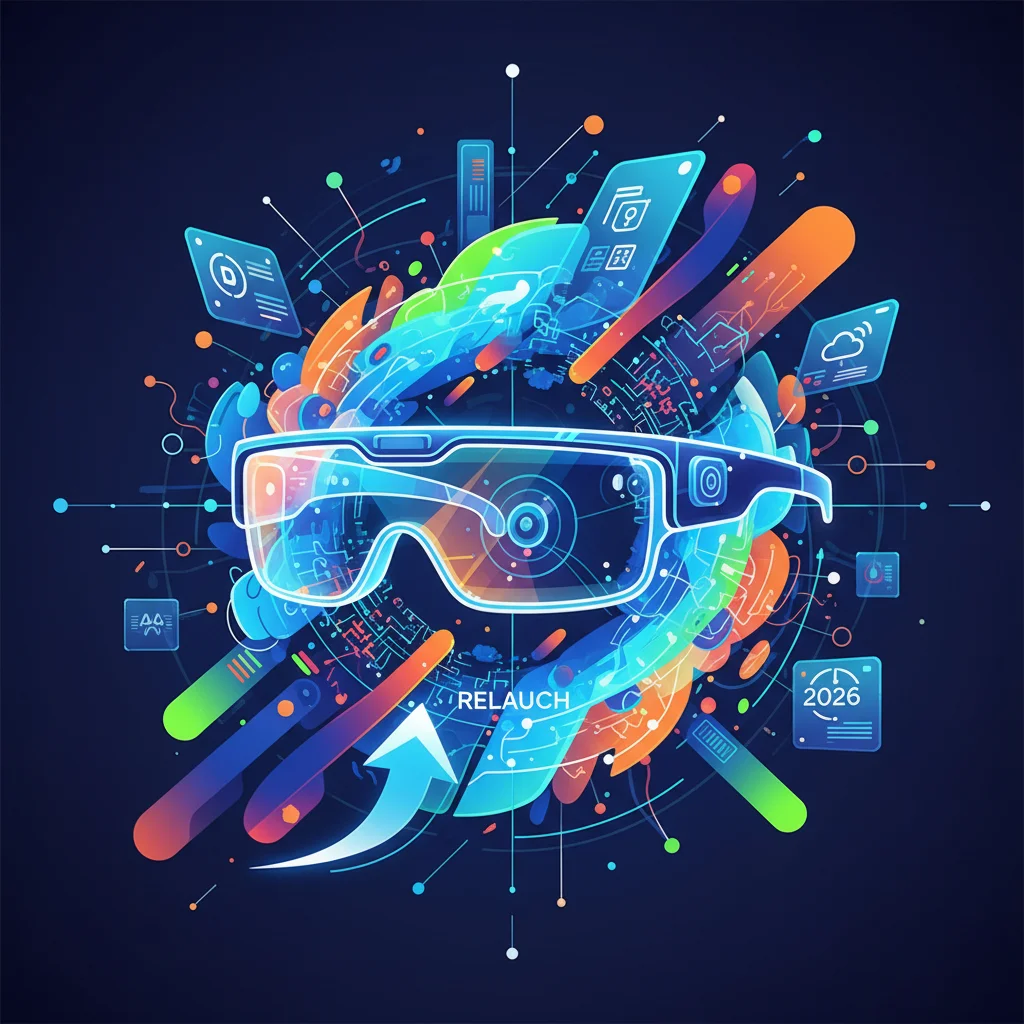
Google Glass is Back: Why AI Makes the 2026 Relaunch a True Game-Changer
Remember Google Glass? For many in the tech world, the name conjures a very specific image: a futuristic, slightly awkward-looking headset that promised to overlay the digital world onto our own. It was a bold, ambitious swing at the future that, despite its hype, ultimately struck out with consumers. Pulled from the market in 2015, it became a Silicon Valley cautionary tale about technology arriving before its time—and before society was ready for it.
Well, get ready for round two. Google is stepping back into the ring. According to a recent BBC report, the tech giant is planning a major comeback in the smart glasses space, targeting a 2026 release. This isn’t just a nostalgic reboot; it’s a strategic move backed by a decade of exponential technological progress, particularly in the field of artificial intelligence.
The world of 2026 is vastly different from the world that rejected the original Google Glass. Today, we live in an era of ambient computing, where AI assistants are in our pockets and homes, and wearable tech is commonplace. The question is no longer *if* we can build smart glasses, but *how* we can make them intuitive, useful, and socially acceptable. This time, Google isn’t just betting on hardware; it’s betting on the intelligence that powers it.
The Ghost of Glass Past: A Lesson in Innovation and Hubris
To understand why the 2026 relaunch is so significant, we must first look back at why the original failed. The Google Glass Explorer Edition was a marvel of engineering for its time, but it was plagued by a trifecta of problems that proved fatal for its consumer ambitions.
1. The Social Stigma and Privacy Nightmare
The most significant hurdle wasn’t technical; it was human. The forward-facing camera, indicated only by a tiny light, created immediate social friction. Wearers were dubbed “Glassholes,” and concerns over covert recording led to the device being banned in bars, cinemas, and casinos. Society simply wasn’t ready for a world of always-on cameras. As one analysis from Investopedia points out, the lack of a clear etiquette or social contract for the device created a powerful and immediate backlash.
2. Technical Immaturity
The hardware itself, while innovative, was far from perfect. Users reported subpar battery life that barely lasted a few hours with active use, a clunky user interface, and issues with overheating. The display was functional but not immersive, and the device’s reliance on a paired smartphone for connectivity and processing power made it feel less like a standalone revolution and more like a very expensive accessory.
3. The Missing “Why”: Lack of a Killer App
For all its futuristic appeal, Google Glass struggled to answer a fundamental question: What is this for? While developers experimented, no single “killer application” emerged to make it a must-have device for the average person. It could take pictures, show notifications, and give directions, but so could the smartphone already in everyone’s pocket—and the phone did it better, more discreetly, and at a fraction of the cost.
These lessons were painful but invaluable. They taught Google and the entire tech industry that for augmented reality to succeed, it needs to be more than just a screen in front of your eye. It needs to be intelligent, seamless, and, most importantly, socially graceful.
India's 'Super App' Mandate: A New Era of Digital Governance or a Privacy Nightmare?
Why 2026 is Different: The AI-Powered Renaissance
A decade is an eternity in technology. The advancements between 2015 and today have fundamentally changed the calculus for smart glasses. The key differentiator this time around isn’t just better hardware; it’s the profound integration of artificial intelligence and machine learning that can finally unlock the device’s true potential.
Here’s what’s changed:
- On-Device AI and Powerful Language Models: The original Glass relied heavily on the cloud for processing. Today, we have incredibly powerful and efficient AI chips that can perform complex machine learning tasks directly on the device. This means faster response times, better privacy (since less data needs to be sent to the cloud), and more sophisticated capabilities. Imagine glasses that can perform real-time language translation, identify objects in your field of view, or summarize a document you’re looking at—all powered by an onboard model like a miniaturized version of Google’s Gemini.
- Computer Vision That Understands Context: Modern AI-powered computer vision is light-years ahead of where it was. Instead of just recognizing a face, new systems can understand context—interpreting scenes, reading body language, and providing relevant information based on what you’re seeing. This transforms the device from a passive display to an active, intelligent assistant that understands your world.
- The Rise of Voice and Conversational UI: We are now accustomed to talking to our devices. The awkward “OK, Glass” command can be replaced by a natural, conversational interface. This shift makes interaction hands-free and intuitive, a critical factor for a device meant to be worn all day. This new paradigm of software interaction is key to user adoption.
- Cloud Infrastructure and SaaS Integration: While on-device processing is crucial, the power of the cloud remains essential. A modern smart glass platform can seamlessly sync with a user’s digital life, powered by a robust ecosystem of SaaS (Software as a Service) applications. For startups and developers, this presents a massive opportunity to build specialized applications—from enterprise automation tools to consumer wellness apps—that live on this new platform.
To illustrate the leap, let’s compare the original Explorer Edition with what we can realistically expect from a 2026 model.
| Feature | Google Glass (Explorer Edition, 2013) | Speculated Google Glasses (2026) |
|---|---|---|
| Core Technology | Basic notifications, simple commands, smartphone tethering. | On-device AI, contextual awareness, real-time processing, ambient computing. |
| AI/ML Capability | Minimal. Basic voice recognition, cloud-dependent. | Deeply integrated. Real-time translation, object recognition, generative AI summaries, proactive assistance. |
| User Interface | Clunky touchpad, rigid voice commands (“OK, Glass”). | Conversational AI, gesture control, natural language interaction. |
| Design & Social | Obtrusive, tech-forward design. Obvious camera led to privacy concerns. | Likely a more discreet, fashion-conscious design. Focus on subtle indicators and user privacy controls. |
| Primary Use Case | Unclear. A mix of niche enterprise and tech enthusiast novelty. | Clear utility-driven applications: AI-powered assistant, navigation, communication, and specialized professional tools. |
A New Frontier for Developers, Startups, and Innovation
A successful launch of a new computing platform is a watershed moment for innovation. Just as the iPhone created the app economy, a viable smart glass ecosystem could ignite a new wave of creativity for developers and entrepreneurs.
The opportunities are vast. Startups could emerge to build niche solutions for specific industries:
- Manufacturing & Logistics: Hands-free assembly instructions, quality control overlays, and automated inventory scanning.
- Healthcare: Surgeons accessing patient data mid-procedure, remote expert consultation, and medical student training simulations.
- Education: Interactive museum exhibits, immersive language learning, and hands-on science experiments with digital overlays.
For developers, this means learning a new paradigm of programming—one focused on context, brevity, and non-intrusive interaction. The best apps won’t be scaled-down smartphone apps; they will be entirely new experiences built for “glanceable” information and ambient assistance. This is a chance to define the user interface of the future.
Valentino's AI Nightmare: A Cautionary Tale for Brands Rushing into Automation
The potential for automation is also immense. Imagine a field technician looking at a piece of machinery, and the glasses automatically identify the model, pull up the maintenance history, and guide them through the repair process step-by-step. This fusion of the physical and digital worlds is the true promise of augmented reality.
Will History Repeat Itself?
Google is not alone in this race. Meta is already on its second generation of Ray-Ban smart glasses, and Apple’s Vision Pro, while a different category of device, has pushed the concept of spatial computing into the mainstream consciousness. According to Statista, the global AR/VR market is projected to grow exponentially, signaling a massive industry-wide bet on this technology’s future. Google’s re-entry is both a validation of this trend and a direct challenge to its competitors.
The stage is set for a fascinating battle for the next great computing platform. Google has the advantage of its immense AI research, its global mapping data, and its powerful Android ecosystem. But it also carries the baggage of its past failure.
The success of Google’s 2026 smart glasses will hinge on its ability to prove it has learned its lessons. It needs to deliver a product that is not only technologically brilliant but also thoughtfully designed, socially conscious, and undeniably useful. It needs to provide a clear and compelling answer to the question that mattered most in 2015 and still matters today: Why?
If they can answer that, they won’t just be launching a new gadget. They’ll be launching the next chapter of our relationship with technology.
Beyond the Battlefield: How AI and a Revolutionary Scanner are Decoding Brain Trauma in Real-Time

Related Posts
Beyond the Algorithm: What Chomsky and HAL 9000 Reveal About the Future of AI in Finance
TikTok’s Great Divide: What the US Divestiture Really Means for AI, Cloud, and the Future of the Internet