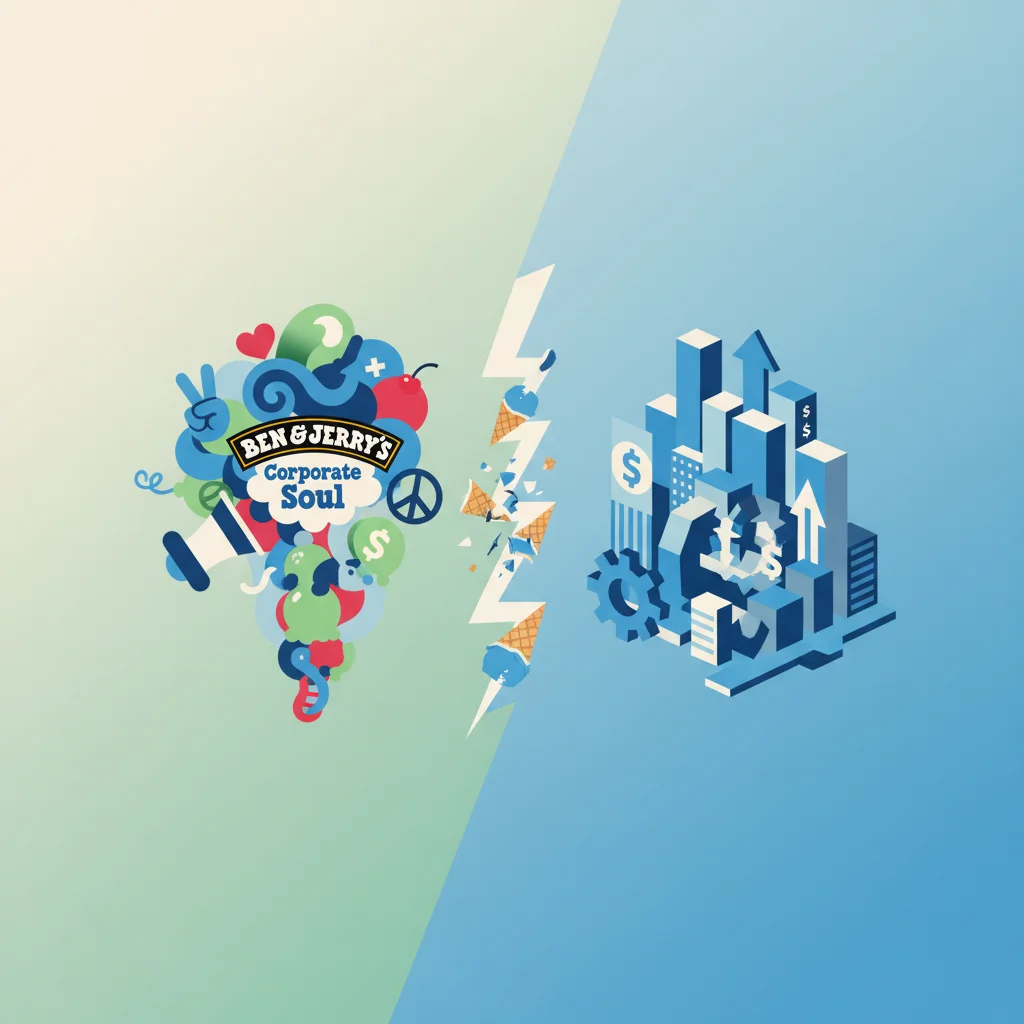
Ben & Jerry’s vs. Unilever: A High-Stakes Battle for Corporate Soul and Shareholder Value
It’s more than just ice cream. For decades, Ben & Jerry’s has been a cultural icon, a brand synonymous not only with whimsical flavor names like “Cherry Garcia” and “Phish Food” but also with a bold, unwavering commitment to social and political activism. This carefully crafted identity, a fusion of capitalism and conscience, has cultivated a fiercely loyal customer base and made it a pioneer in what we now call stakeholder capitalism. But that very identity is now at the center of a corporate firestorm, pitting the company’s founders against its colossal parent, Unilever.
The alarm was sounded by co-founder Ben Cohen himself, who issued a stark warning that the iconic brand’s values—and indeed its very existence—could be “destroyed.” In a recent interview, Cohen expressed grave concerns over the independence of the Ben & Jerry’s board, stating, “I think Unilever is a great company… but I think the board of Ben & Jerry’s has been the guardian of that social mission.” His comments cut to the heart of a fundamental conflict in the modern economy: what happens when a mission-driven company is swallowed by a multinational giant focused on maximizing shareholder returns? This is not just a story about ice cream; it’s a critical case study in corporate governance, the financialization of brand equity, and the future of purpose-led investing.
A Deal with a Devil’s Bargain? The History of a Unique Acquisition
To understand today’s conflict, we must rewind to the year 2000. When the global consumer goods conglomerate Unilever acquired Ben & Jerry’s for $326 million, many feared the quirky Vermont-based company would lose its activist soul. Anticipating this, the founders negotiated a landmark—and highly unusual—acquisition agreement. This deal was the key to preserving the brand’s integrity.
The masterstroke was the creation of a unique governance structure: an independent Board of Directors for Ben & Jerry’s, separate from Unilever’s main board. According to the merger agreement, this board was granted control over the company’s “Social Mission” and “brand equity.” As legal scholar Brian Quinn noted in a 2022 analysis, this gave the board “authority over the ‘social mission’ and the power to enter into agreements to implement it,” a rare provision in corporate takeovers. This structure was designed to act as a permanent firewall, allowing the ice cream maker to continue its advocacy on issues from climate change to racial justice, even if it created friction with its corporate parent.
For two decades, this fragile arrangement held. But the truce was shattered in 2022 when Unilever announced the sale of Ben & Jerry’s business interests in Israel to a local licensee, a move that would keep the ice cream on shelves in the occupied West Bank. This directly contradicted a 2021 decision by the Ben & Jerry’s board to cease sales in the territory, which they stated was “inconsistent with our values.” The board sued Unilever to block the sale, a dramatic escalation that put their unique governance agreement to the ultimate legal test. While the lawsuit was eventually settled, the underlying tension remains, culminating in Cohen’s recent public warning.
The timeline below highlights the key moments in this evolving relationship, showcasing a long history of both collaboration and conflict.
| Year | Key Event | Implication for Governance & Brand |
|---|---|---|
| 2000 | Unilever acquires Ben & Jerry’s for $326 million. | An independent board is created to protect the brand’s social mission and integrity, a unique provision in M&A. |
| 2012 | Ben & Jerry’s becomes a certified B Corporation. | This legally solidifies its commitment to balancing profit and purpose, aligning with the board’s mandate but potentially creating friction with a traditional corporate parent. |
| 2015-2020 | The brand engages in high-profile activism (e.g., Black Lives Matter, climate justice). | Demonstrates the independent board’s power to steer the brand on controversial issues, testing the limits of Unilever’s tolerance. |
| 2021 | Ben & Jerry’s board announces it will stop selling ice cream in the occupied West Bank. | The board exercises its social mission authority on a major geopolitical issue, triggering significant backlash and pressure on Unilever. |
| 2022 | Unilever sells the Israeli business to a local licensee to circumvent the board’s decision. The board sues Unilever. | The fundamental conflict over control erupts into a legal battle, questioning the true power of the independent board. |
| 2024 | Co-founder Ben Cohen publicly warns that Unilever’s actions could “destroy” the brand. | The conflict becomes a public narrative, raising alarms for investors and consumers about the brand’s future. |
This ongoing saga is a real-world stress test of stakeholder capitalism versus the traditional doctrine of shareholder primacy that has dominated the stock market for a century.
Shein and Temu Under Fire: A Political Storm with Stock Market Consequences
The Billion-Dollar Question: Quantifying the Financial Value of Authenticity
For finance professionals and investors, the core issue is whether Ben & Jerry’s social mission is a charming quirk or a core financial asset. The evidence overwhelmingly suggests it is the latter. The brand’s activism is not incidental; it is the engine of its growth and a key driver of its “brand equity”—the intangible but immensely valuable asset representing consumer perception, loyalty, and market position.
In today’s market, consumers, particularly younger demographics, increasingly make purchasing decisions based on a company’s values. A 2023 Deloitte survey found that nearly one in three consumers have stopped purchasing certain brands due to ethical or sustainability concerns. Ben & Jerry’s has built its empire on this very principle. By taking authentic, and often risky, stances, it has cultivated a level of customer loyalty that marketing departments can only dream of. This translates directly into pricing power, market share, and resilient revenues, even in a competitive market.
Undermining this activism, as Ben Cohen fears, poses a direct financial threat. If consumers perceive that Ben & Jerry’s has become just another corporate subsidiary, stripped of its independent voice, the brand’s unique selling proposition evaporates. This is the nightmare scenario for ESG (Environmental, Social, and Governance) investors, who have poured trillions into companies that demonstrate strong social and ethical performance. The Ben & Jerry’s case is a litmus test for the “S” and “G” in ESG: is a company’s stated commitment to social good and robust governance genuine, or is it merely “purpose-washing” that can be discarded when inconvenient?
A loss of authenticity would not only harm Ben & Jerry’s sales but could also create a contagion effect for Unilever, damaging its reputation among the growing cohort of ethically-minded investors and consumers. This is where the world of corporate branding intersects directly with trading and market valuation.
Green Shoots or a False Dawn? Unpacking the UK's Tentative Stock Market Revival
A Cautionary Tale for the Broader Market
The Ben & Jerry’s-Unilever conflict is not an isolated incident. It is a high-profile example of a recurring theme in corporate America, where pioneering, values-driven brands are acquired by larger entities and subsequently face an identity crisis. The Body Shop, acquired by L’Oréal in 2006, faced years of criticism from consumers who felt its ethical stance on animal testing was compromised under a parent company that did not share the same policy globally. Eventually, L’Oréal sold the brand in 2017 after a period of stagnating sales, a testament to the financial consequences of perceived inauthenticity.
This dynamic has profound implications for the entire M&A landscape. As large corporations look to acquire innovative, high-growth brands to stay relevant, they are often buying an ethos, not just a product line. The Ben & Jerry’s case serves as a powerful reminder that the “synergy” promised in acquisition announcements can quickly turn into a culture clash if the acquirer fails to respect the very essence of what made the target successful.
For business leaders and investors, the key takeaways are clear:
- Governance is Paramount: Unique governance structures, like Ben & Jerry’s independent board, are critical for preserving brand integrity post-acquisition. The strength and enforceability of these structures should be a primary focus of due diligence.
- Brand Equity is a Financial Asset: A brand’s social mission can be one of its most valuable assets. Any action that dilutes this authenticity is a direct destruction of shareholder value, even if it appears to solve a short-term PR problem.
- The ESG Promise is Being Tested: This conflict will be closely watched by the ESG community. It underscores the need for investors to look beyond corporate reports and assess the real-world power dynamics and governance mechanisms that either support or undermine a company’s stated mission. The worlds of banking and finance must evolve to better price this authenticity risk.
Beyond the Headlines: Why a Local 'Warm Homes' Scheme is a Bellwether for the Future of Finance
Conclusion: The Future of Profit and Purpose
The battle for Ben & Jerry’s soul is far from over. It is a complex struggle of legal agreements, corporate power, and brand identity that encapsulates one of the defining business challenges of our time. Ben Cohen’s warning is not just the lament of a founder watching over his legacy; it is a crucial signal to the entire market. It forces us to ask difficult questions about the true nature of corporate ownership and the compatibility of radical social purpose within a traditional financial ecosystem.
Whether this iconic brand can continue to be a beacon of corporate activism or becomes a diluted, homogenized version of its former self will have repercussions far beyond the freezer aisle. It will influence M&A strategies, shape the future of ESG investing, and provide a defining answer to whether, in the cold, hard world of economics and finance, a company’s soul is ultimately an asset or a liability.

Related Posts
Wall Street vs. Washington: Unpacking Trump’s $5 Billion Lawsuit Against JPMorgan Chase

The Ghost in the Machine: Why China Intervened in Meta’s Tiny Dutch VR Deal