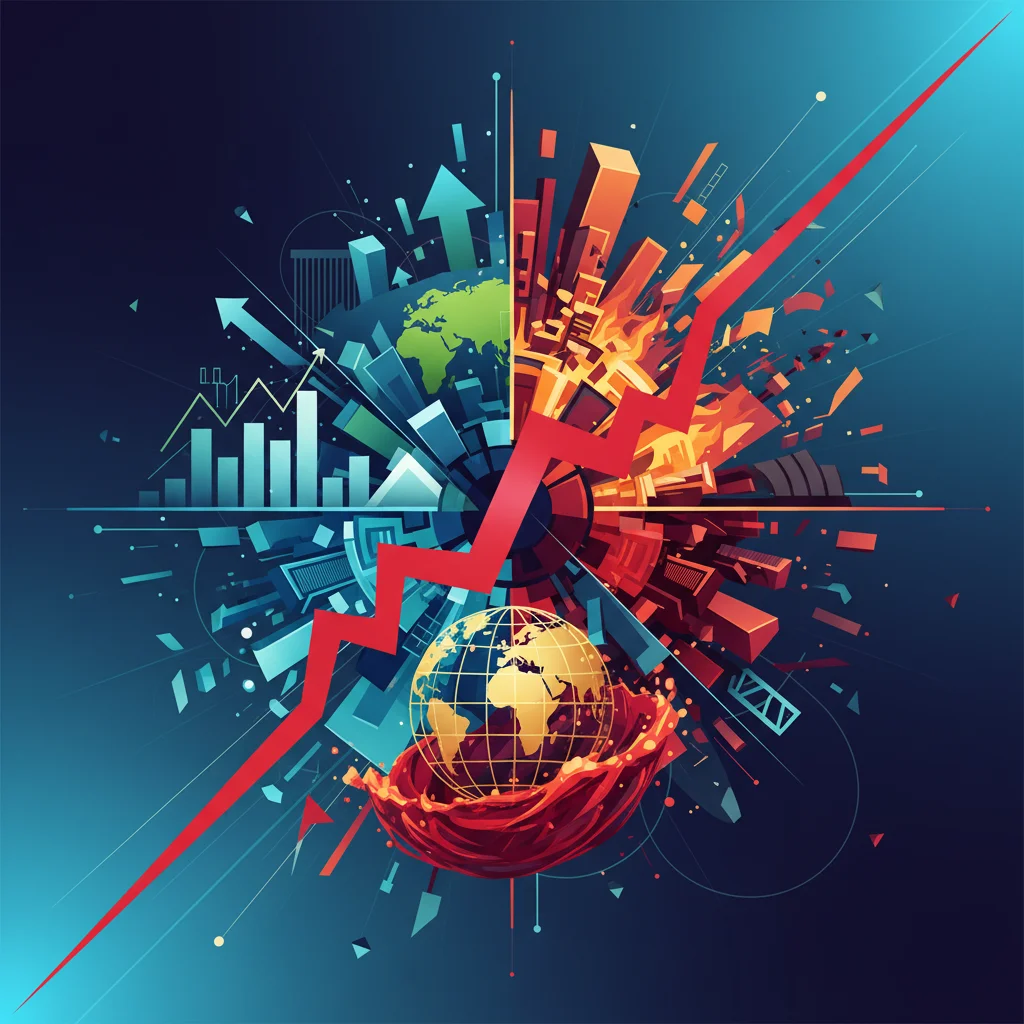
A Red Line Crossed: Why the 1.5°C Climate Breach is a Tipping Point for the Global Economy
A critical threshold is about to be crossed, one that financial markets have long been warned about but have yet to fully price in. It’s not a new inflation print or a central bank announcement, but a planetary boundary with profound implications for every facet of the global economy. For the first time in modern history, the world is on track to experience a three-year average temperature that exceeds the crucial 1.5°C warming limit set by the Paris Agreement. This isn’t a distant forecast; it’s a near-term reality projected for 2025.
Recent data serves as a stark alarm bell. November 2023 was a staggering 1.54°C warmer than the pre-industrial average, contributing to a year that is virtually certain to be the hottest on record. While a temporary breach of the 1.5°C mark has been anticipated, the confirmation that we are entering a multi-year period above this level signals a fundamental shift. It moves the climate crisis from a theoretical risk to a tangible, persistent drag on economic growth, a disruptor of supply chains, and a catalyst for a historic repricing of assets across the entire stock market.
For investors, business leaders, and finance professionals, this data point is far more than an environmental headline. It is a financial indicator of immense significance, heralding a new era of volatility and opportunity that demands immediate attention.
The Data Behind the Danger: Understanding the 1.5°C Threshold
The Paris Agreement, a landmark international accord, established 1.5°C as the target limit for global warming to avert the most catastrophic and irreversible impacts of climate change. Breaching this level, even temporarily, unleashes a higher frequency and intensity of extreme weather events—events that carry staggering economic costs. A sustained period above 1.5°C, as is now projected, signifies that these are no longer “black swan” events but a new, challenging baseline for the global economy.
The progression towards this reality has been rapid. The combination of ongoing greenhouse gas emissions and the cyclical El Niño weather pattern has accelerated warming, pushing 2023 into record territory and setting the stage for 2024 and 2025 to follow suit. According to the Financial Times, the data indicates that by 2025, the three-year average will officially surpass the 1.5°C mark (source).
To put the stakes into perspective, consider the difference in economic and physical impacts between a 1.5°C world and a 2.0°C world—a future that becomes increasingly likely with every year we spend above the initial threshold.
The following table illustrates the escalating severity of climate impacts, which translate directly into economic and financial risks:
| Impact Area | At 1.5°C Warming | At 2.0°C Warming |
|---|---|---|
| Extreme Heat Exposure | 14% of the global population exposed to severe heatwaves at least once every 5 years. | 37% of the global population exposed (nearly triple the risk). |
| Arctic Sea Ice | Ice-free summer once every 100 years. | Ice-free summer once every 10 years, disrupting global weather patterns. |
| Crop Yield Decline | Significant but manageable declines in key regions for maize, rice, and wheat. | Severe declines, threatening global food security and driving commodity price volatility. |
| Sea Level Rise Impact | An additional 10 million people exposed to risk by 2100. | Impacts accelerate significantly, threatening trillions in coastal real estate and infrastructure. |
This data is not abstract. Each percentage point represents billions in potential losses, millions of disrupted lives, and a fundamental challenge to the stability of our economic systems.
The China Paradox: Why Europe's Biggest Companies Are Doubling Down on a Risky Market
The Economic Contagion: How Climate Risk Permeates Finance
The breach of the 1.5°C threshold is the starting gun for a cascade of economic consequences that will ripple through every sector. This is no longer a conversation confined to ESG (Environmental, Social, and Governance) funds; it is a core topic for risk management, trading, banking, and macroeconomic policy.
1. Supply Chain Disruption and Corporate Earnings
Increased floods, droughts, wildfires, and storms directly sever critical links in global supply chains. A factory flooded in Southeast Asia, a drought reducing agricultural output in South America, or a wildfire disrupting logistics in North America—these events lead to production halts, increased transportation costs, and material shortages. For publicly traded companies, this translates directly to lower revenues, compressed margins, and downward revisions in earnings guidance, impacting the broader stock market.
2. The Repricing of Insurance and Banking Risk
The insurance industry is on the front lines, facing unprecedented payouts for natural disasters. As these events become more frequent, insurance premiums are skyrocketing in high-risk areas, and in some cases, coverage is being withdrawn entirely. This “insurance desertification” has a direct knock-on effect on the banking sector. A property that cannot be insured is a high-risk asset to hold on a mortgage book. As such, banks are being forced by regulators and market realities to integrate sophisticated climate risk models into their lending decisions, potentially creating credit crunches in vulnerable regions.
3. Volatility in Commodity Trading
The economics of agriculture, energy, and raw materials are inextricably linked to climate stability. Persistent droughts affect crop yields, impacting everything from food prices to the cost of biofuels. Water scarcity can halt mining and industrial operations. Unpredictable weather patterns affect renewable energy generation. This climate-induced volatility presents both immense risks and new opportunities for sophisticated commodity trading desks.
The New Investment Landscape: From Risk Mitigation to Alpha Generation
Where there is disruption, there is opportunity. The transition to a low-carbon, climate-resilient economy represents the most significant investment theme of our lifetime. Astute investors and businesses are looking beyond the risks to capitalize on the solutions.
1. The Green Technology Revolution
The imperative to decarbonize is fueling a massive wave of innovation and investing in areas like renewable energy, battery storage, green hydrogen, and carbon capture technologies. This isn’t just about environmentalism; it’s about pure economics. As these technologies scale, their costs are plummeting, making them increasingly competitive with fossil fuels. The growth potential in these sectors is astronomical, offering fertile ground for venture capital, private equity, and public market investors.
2. The Role of Financial Technology (Fintech) and Blockchain
The complexity of the climate challenge is a perfect catalyst for financial technology. Fintech platforms are emerging to facilitate the issuance and trading of green bonds, democratize investment in renewable energy projects, and provide more accurate climate risk analytics for portfolios. Furthermore, technologies like blockchain are finding a crucial use case in this new economy. Blockchain’s immutable ledger offers a transparent and trustworthy mechanism for tracking carbon credits, verifying the green credentials of supply chains, and preventing the “double counting” that has plagued voluntary carbon markets. This infusion of technology is making climate finance more efficient, transparent, and accessible. The scale of this transition requires robust financial infrastructure, and fintech is building it.
Beyond the Picket Line: A Financial Analysis of the UK Doctors' Strike and Its Economic Shockwaves
3. Investing in Resilience and Adaptation
Beyond mitigation, there is a multi-trillion-dollar market emerging around adaptation. This includes investing in climate-resilient infrastructure (sea walls, upgraded power grids), water-efficient agricultural technology, and advanced weather prediction and management systems. These are no longer niche sectors but are becoming essential components of a modern, functioning economy, creating durable, long-term investment opportunities.
A Paradigm Shift for the Global Economy
The implications of crossing the 1.5°C threshold extend to the highest levels of economic policy. Central banks, the traditional stewards of financial stability, are now awake to the threat. Institutions like the European Central Bank and the Bank of England are incorporating climate scenarios into their stress tests for the banking system. They recognize that climate change is a systemic risk capable of triggering a financial crisis.
This new reality will influence monetary policy, financial regulation, and national budgets for decades to come. Debates around carbon pricing, green subsidies, and border adjustment tariffs will intensify, creating a complex regulatory landscape that businesses and investors must navigate. The principles of economics are being rewritten to account for natural capital and climate externalities, a profound shift that will redefine value in the 21st century.
In conclusion, the news that we are set to breach the 1.5°C warming barrier for a sustained period is a watershed moment. It marks the point where climate risk graduates from a peripheral concern to a central driver of the global economy and financial markets. For investors and business leaders, the path forward requires a dual strategy: defensively positioning portfolios and operations against the escalating physical and transition risks, while offensively seeking the generational opportunities embedded in the climate transition. Ignoring this signal is no longer a viable option; it is a direct path to being on the wrong side of economic history.

Related Posts

Australia’s Trial by Fire: The New Economic Reality of Climate Risk
The Price of Green Power: Decoding the UK’s Record Offshore Wind Auction and Its Impact on Finance and the Economy