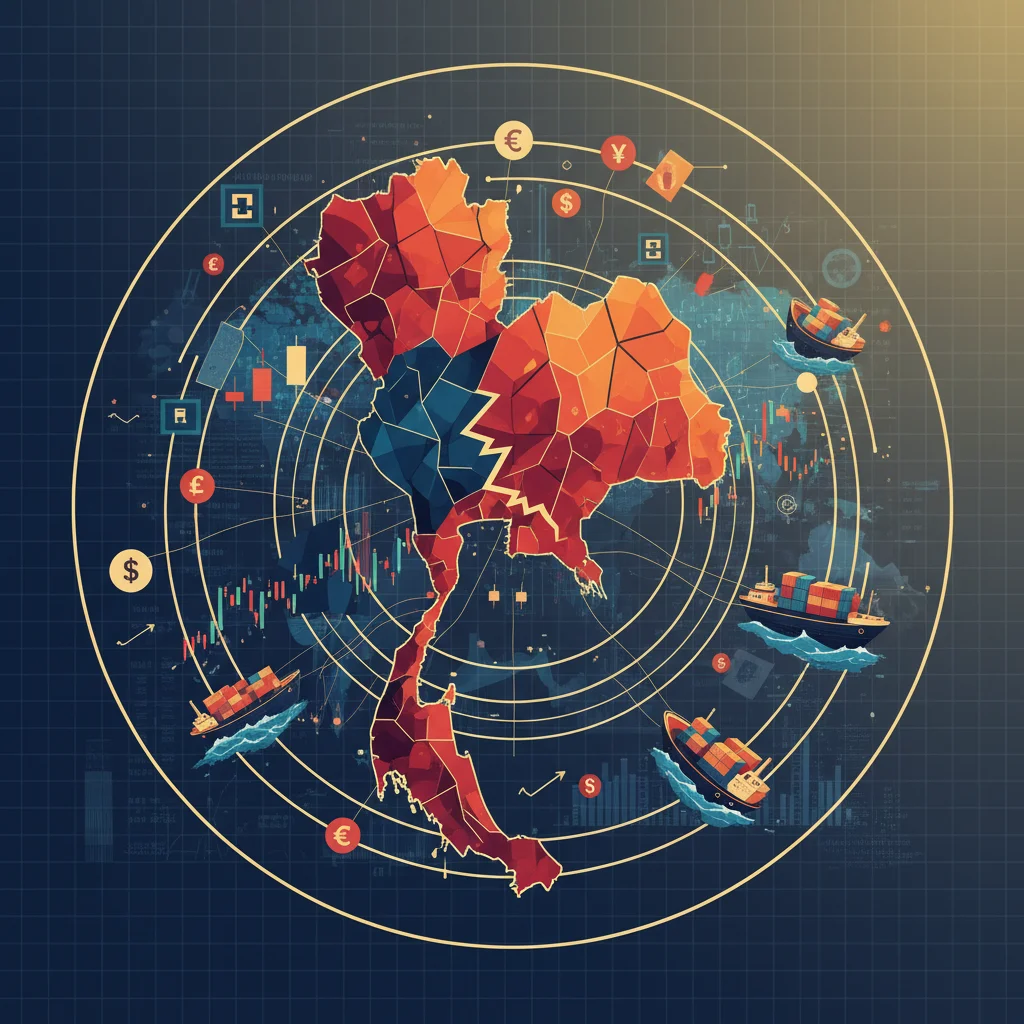
Geopolitical Tremors: Analyzing the Economic Fallout of the Thailand-Cambodia Border Clash
The Fragility of Peace: When Border Disputes Rattle Global Markets
In the world of high-stakes finance and global investing, it’s often the macroeconomic indicators, quarterly earnings reports, and central bank policies that dominate the headlines. Yet, sometimes, the most significant market-moving events don’t originate in a boardroom or a trading floor, but from the flash of artillery fire across a disputed border. The recent eruption of cross-border clashes between Thailand and Cambodia serves as a stark reminder of this reality. Following the collapse of a truce, what was a simmering, localized dispute has escalated, sending ripples far beyond the immediate conflict zone. According to reports, this outbreak follows a tense five-day conflict just months prior, signaling a dangerous breakdown in regional stability.
For the casual observer, this may seem like a distant problem. For the astute investor, finance professional, or business leader, it’s a critical case study in geopolitical risk. This isn’t just about territory; it’s about the intricate web of economics, trade, and investment that underpins the burgeoning growth story of Southeast Asia. How does a border skirmish impact the Thai stock market? What does it mean for supply chain finance reliant on cross-border trade? And how can modern financial technology help mitigate the fallout? This article delves into the profound economic consequences of the Thailand-Cambodia conflict, exploring its impact on everything from local economies to global investment strategies.
A Century of Contention: The Roots of the Conflict
To understand the financial implications, we must first grasp the historical context. This is not a new or random flare-up. The border between Thailand and Cambodia has been a source of tension for over a century, with the primary flashpoint being the 11th-century Preah Vihear temple. Perched on a clifftop, the temple was awarded to Cambodia by the International Court of Justice in 1962, but Thailand has continued to claim ownership of the surrounding land. This long-standing disagreement has led to periodic, and sometimes deadly, military confrontations, most notably a series of severe clashes in 2011.
These recurring conflicts create a persistent atmosphere of uncertainty, a factor that is poison to long-term investment and economic planning. Each skirmish forces a recalculation of risk, not just for the two nations involved, but for the entire ASEAN (Association of Southeast Asian Nations) bloc, which aims to present itself as a stable and integrated economic powerhouse. The recent collapse of the truce underscores the fragility of diplomatic solutions and the persistent threat of military escalation, forcing the market to price in a higher risk premium for the region.
Quantifying the Shock: The Immediate Economic Damage
The most immediate and visible impact of military conflict is on the local and national economies. For Thailand and Cambodia, whose economies are deeply intertwined through trade and tourism, the costs are multifaceted. Cross-border trade, which involves everything from agricultural products to manufactured components, grinds to a halt. This disruption immediately impacts logistics companies, importers, and exporters, creating a domino effect that ripples through the supply chain.
Furthermore, the tourism industry, a cornerstone of both economies, takes a significant hit. International travel advisories are updated, and tourist confidence plummets, leading to canceled bookings and a sharp drop in revenue that affects hotels, airlines, and local businesses. This is particularly damaging as both nations rely heavily on tourism dollars to support their currency and generate employment. The diversion of national budgets toward increased military spending also represents a significant opportunity cost, pulling funds away from crucial areas like infrastructure, education, and healthcare—the very things that drive long-term economic growth.
To better understand the economic landscape, let’s compare the two nations:
| Economic Indicator | Thailand | Cambodia |
|---|---|---|
| Nominal GDP (approx.) | ~$500 Billion (World Bank) | ~$30 Billion (World Bank) |
| Key Industries | Electronics, Automotive, Tourism, Agriculture | Garments, Tourism, Construction, Agriculture |
| Stock Market | Stock Exchange of Thailand (SET) | Cambodia Securities Exchange (CSX) |
| Role in ASEAN | Founding member, major economic hub | Member since 1999, developing economy |
Coupang's Data Breach: A Financial Tsunami Beyond the Headlines
The Investor’s Perspective: Navigating Geopolitical Risk in Trading
For the global investor, the Thailand-Cambodia conflict is a live-fire drill in managing geopolitical risk. The first and most obvious impact is on the Thai **stock market**. The SET Index often reacts negatively to news of border instability, as investors sell off shares in tourism-related companies, banks with cross-border exposure, and industrial firms reliant on regional supply chains. Currency **trading** also becomes more volatile, with the Thai Baht (THB) likely to weaken against major currencies like the US dollar as foreign capital seeks safer havens.
This is where sophisticated **economics** and financial modeling come into play. Investment firms and hedge funds use complex models to quantify country risk, adjusting their valuations and portfolio allocations accordingly. A conflict escalation means a higher country risk premium, which in turn means investors demand a higher potential return to compensate for the added uncertainty. This can depress asset prices and make it more expensive for Thai and Cambodian companies to raise capital on the international markets.
The key takeaway for anyone involved in **investing** in emerging markets is that geopolitical stability is not a given; it is a critical and dynamic variable that must be continuously monitored. Diversification, hedging strategies using derivatives, and a deep understanding of local political history are essential tools for any investor looking to navigate these turbulent waters.
Financial Technology’s Role: A Shield or a Target?
The intersection of this conflict with the world of modern **finance** and **financial technology** is particularly fascinating. On one hand, the **banking** sector is vulnerable. Banks with physical branches near the border face operational risks, while those facilitating cross-border trade finance face an increased risk of defaults and disruptions. The entire system of cross-border payments, essential for a modern **economy**, is threatened when diplomatic ties break down.
On the other hand, **fintech** could offer innovative solutions. Decentralized payment systems might prove more resilient than traditional banking infrastructure in a conflict. Insurtech platforms could develop new products specifically designed to cover geopolitical risks for supply chain businesses. There’s also a compelling, albeit futuristic, argument for the use of **blockchain** technology. Imagine a scenario where a disputed territory’s land registry is managed on a transparent, immutable blockchain, agreed upon by both nations and overseen by a neutral third party like ASEAN. This could remove a major source of contention by creating a single, undisputed source of truth. While not an immediate solution, it highlights how **financial technology** can be leveraged to build more robust and transparent systems that are less susceptible to political whims.
Beyond the Billable Hour: Why Top Firms Are Investing in Perks Over Paychecks
The Wider Implications for ASEAN and Global Supply Chains
No conflict happens in a vacuum. The clashes between Thailand and Cambodia are a direct challenge to the core mission of ASEAN, which is to promote regional peace and economic integration. The bloc’s credibility is on the line. Its ability (or inability) to mediate this dispute effectively will send a powerful signal to the rest of the world about its viability as a stable region for investment.
For international corporations, this is a supply chain nightmare. Southeast Asia has become the world’s factory, a critical node in the global manufacturing and logistics network. A conflict that disrupts the flow of goods through Thailand—a major logistics hub—can have knock-on effects that are felt in factories in China, warehouses in Europe, and retail stores in the United States. This forces companies to reconsider their supply chain strategies, potentially accelerating the trend towards diversification and near-shoring to mitigate their exposure to such regional instabilities.
The hidden costs of conflict are substantial and often underestimated, as illustrated below.
| Category of Cost | Description |
|---|---|
| Direct Costs | Military expenditure, rebuilding damaged infrastructure, humanitarian aid for displaced populations. |
| Indirect Economic Costs | Lost trade and investment, decline in tourism revenue, disruption to supply chains, increased insurance premiums. |
| Social & Political Costs | Erosion of diplomatic ties, rise in nationalism, long-term damage to investor confidence and regional reputation. |
Japan's Financial Earthquake: Why the BoJ's Next Move Could Shake Global Markets
Conclusion: From Battlefield to Balance Sheet
The recent clashes between Thailand and Cambodia are more than just a headline; they are a potent lesson in the interconnectedness of our modern world. They demonstrate, in sharp relief, how quickly geopolitical tensions can translate into tangible economic and financial consequences. For investors, it’s a call to look beyond the numbers on a screen and appreciate the profound impact of political stability on market performance. For business leaders, it’s a mandate to build more resilient supply chains and risk management strategies. And for policymakers, it’s a stark reminder that lasting peace is the ultimate foundation for economic prosperity.
As the situation unfolds, the global financial community will be watching closely. The path to de-escalation will not only determine the fate of the communities along the border but will also influence capital flows, shape investment strategies, and define the economic trajectory of Southeast Asia for years to come.

Related Posts
UK’s Fiscal Surprise: Decoding the December Dip in Government Borrowing and What It Means for Investors

UK’s Unexpected Fiscal Breather: Decoding the December Borrowing Drop and Its Impact on the Economy