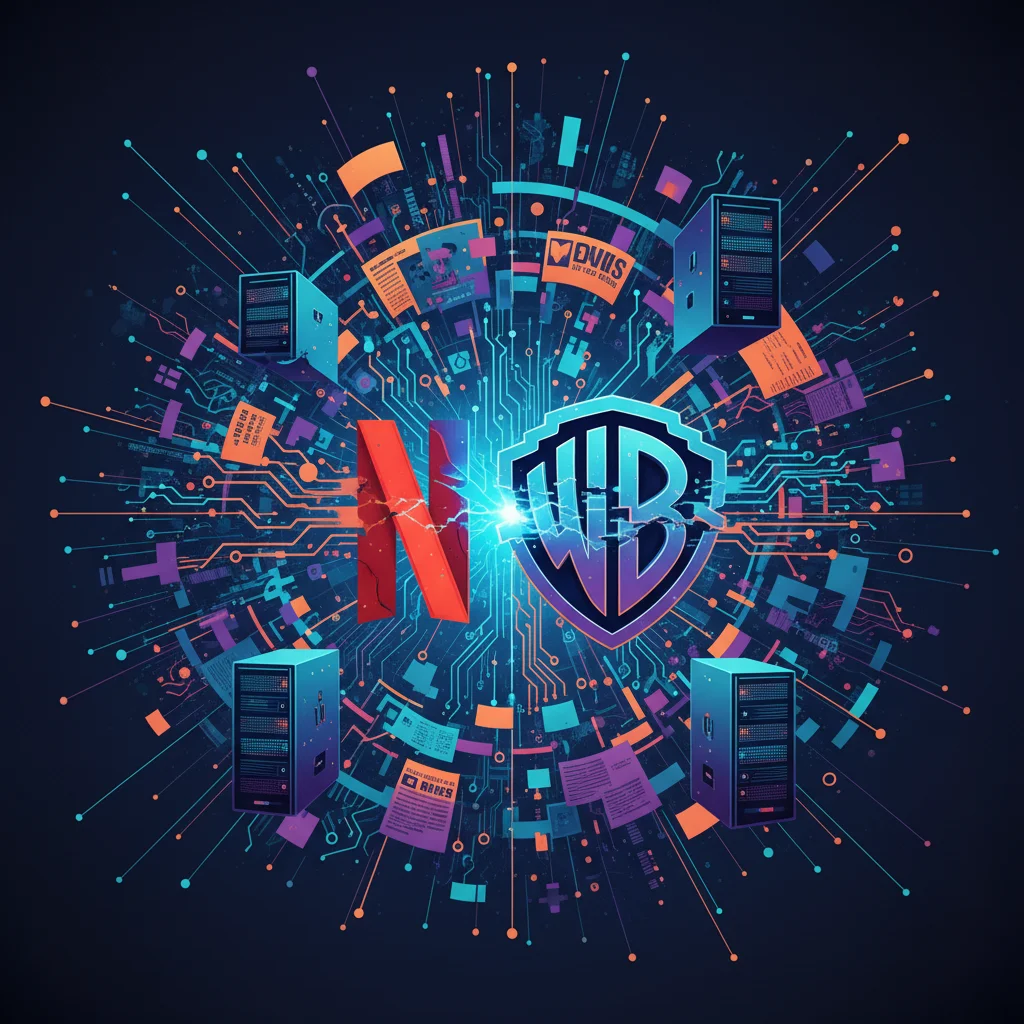
Beyond the Headlines: The Tech Revolution Behind a Potential $72B Netflix-Warner Bros. Merger
You may have seen the headlines. A potential, colossal $72 billion deal that could see Netflix acquire Warner Bros. Discovery has drawn attention from the highest levels, with figures like Donald Trump calling it something that “could be a problem.” On the surface, this is a story about media consolidation, content libraries, and the ever-escalating streaming wars. It’s about Batman and Stranger Things living under one digital roof.
But for those of us in the technology space—developers, entrepreneurs, and innovators—this is a different story entirely. This isn’t just about who owns which superhero franchise. It’s about the creation of a technology behemoth of unprecedented scale. It’s a story about cloud infrastructure, artificial intelligence, bespoke software, and the future of digital content delivery. A merger of this magnitude would create seismic shifts in how entertainment is built, distributed, and consumed, with massive implications for everything from SaaS platforms to cybersecurity protocols.
Let’s peel back the Hollywood veneer and look at the code, the data, and the algorithms. What would a Netflix-Warner Bros. entity actually look like from a technological standpoint? And more importantly, would it be a catalyst for innovation or a monopoly that stifles it?
The Scale of a Streaming Superpower
To grasp the technological implications, we first need to understand the sheer scale of what this merger would represent. This isn’t just adding one company’s catalog to another’s platform. It’s combining two giants with distinct audiences, massive global footprints, and complex technological backbones.
Netflix is the undisputed king of streaming, a company born from software and data-driven decisions. Warner Bros. Discovery, on the other hand, is a legacy media titan that has been aggressively navigating its digital transformation, bringing together iconic brands like HBO, Warner Bros. Pictures, CNN, and the Discovery Channel. A union would create a content library and user base that would dwarf every competitor.
Here’s a snapshot of what these two giants look like in the current landscape, based on recent industry data.
| Metric | Netflix | Warner Bros. Discovery (Max) | Combined Potential |
|---|---|---|---|
| Global Subscribers | ~270 Million (Q1 2024) | ~99.6 Million (Q1 2024) | ~370 Million+ |
| Key Content Franchises | Stranger Things, The Crown, Bridgerton, Squid Game | Game of Thrones, Harry Potter, DC Universe, Friends | An unparalleled library of iconic IP |
| Core Tech Stack | AWS-native, microservices, proprietary CDN (Open Connect) | Hybrid cloud, migrating legacy systems | A massive cloud integration challenge |
| Primary Innovation Focus | Recommendation AI, interactive content, global scaling | Live streaming (sports/news), consolidating platforms | Synergy of personalization and live content |
This combined entity wouldn’t just be the market leader; it would redefine the market itself. The technical challenge of merging these two ecosystems would be monumental, but the potential technological synergies are where the real story lies.
Merging Clouds: A Herculanean Engineering Feat
At the heart of any modern streaming service is its cloud infrastructure. Netflix is legendary in the tech world for going all-in on Amazon Web Services (AWS) over a decade ago, pioneering the use of microservices architecture to achieve massive global scale and resilience. Their entire platform is a complex web of independent services, a prime example of cloud-native software development that has been studied and emulated by countless startups.
Warner Bros. Discovery, with its legacy roots, has a more complex, hybrid infrastructure. Merging these two would be one of the most significant cloud migration and integration projects ever attempted. Engineers would face daunting challenges:
- Data Integration: Combining petabytes of user data, viewing histories, and content metadata from two entirely different systems without disrupting the user experience.
- Content Delivery Networks (CDNs): Netflix has its own powerful CDN, Open Connect, which places servers directly within ISP networks for faster streaming. Integrating Warner’s vast library into this system would be a massive logistical and engineering task, but could result in superior performance for all content.
– Architectural Philosophy: Would they try to migrate Warner’s assets onto Netflix’s microservices architecture, or maintain a hybrid model? This decision alone would impact thousands of developers and require years of programming effort.
The automation required to manage this combined infrastructure would be staggering. Teams would need to build sophisticated CI/CD pipelines and infrastructure-as-code scripts to handle a content library and user base of this magnitude, pushing the boundaries of what’s possible in cloud computing.
From Mouse to Mind: Logitech's Audacious Plan to Become the "Hands of AI"
The AI Engine: Supercharging Personalization with Unrivaled Data
If cloud is the skeleton, artificial intelligence is the brain. Netflix’s success is built on the back of its recommendation engine, a sophisticated machine learning system that analyzes viewing habits to personalize every aspect of the user experience, from the homepage layout to the artwork shown for a specific title.
Now, imagine feeding that proven AI engine with the rich, diverse, and beloved content library of Warner Bros. Discovery. The possibilities are transformative:
- Hyper-Personalization: The AI could draw connections between seemingly disparate content. Did a user just finish a gritty Netflix crime drama like Ozark? The system could seamlessly recommend HBO’s The Sopranos. Are they a fan of fantasy epics like The Witcher? It could immediately surface Game of Thrones or the Harry Potter films.
- Predictive Content Creation: With a dataset encompassing nearly 400 million subscribers and a century of content, the company could use predictive analytics to greenlight new projects with an unprecedented level of confidence. The AI could identify underserved niches, successful genre mashups, and emerging talent with stunning accuracy.
- AI-Powered Production: Beyond recommendations, AI could be integrated deeper into the production pipeline. This includes everything from using machine learning for more efficient visual effects rendering to automating parts of the editing and localization process, driving down costs and speeding up time-to-market.
A New Frontier for Cybersecurity
With great data comes great responsibility—and an enormous target. A combined Netflix-Warner Bros. would be one of the most valuable targets on the planet for cybercriminals. The cybersecurity challenges would be immense, requiring a defense-in-depth strategy that leverages cutting-edge technology.
The primary threats would include:
- Massive Data Breaches: Protecting the personal and payment information of over 370 million subscribers would be paramount. A breach of this scale would be catastrophic.
- Intellectual Property Theft: Securing pre-release content for blockbuster films and flagship series from leaks is a constant battle. A merged entity would need to secure a sprawling global production pipeline.
- Platform Disruption: Denial-of-service (DDoS) attacks or other disruptions aimed at taking the world’s largest streaming service offline would have a global impact.
Here again, AI and automation would be critical. Cybersecurity teams would rely on machine learning algorithms to detect anomalous behavior, automate threat responses, and predict potential vulnerabilities across their vast cloud infrastructure before they can be exploited.
The Ripple Effect: What Does This Mean for Startups and Developers?
A merger of this size doesn’t happen in a vacuum. It would send shockwaves through the entire tech ecosystem, creating both opportunities and challenges for startups and developers.
On one hand, a single, dominant player could stifle competition. A startup trying to build the next great video compression algorithm or a new SaaS platform for production management might find its potential customer base narrowed to one giant who prefers to build solutions in-house. It could create a “monopsony” effect, where there is effectively only one major buyer for specialized media tech.
On the other hand, the sheer complexity of a merged “Net-Warner” could create new niches. Startups specializing in multi-cloud management, data governance for massive datasets, or AI-driven compliance tools could find a valuable new client. The new entity might be forced to rely on external vendors and specialized software to manage its own internal complexity, creating opportunities for agile tech firms.
NHS Data for Sale? The AI Gold Rush and Your Health Records
Conclusion: An Innovation Catalyst or a Tech Monopoly?
The conversation around the potential $72 billion Netflix-Warner Bros. deal will likely continue to focus on market share, content, and antitrust concerns. But for the tech world, the real story is about the creation of a new kind of company—one with a technological scale and an AI-driven potential that we’ve never seen before in media.
This is more than a merger; it’s a monumental challenge in software engineering, cloud architecture, machine learning, and cybersecurity. Whether it ultimately becomes a catalyst for a new wave of media innovation or a cautionary tale of a monopoly that grew too big to innovate is the multi-billion dollar question. The answer will shape not just what we watch, but the very technology that delivers it to our screens.