The Biscuit Barometer: What a Trader’s Nervous Habit Reveals About Modern Finance
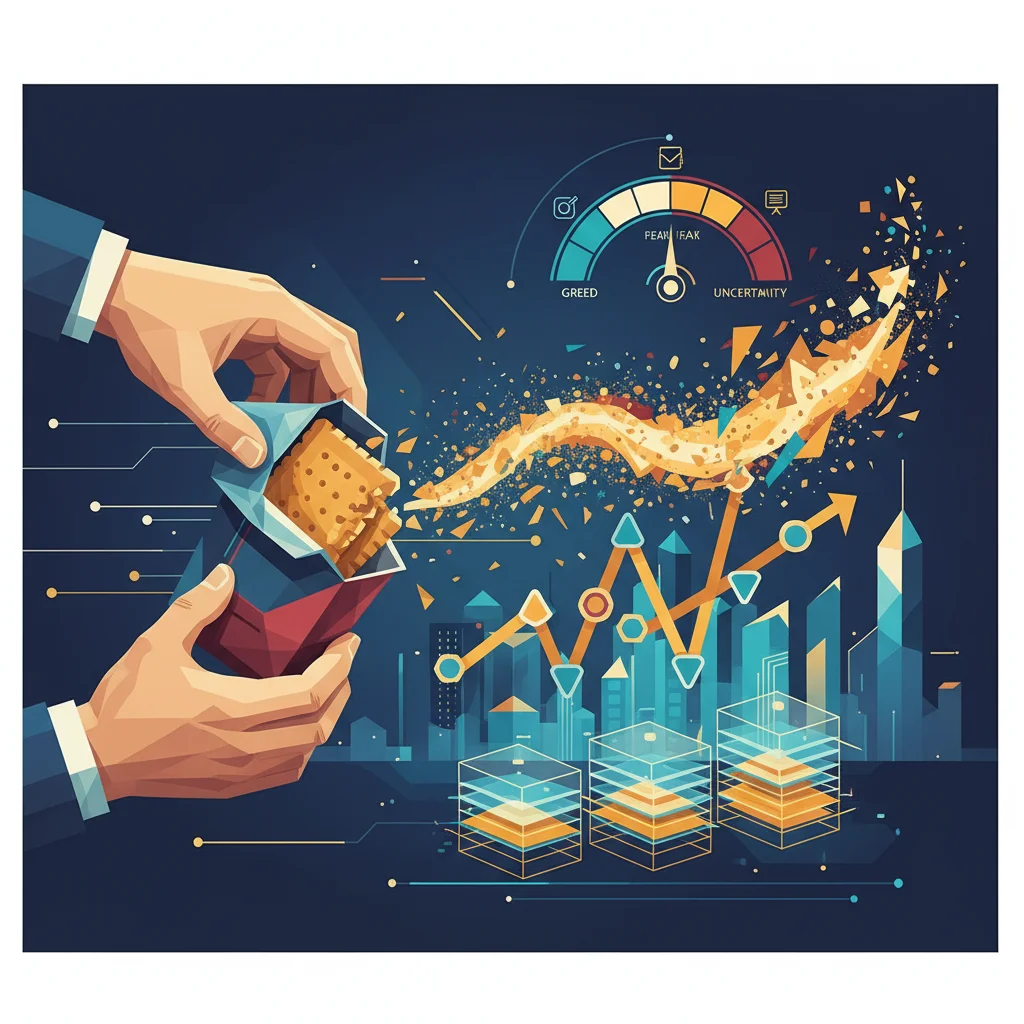
In a brief but wonderfully evocative letter to the Financial Times, a reader named Michael Contaldo reminisced about his time in the City of London. He described a senior trader who kept a packet of biscuits on his desk. On calm days, they remained untouched. But when the market turned volatile, the trader would nervously devour the entire packet. “I always knew when it was going to be a stressful day,” Mr. Contaldo wrote, “by the number of empty biscuit packets in his bin.”
This simple anecdote, the “biscuit barometer,” is more than just a charming memory from a bygone era of trading floors. It’s a powerful metaphor for the immense psychological pressure inherent in the world of finance. It serves as a perfect entry point to explore the timeless human element in investing, the evolution of risk management from gut-feel to big data, and the profound impact of financial technology on the modern economy.
While the tools have changed from telephone receivers and biscuit packets to fiber-optic cables and complex algorithms, the underlying human emotions—fear, greed, and anxiety—remain the bedrock of market dynamics. Let’s unwrap this story to understand what it teaches us about the past, present, and future of trading and investing.
The Psychology of the Trading Floor: More Than Just Numbers
The image of a trader stress-eating biscuits cuts to the core of a truth often overlooked in quantitative models and financial reports: markets are driven by people. The pressure on a trading floor, whether physical or virtual, is immense. Fortunes can be made or lost in seconds, and every decision is scrutinized. This high-stakes environment is a crucible for cognitive biases, the mental shortcuts and emotional responses that can lead to irrational financial decisions.
Behavioral economics, a field pioneered by psychologists like Daniel Kahneman and Amos Tversky, provides a framework for understanding these irrationalities. Key biases that the biscuit-eating trader was likely battling include:
- Loss Aversion: The principle that the pain of losing is psychologically about twice as powerful as the pleasure of gaining. A volatile market, filled with the potential for sudden losses, would naturally trigger a significant stress response.
– Herding: The tendency for individuals to follow the actions of a larger group, even if those actions are not rational. Seeing panic on the floor or a sea of red on the screens can create an overwhelming urge to sell, regardless of one’s own strategy.
– Confirmation Bias: The inclination to search for, interpret, and recall information in a way that confirms pre-existing beliefs. During a downturn, a trader might focus only on negative news, reinforcing their anxiety and potentially leading to poor decisions.
The trader’s nervous habit was a “tell”—an external manifestation of his internal psychological battle. It was a coping mechanism for the cognitive dissonance and emotional strain of navigating an unpredictable stock market. According to a study on the neurobiology of stress, acute stress can impair the kind of flexible, goal-directed decision-making that is crucial for successful investing, while promoting more rigid, habit-based behaviors (source). In this case, the habit was reaching for a biscuit.
The Investor's Lexicon: Decoding the Puzzles of the Modern Economy
From Biscuits to Big Data: The Evolution of Risk Management
Mr. Contaldo’s observation was, in its own way, a form of risk management. The number of empty biscuit packets was a qualitative indicator of market stress and potential portfolio risk. This intuitive, human-centric approach has been the cornerstone of banking and finance for centuries. A loan officer’s judgment of character or a trader’s “feel” for the market were once the primary tools for assessing risk.
Today, the landscape is radically different. The “biscuit barometer” has been replaced by sophisticated quantitative models and real-time data analytics. The rise of fintech has transformed risk management from an art into a science. Below is a comparison of these two worlds:
| Risk Indicator Type | The ‘Biscuit’ Era (Intuitive & Qualitative) | The Algorithmic Age (Quantitative & Real-Time) |
|---|---|---|
| Market Volatility | Raised voices, frantic activity on the trading floor, empty biscuit packets. | Real-time volatility indexes (e.g., VIX), standard deviation calculations, GARCH models. |
| Credit Risk | Personal relationships, reputation, “gut feeling” about a borrower. | Credit scores (FICO, VantageScore), machine learning models analyzing thousands of data points. |
| Operational Risk | Manual checks, dual-person controls, observing staff behavior for signs of stress or fraud. | Automated transaction monitoring, AI-powered fraud detection, cybersecurity threat analysis. |
| Liquidity Risk | Phone calls to other traders to gauge market depth, personal network. | Automated liquidity coverage ratio (LCR) reporting, real-time order book analysis. |
Modern financial institutions now employ armies of “quants” and data scientists to build models that can predict and mitigate risk with a precision unimaginable in the past. This data-driven approach has undeniably made the financial system more resilient in many ways, reducing reliance on the subjective (and often biased) judgment of individuals.
The New Trading Floor: Fintech, AI, and the Human Element
The world Mr. Contaldo described—a physical trading floor bustling with people—is largely a relic. Today, the majority of trades are executed electronically. A 2021 report estimated that algorithmic trading accounted for 60-73% of equity trading in the US. This technological revolution, broadly termed fintech, has fundamentally altered the mechanics of the market.
High-Frequency Trading (HFT) firms use powerful computers to execute millions of orders per second, capitalizing on minuscule price discrepancies. AI and machine learning algorithms now analyze news sentiment, economic data, and satellite imagery to predict market movements. The rise of blockchain technology promises to further revolutionize the industry by enabling near-instantaneous settlement of trades, reducing counterparty risk and operational overhead.
This shift has led many to question whether the human trader is becoming obsolete. Algorithms are faster, can process vastly more information, and are free from the emotional biases that lead to stress-eating biscuits. However, the human element has proven remarkably persistent.
Decoding the Market: How to Solve the Global Economy's Most Complex Puzzle
The 2010 “Flash Crash,” where the Dow Jones Industrial Average plunged nearly 1,000 points in minutes, was largely attributed to the interaction of automated trading algorithms running amok. It took human intervention to stabilize the market. This event highlighted a critical vulnerability: algorithms excel at operating within defined parameters, but they can lack the common sense and contextual understanding to handle novel or extreme situations. They can execute a strategy flawlessly but cannot question whether the strategy itself is still sound in a rapidly changing world.
Finding Your Own “Biscuit Barometer” in Modern Investing
So, what is the ultimate takeaway for today’s investors, business leaders, and finance professionals? The story of the biscuit-eating trader is not just a nostalgic anecdote; it’s a timeless lesson in self-awareness.
While you may not be on a trading floor, the same psychological pressures affect every investor. The 24/7 news cycle, the constant stream of market data on your phone, and the social media chatter all create a digital equivalent of the noisy, high-stress trading pit. Your “biscuit” might be compulsively checking your portfolio, making rash decisions after reading a headline, or chasing a hot stock based on a friend’s tip.
The key to successful long-term investing is to recognize your own emotional triggers. Understanding your personal “biscuit barometer” is the first step toward building the discipline needed to stick to a well-thought-out financial plan, even when markets are volatile.
The future of finance will undoubtedly involve even greater integration of technology. AI will become a more powerful partner, and blockchain may rebuild the industry’s plumbing. But the final decisions—the strategic allocation of capital, the long-term vision, and the management of firm-wide risk—will still require human wisdom. The most successful financial systems of the future will likely be “centaur” models, combining the computational power of machines with the contextual insight and ethical oversight of humans.
In the end, the markets will always be a reflection of human psychology. And as long as that’s true, there will always be a need to watch for the metaphorical empty biscuit packets in the bin—both in the market and within ourselves.
Market Tremors: Decoding the Financial Fallout of the New US Immigration Policy