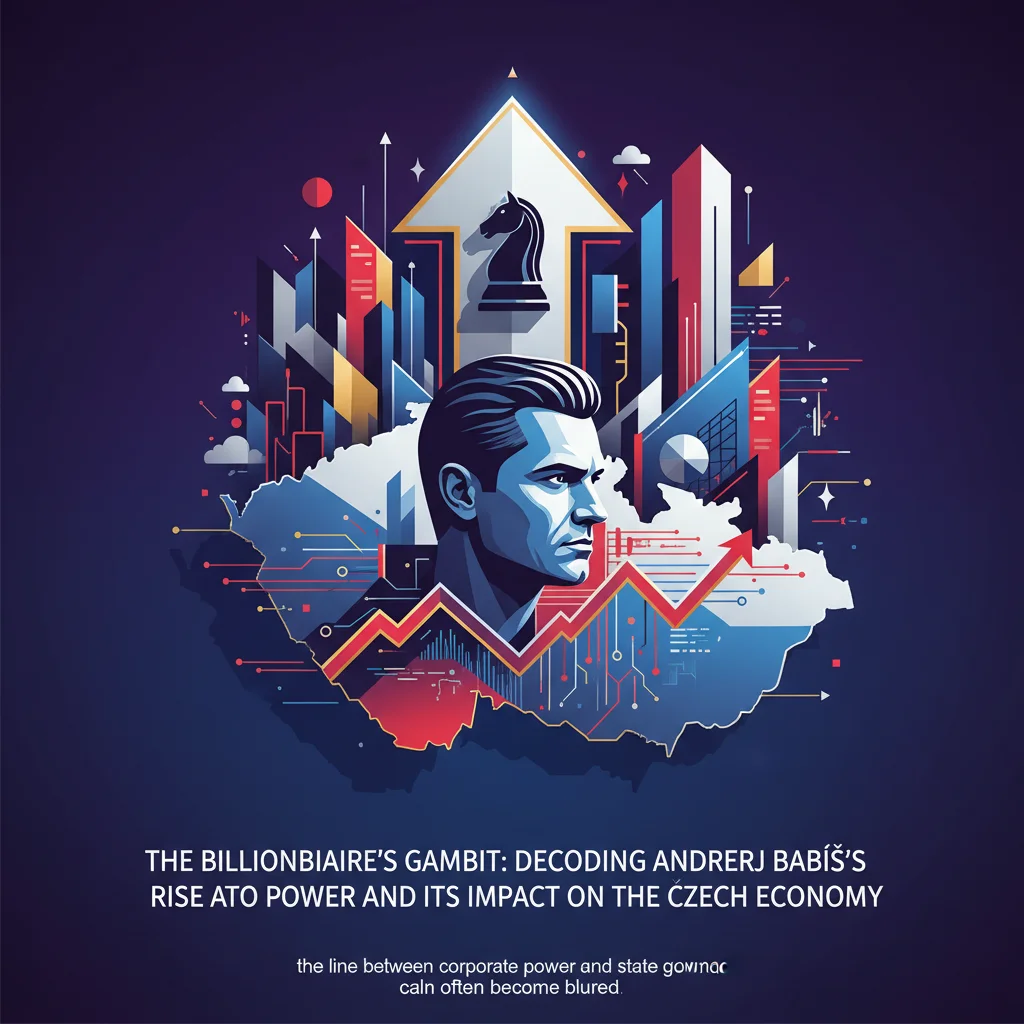
The Billionaire’s Gambit: Decoding Andrej Babiš’s Rise to Power and Its Impact on the Czech Economy
The Intersection of Power, Politics, and Unprecedented Wealth
In the high-stakes world of international politics and finance, the line between corporate power and state governance can often become blurred. Few cases illustrate this complex dynamic as vividly as the political ascent of Andrej Babiš, the billionaire founder of the Agrofert conglomerate, to the position of Czech Prime Minister. His journey to the top was paved with immense business success but shadowed by persistent accusations of conflicts of interest. The pivotal moment came when, in a move designed to quell a political firestorm, Babiš ceded control of his vast business empire. According to the Czech President at the time, this act was the final key, unlocking his appointment to the nation’s highest office.
This single event is more than just a political maneuver; it is a profound case study for investors, business leaders, and students of economics. It forces us to ask critical questions: Can a business magnate truly separate their corporate interests from their public duties? What does such a transition mean for a nation’s economy, its stock market, and its attractiveness to foreign investment? This article delves into the intricate web of finance, politics, and corporate governance surrounding Andrej Babiš, analyzing the mechanisms of his power transfer and the lasting implications for the Czech Republic’s financial landscape.
Who is Andrej Babiš? The Rise of a Tycoon
To understand the controversy, one must first understand the man at its center. Andrej Babiš is not a traditional politician. His career began in the waning days of communist Czechoslovakia, where he worked in foreign trade. After the Velvet Revolution of 1989, he leveraged his connections and business acumen to found Agrofert in 1993. Initially a small trading company, Agrofert grew at an astonishing rate, acquiring and consolidating assets across the agricultural, chemical, and food processing sectors.
By the 2010s, Babiš had become one of the wealthiest individuals in Central Europe, and Agrofert had transformed into a sprawling conglomerate deeply embedded in the Czech economy. His narrative of being a self-made man who could run the state as efficiently as he ran his business resonated with a significant portion of the electorate tired of traditional politics. In 2011, he founded his political movement, ANO (which translates to “YES” and is also an acronym for Action of Dissatisfied Citizens), positioning himself as an anti-establishment populist. This populist appeal, combined with his immense personal wealth and media ownership, propelled him into the heart of Czech politics, first as Finance Minister and eventually to the premiership.
Agrofert: An Empire Woven into the National Economy
It is impossible to overstate the significance of Agrofert to the Czech economy. It is not merely a large company; it is a systemic force. With hundreds of subsidiary companies, its influence extends from the farms that grow the crops to the bakeries that sell the bread, the chemical plants that produce fertilizer, and the media outlets that report the news. This deep integration presents a unique challenge when its founder holds the reins of national government.
For investors and financial analysts, the scale of Agrofert is a critical factor in assessing the Czech market. While not publicly traded on the stock market, its performance and strategic decisions have ripple effects across multiple sectors, influencing commodity prices, employment rates, and the competitive landscape for smaller businesses. The following table provides a snapshot of the conglomerate’s vast reach:
| Sector | Description of Agrofert’s Involvement | Economic Impact |
|---|---|---|
| Agriculture | One of the largest farming and agricultural trading companies in the country. Major producer of grains, oilseeds, and other crops. | Significant influence on agricultural policy, land use, and EU subsidy distribution. |
| Chemicals | Dominant producer of fertilizers, fuels, and other chemical products through subsidiaries like DEZA and Precheza. | Key player in the national industrial and energy sectors, affecting input costs for other industries. |
| Food Processing | Vast network of companies involved in meat processing, dairy, and baked goods. Owns some of the country’s most popular food brands. | Impacts consumer prices, food safety regulations, and the entire food supply chain. |
| Media | Ownership of major newspapers (e.g., MF Dnes, Lidové noviny), websites, and a radio station. | Raises concerns about media independence and the ability to shape public discourse. |
This level of integration created what critics called an “untenable” conflict of interest. As Prime Minister, Babiš would be in a position to influence legislation, public tenders, and, most critically, the allocation of billions of euros in European Union subsidies—funds from which his companies were major beneficiaries. This concern was not merely theoretical; it became the subject of investigations by both Czech authorities and the European Commission (source).
The UK Budget's Double-Edged Sword: A Deep Dive into Winners, Losers, and the Economic Fallout
The Trust Fund “Solution”: A Financial Veil?
Faced with mounting pressure and a new conflict-of-interest law, Babiš opted for a solution common in the world of high-finance: he transferred his ownership of Agrofert and his other businesses into two trust funds. On paper, this move severed his direct control. The day-to-day management was handed over to a board of trustees, and Babiš was no longer the legal owner. This was the specific action that the Czech President cited as resolving the conflict, paving the way for his appointment (as reported by the Financial Times).
However, critics and corporate governance experts were quick to point out that this was far from a “blind trust.” In a true blind trust, the beneficiary has no knowledge of how the assets are managed and no communication with the trustees. In Babiš’s case, the structure was more transparent. The trustees included his long-term associates, and his wife was reportedly named as a beneficiary. This arrangement led to accusations that the trusts were merely a legal facade, designed to comply with the letter of the law while violating its spirit. The ultimate beneficial owner, in essence, remained connected to the empire he had built, even if he wasn’t signing the checks himself.
From a financial technology perspective, the use of complex legal and financial instruments like trusts to manage assets for politically exposed persons (PEPs) is a major area of focus in the fintech and banking compliance world. The goal of anti-money laundering (AML) and know-your-customer (KYC) regulations is to ensure transparency, but sophisticated structures can often obscure the ultimate lines of control and influence, posing a continuous challenge for the financial system.
Implications for Investors and the Czech Economy
The saga of Babiš and Agrofert carries significant lessons for anyone investing in or doing business with the Czech Republic and the wider Central European region. The situation touches upon several key pillars of a healthy investment climate:
- Corporate Governance and Rule of Law: The perception that the highest political office is occupied by someone with a vested interest in a specific corporate entity can erode confidence in the fairness of the market. Investors prize predictability and a level playing field. When it appears that one company has a direct line to the Prime Minister, it raises concerns about fair competition, impartial regulation, and the sanctity of contracts.
- Political Risk: This episode undeniably increased the political risk profile of the Czech Republic. The ongoing battles between Babiš’s government, opposition parties, and EU institutions over subsidy payments and conflicts of interest created a climate of uncertainty. For those involved in the stock market or direct investment, political stability is a primary driver of confidence. Prolonged uncertainty can lead to capital flight and a higher risk premium on Czech assets.
- EU Relations and the Banking Sector: The conflict put the Czech Republic on a collision course with Brussels. The potential withholding of EU funds is a major macroeconomic risk, as these funds are crucial for infrastructure development and economic convergence. The national banking sector must also navigate this complex environment, ensuring compliance with both national law and EU directives, especially concerning payments to entities under scrutiny.
While some might argue that having a “business-minded” leader is good for the economy, the potential for cronyism and a distorted market can do more long-term damage than any short-term, efficiency-driven gains. The principles of economics suggest that open, fair competition is the most sustainable driver of innovation and growth.
The New UK Mansion Tax: A Deep Dive for Investors and Homeowners
A Global Phenomenon: The Tycoon-Turned-Politician
The Babiš case is not an isolated incident. It is part of a broader global trend of billionaire populists leveraging their business success and anti-establishment rhetoric to gain political power. From Silvio Berlusconi in Italy to Donald Trump in the United States, this archetype has become a defining feature of 21st-century politics. These leaders often present their business acumen as the primary qualification for running a country, promising to cut through bureaucratic red tape and deliver results.
However, the challenge remains the same in every case: the entanglement of personal financial interests with public duty. The complex global trading networks and sophisticated financial instruments available today make separating these two spheres more difficult than ever. The rise of decentralized finance and blockchain technologies could, in the future, offer new models for transparency, but they could equally be used to create even more opaque ownership structures.
Asahi's Bitter Aftertaste: How a Single Cyber-Attack Exposes a Multi-Trillion Dollar Economic Threat
Conclusion: A Lingering Question for Modern Democracies
The story of Andrej Babiš’s transfer of his business to secure the premiership is a compelling chapter in the ongoing dialogue about the relationship between wealth and power. It demonstrates that legal solutions, like the creation of trust funds, may not be sufficient to resolve the fundamental ethical and economic conflicts at play. For the Czech Republic, the long-term effects on its democratic institutions and economic competitiveness are still being assessed.
For the global investor, the finance professional, and the business leader, this case serves as a critical reminder. When evaluating a market, it is essential to look beyond the top-line economic indicators. One must scrutinize the quality of governance, the rule of law, and the intricate connections between the political and corporate elite. In an increasingly complex global economy, understanding these dynamics is no longer just good practice—it is essential for successful and sustainable investing.

Related Posts
Cracks in Confidence: How a Nuclear Scandal Shakes Japan’s Economy and Investor Trust
The Politicization of the Portfolio: How State Interference Puts US Companies and Investors at Risk