Human OS 2.0: How Synthetic Genomes Are Rewriting the Code of Life
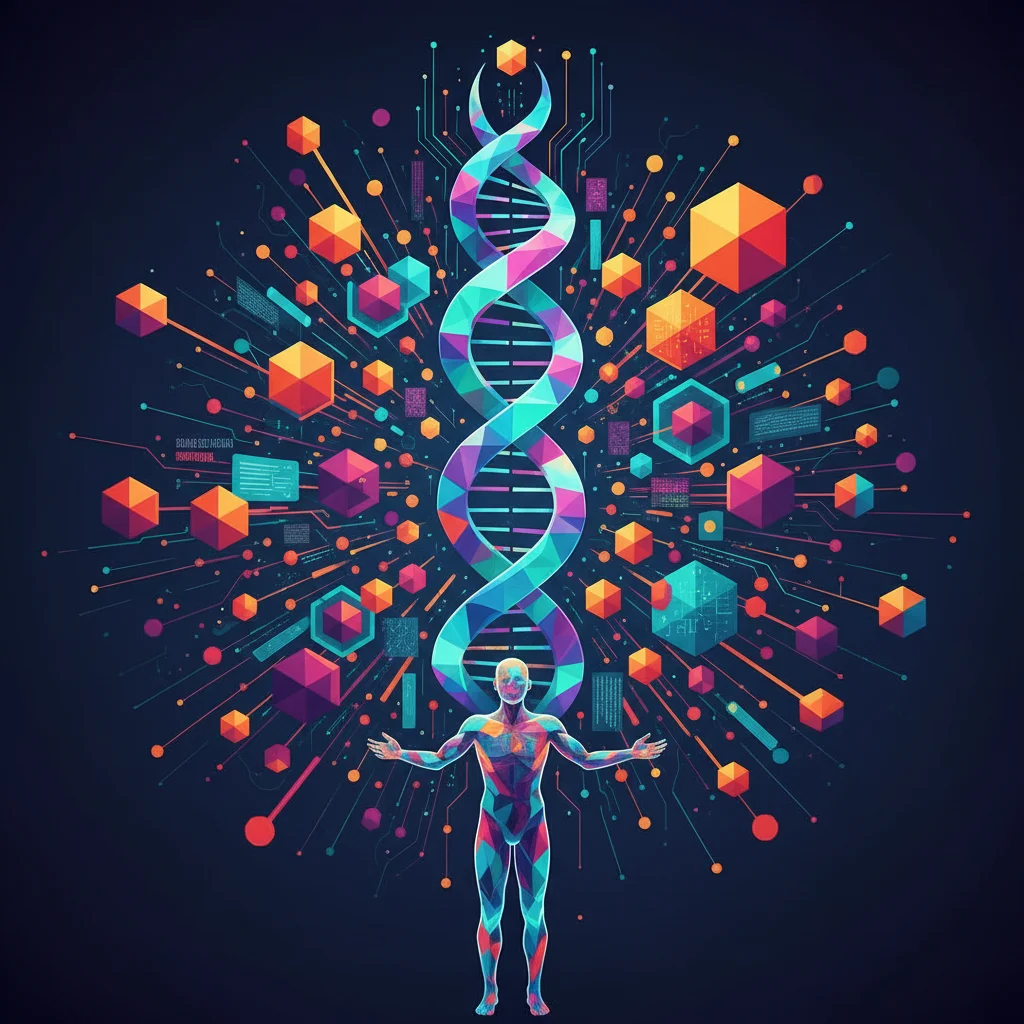
Imagine your body’s operating system. Like the software running your phone or laptop, your DNA is the source code that dictates every function, from how you process energy to how you fight off a common cold. For decades, we’ve been learning to read this code. Now, we’re on the cusp of learning to write it. A groundbreaking development in synthetic biology is moving us from being mere users of our biological hardware to becoming its developers.
Recent research, highlighted in a report by the Financial Times, reveals that scientists have successfully designed, built, and transferred a synthetic chromosome into human cells. This isn’t just a minor tweak or a simple gene edit; it’s the equivalent of installing a powerful new software module directly into our cellular machinery. For anyone in the world of tech—from developers and entrepreneurs to AI specialists—this should sound incredibly familiar. We are witnessing the birth of programmable biology, and it’s poised to become the most profound innovation of our lifetime.
This isn’t science fiction. This is the next frontier of programming, and it has massive implications for everything from medicine and materials science to cybersecurity and the very definition of what it means to be human.
What Exactly is a “Synthetic” Chromosome?
Before we dive into the implications, let’s establish a baseline. Think of your genome as a massive library. This library contains 23 pairs of books, and these books are your chromosomes. Each book is filled with sentences (genes) written in a four-letter alphabet (A, T, C, G). This genetic code is the blueprint for you.
For years, scientists have used tools like CRISPR to act as a “find and replace” function, editing a few words here and there. Synthetic genomics is a completely different paradigm. Instead of editing the existing book, scientists are writing an entirely new one from scratch and adding it to the library.
In this landmark project, an international team of researchers, part of the Genome Project-write consortium, constructed a brand-new chromosome containing 925,000 base pairs—the letters in our genetic alphabet. They then successfully integrated it into human cells, where it coexisted and functioned alongside the natural chromosomes. This is the biological equivalent of running a custom-built application on a standard operating system, a feat that opens up a universe of possibilities.
Biology’s First “Hello, World!” with a Cybersecurity Twist
The first major application being tested with this technology is nothing short of a biological firewall. The primary goal of the research, led by Jef Boeke at NYU Langone Health, is to create human cells that are completely resistant to viral infections. How? By recoding the genome in a way that makes it unreadable to viruses.
Viruses are nature’s ultimate hackers. They inject their own malicious code into our cells and hijack the machinery to replicate. The synthetic chromosome project aims to change the very “language” that parts of our cells speak. If a virus tries to execute its code in a cell with this new synthetic hardware, it simply won’t compile. The cell won’t understand the instructions, and the infection will be stopped in its tracks.
This is a revolutionary approach to cybersecurity on a biological level. Instead of relying on external “antivirus” software (vaccines and antiviral drugs), we could build resistance directly into the cellular “hardware.” Furthermore, the scientists have engineered a “kill switch” into these synthetic chromosomes. If the cells start behaving unexpectedly, they can be programmed to self-destruct, a crucial safety feature reminiscent of the robust error-handling and fail-safes required in critical software systems.
The Billion-Dollar Pivot: How Synthesia Traded Hollywood Dreams for a SaaS Empire
The Tech Stack for Programming Life
The convergence of biology and technology isn’t just an analogy; it’s a practical reality. The tools and concepts driving the digital revolution are the very same ones enabling this biological one.
- Artificial Intelligence (AI) and Machine Learning: Designing a functional chromosome with nearly a million base pairs is not something you can do on a whiteboard. It’s a colossal optimization problem. AI algorithms are essential for predicting how different gene combinations will behave, identifying potential conflicts, and designing stable genetic circuits. Machine learning models can be trained on vast genomic datasets to accelerate the design process from years to weeks.
- Automation and Cloud Computing: The physical process of synthesizing long strands of DNA is meticulous and labor-intensive. Companies are already building “bio-foundries” that use robotics and advanced automation to print DNA sequences designed in the cloud. A researcher could soon design a genetic sequence using a SaaS platform and have it synthesized and tested by an automated lab on the other side of the world.
- Programming and Software Development: Genetic engineers are starting to think like software developers. They are creating libraries of standardized genetic “parts” (promoters, terminators, etc.) that can be assembled into complex programs. This modular approach to programming life is what will allow the field to scale, enabling the creation of ever more complex biological functions.
This new ecosystem is a massive opportunity for startups. The intersection of biotech, AI, and automation is creating a fertile ground for innovation, promising to disrupt healthcare, manufacturing, and even data storage.
The £1 Website Hack: What the UK Budget Leak Teaches Startups About Cybersecurity
The Roadmap: Potential Applications and Hurdles
The potential applications are staggering, but the path to realizing them is long and fraught with challenges. Here’s a look at what the future could hold, balanced with a dose of reality.
| Application Area | Potential Breakthrough | Key Challenges & Considerations |
|---|---|---|
| Medicine & Healthcare | Curing genetic diseases (e.g., Cystic Fibrosis, Huntington’s) by replacing faulty chromosomes. Engineering immune cells to be hyper-effective cancer killers. | Extremely high safety and efficacy standards. Unintended off-target effects. Ethical concerns about germline editing (heritable changes). |
| Viral Resistance | Creating humans (or livestock) completely immune to all known viruses, as demonstrated by the current research. Ending pandemics before they start. | Viruses can evolve. Long-term stability and a biological “arms race.” High cost and accessibility issues. |
| Longevity & Aging | Designing cells with enhanced DNA repair mechanisms and resistance to the cellular decay associated with aging. | Aging is an incredibly complex multi-system process. Risk of inducing cancer by overriding natural cell death cycles. Deep societal and ethical implications. |
| Bio-Manufacturing | Programming yeast or bacteria to produce complex pharmaceuticals, sustainable biofuels, or even novel materials like self-healing concrete. | Scaling production from the lab to industrial levels. Ensuring the stability of engineered organisms. Containing them in the environment. |
The Ultimate Ethical Firewall
With great power comes an even greater need for caution. The ability to rewrite the human genome is arguably the most powerful technology humanity has ever developed, and it raises profound ethical questions that we must address with the same rigor we apply to the science itself.
The concerns are numerous:
- Unintended Consequences: The genome is an unfathomably complex, interconnected system. A change intended to provide viral resistance could have unforeseen negative effects on other cellular functions decades later.
- Equity and Access: Will these revolutionary therapies be available only to the ultra-wealthy, creating a genetic divide between the “enhanced” and the “naturals”?
- Dual-Use: The same technology that can create a virus-resistant cell could, in the wrong hands, be used to create a more resilient bioweapon. This makes “bio-security” a critical component of national and global cybersecurity strategies.
- The “Playing God” Debate: Where do we draw the line? Curing disease is one thing, but what about enhancement? Should we engineer humans to be stronger, smarter, or different in other ways?
Just as the software world developed ethics around data privacy and AI bias, the synthetic biology community must build a robust framework for responsible innovation. Open-source collaboration, transparent peer review, and public discourse are not optional—they are essential safety features for this journey.
India's Fintech Tsunami: Why Pine Labs' Chief Says It's Already Beaten China
The Code is Compiling
The successful creation and integration of a synthetic human chromosome is not the end of the story; it’s the beginning of a new one. We are transitioning from being passive inheritors of our genetic code to its active architects. The line between digital code and genetic code is blurring, and the implications will reshape our world.
For the tech community, this is a call to action. The skills used to build complex software, design intelligent algorithms, and ensure digital security are now directly applicable to the operating system of life itself. The question is no longer if we can rewrite the code of life, but how we will choose to do it. The source code is open, the compiler is running, and we are all developers now.