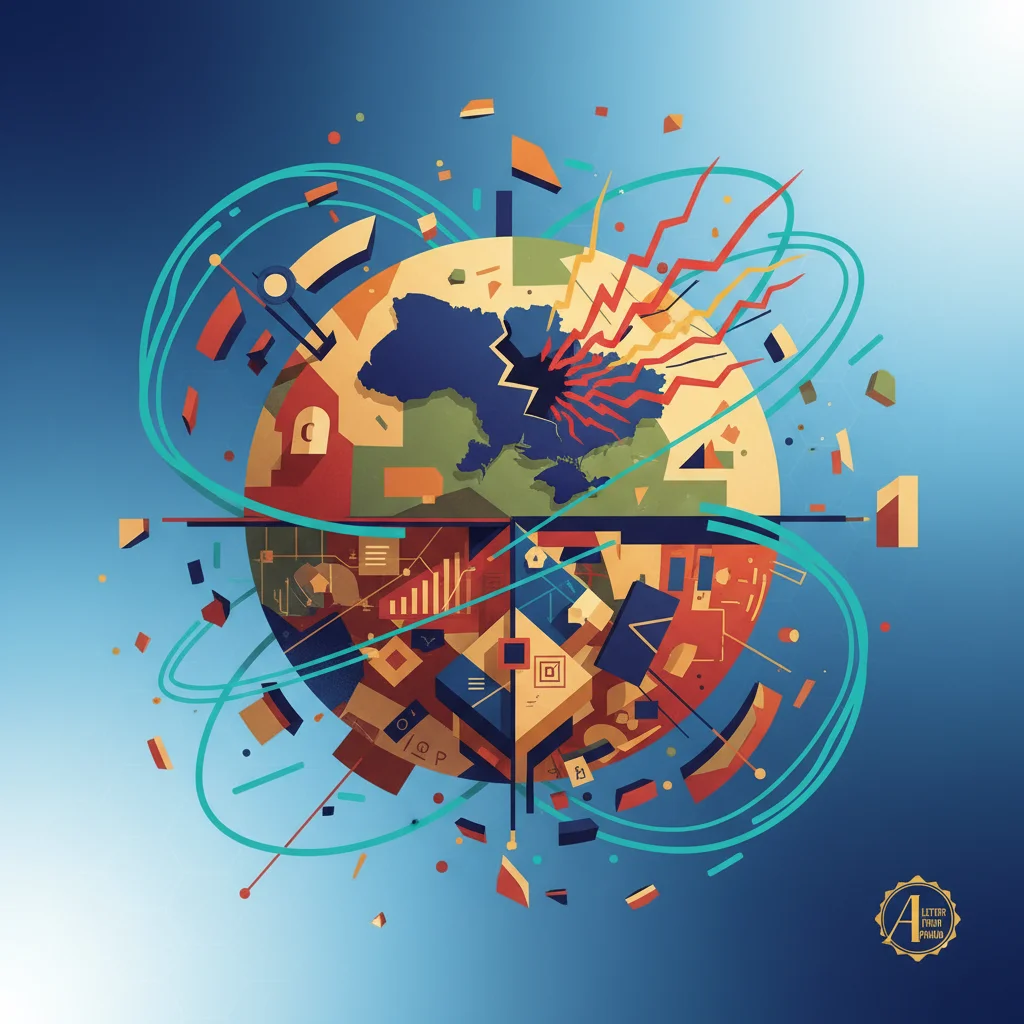
The World is Not Flat: A Global South Perspective on the Ukraine Conflict and Its Economic Shockwaves
Introduction: A Letter from Punjab and a World of Difference
In the fast-paced world of global finance, it’s easy to view major geopolitical events through a singular, often Western-centric, lens. We analyze market data, track capital flows, and model economic outcomes based on assumptions forged in New York, London, and Tokyo. But what if that lens is providing an incomplete picture? A recent letter to the Financial Times from Chander Shekhar Dogra in Punjab, India, serves as a powerful reminder that the world is not economically or philosophically flat. The letter argues that for many in the Global South, the Ukraine conflict is perceived not as a simple battle of good versus evil, but as a “European problem,” viewed with a sense of historical skepticism and pragmatic self-interest.
This perspective, far from being an isolated opinion, represents a seismic shift in global dynamics that investors, business leaders, and finance professionals can no longer afford to ignore. It signals the acceleration of a multipolar world where economic alliances are fluid and national interests often trump ideological alignment. This post will delve into the “Punjab standpoint,” not to debate its political merits, but to dissect its profound implications for the global economy, international investing, and the future of financial technology.
Deconstructing the “Punjab Standpoint”: History, Hypocrisy, and Hard Economics
The core of the perspective from Punjab, and by extension, large parts of the Global South, is rooted in two key areas: historical context and economic reality.
Firstly, there’s the charge of hypocrisy. The letter alludes to a long history of Western interventions and colonial legacies that are still fresh in the collective memory of many nations. When Western powers call for a unified stand on the principle of national sovereignty, many in Asia, Africa, and Latin America recall instances where that same principle was seemingly overlooked when their own interests were at stake. This historical baggage creates a deep-seated reluctance to be drawn into what is perceived as another chapter in a long history of great power politics.
Secondly, and more critically for our audience, is the unwavering focus on economics. For a developing nation like India, with a population of over 1.4 billion, the primary objectives are poverty alleviation, economic growth, and energy security. The Western-led sanctions against Russia, while intended to cripple Moscow’s war machine, have had significant collateral effects, driving up global energy and food prices. According to a World Bank report, the war has led to major shocks in commodity markets, altering global patterns of trade, production, and consumption in ways that will keep prices at historically high levels through the end of 2024.
In this environment, the opportunity to purchase Russian crude oil at a significant discount is not an ideological betrayal but a strategic economic imperative. It helps curb domestic inflation, powers industrial growth, and ensures stability. This pragmatic approach highlights a fundamental divergence in priorities that is reshaping global trade.
Navigating the Upside Down: Investment Lessons from Stranger Things' Final Season
The Great Trade Realignment: Following the Money and the Oil
The most tangible consequence of this geopolitical rift has been a dramatic rerouting of global supply chains, particularly in the energy sector. As Europe has worked to wean itself off Russian energy, Moscow has successfully pivoted its exports eastward to India and China. This isn’t just a temporary shift; it’s the creation of new, resilient economic corridors that are likely to persist.
The data clearly illustrates this massive logistical and financial realignment. Let’s look at the change in Russia’s seaborne crude oil destinations.
| Destination Region | Share of Exports (January 2022) | Share of Exports (January 2023) | Change |
|---|---|---|---|
| Europe (EU & UK) | ~60% | <10% | Drastic Decrease |
| India | ~1% | ~33% | Massive Increase |
| China | ~20% | ~25% | Significant Increase |
Source: Data synthesized from reports by agencies like the International Energy Agency (IEA) and various financial news outlets. Percentages are approximate to show the trend.
This table demonstrates more than just barrels of oil changing direction. It represents a fundamental challenge to the Western-dominated financial and logistical infrastructure. This trade is increasingly being conducted outside the US dollar, utilizing alternative currencies like the UAE dirham, and relying on a “shadow fleet” of tankers to circumvent sanctions and insurance restrictions. This trend, if it continues, has long-term implications for the dollar’s status as the world’s reserve currency and creates new opportunities and risks in currency trading and international banking.
For investors and business leaders, this means geopolitical risk is no longer a peripheral “black swan” event. It is now a central, ongoing factor in capital allocation and supply chain management. The rise of alternative payment systems to bypass SWIFT, driven by sanctions, could also accelerate innovation in the fintech and blockchain space. While nascent, the development of central bank digital currencies (CBDCs) and blockchain-based settlement systems could gain significant traction in a world looking for alternatives to the traditional, Western-led banking infrastructure. The key takeaway is that the old playbook is obsolete. Assuming a single, unified global market is now a dangerously naive strategy.
Implications for the Global Stock Market and Investment Strategy
This new, fragmented reality has direct and immediate consequences for investors and the stock market. The era of placid, synchronized global growth is over, replaced by a more volatile environment where regional dynamics dominate.
- Sector-Specific Volatility: The conflict has created clear winners and losers. Defense stocks have soared, as have traditional energy companies. Conversely, industries reliant on stable, global supply chains and open markets have faced significant headwinds. Investors must now apply a geopolitical lens to sector allocation.
- Currency and Sovereign Risk: The challenge to the US dollar, however slow, introduces new variables into the finance equation. Portfolios heavily concentrated in dollar-denominated assets may need to consider diversification into other currencies and regions. Furthermore, the risk of secondary sanctions on entities trading with Russia adds a new layer of compliance and sovereign risk for multinational corporations.
- The Rise of “Friend-Shoring”: Businesses are actively re-evaluating their supply chains, moving from a “just-in-time” model to a “just-in-case” model. This involves “friend-shoring”—relocating production to allied countries—which benefits nations like Mexico, Vietnam, and even parts of Eastern Europe. This creates new long-term investing opportunities in the infrastructure, manufacturing, and logistics sectors of these beneficiary countries.
The world of financial technology is also adapting. Sophisticated AI-powered tools are being developed to help companies model geopolitical risks, analyze sentiment from non-traditional data sources (like the letter from Punjab), and stress-test their supply chains against various conflict scenarios.
The Billion-Dollar Comment: How One Executive's Words Put Campbell's Brand and Stock on the Line
The Investor’s Playbook for a Multipolar Economy
Navigating this complex environment requires a fundamental shift in mindset. The old strategies of passive, broad-based index investing may no longer be sufficient to manage the inherent risks and capture the emerging opportunities.
- Embrace Active Management: A multipolar world demands an active approach to asset allocation, focusing on regions and sectors poised to benefit from the new economic alignments. Understanding local politics and economics is paramount.
- Prioritize Geopolitical Due Diligence: Before making any significant international investment or business expansion, a thorough geopolitical risk assessment is no longer optional. Who are a country’s key allies? What are its primary economic dependencies? How might it react in a major global crisis?
- Diversify Beyond the Obvious: True diversification now means looking beyond traditional developed markets. Emerging markets are not a monolith. The interests of India, Brazil, Saudi Arabia, and Turkey are vastly different, and each presents a unique risk-reward profile that must be analyzed independently.
- Watch the Commodity and Currency Markets: In a world of competing economic blocs, commodities and currencies are on the front line. Fluctuations in these markets will be leading indicators of shifting geopolitical tides and present both risks and tactical trading opportunities.
The Longevity Dividend: Why Investing in Anti-Ageing Science is the Next Frontier in Finance
Conclusion: The World is Round, and So Are the Arguments
The short letter from Jalandhar, Punjab, is a powerful catalyst for a much larger conversation. It forces those in the financial capitals of the world to look beyond their terminals and acknowledge that their perspective is just one of many. The refusal of major global players like India to fall in line with Western policy is not an anomaly; it is the new norm. It represents the rise of a confident, self-interested Global South that is reshaping the rules of the global economy.
For investors, executives, and financial professionals, the message is clear: the unipolar moment is over. Success in the coming decades will belong to those who can appreciate the world’s complexities, understand the historical grievances and economic priorities that drive nations, and adapt their strategies to thrive in a more fragmented, more competitive, and profoundly different global marketplace.