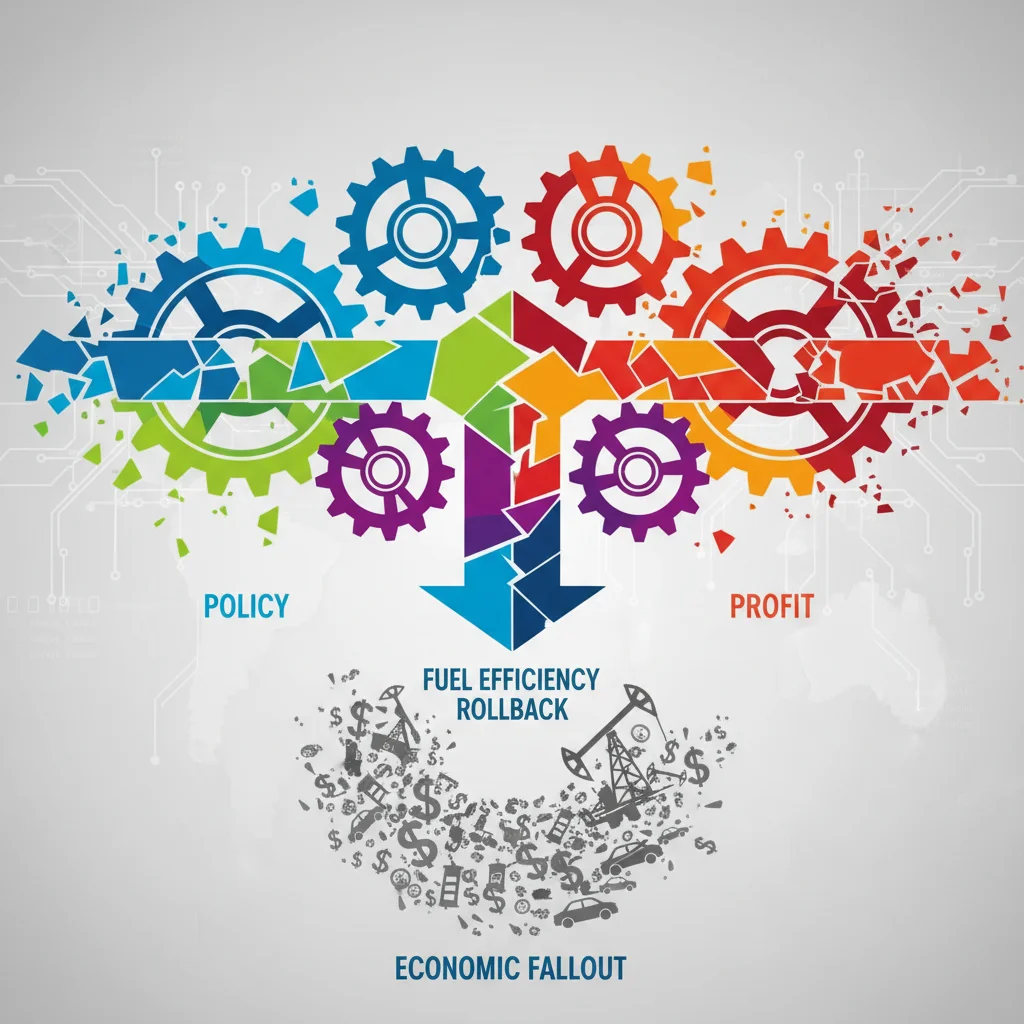
Shifting Gears: The Economic Fallout of Trump’s Proposed Fuel Efficiency Rollback
The Crossroads of Policy and Profit: Decoding the New Auto Industry Battleground
In a move sending shockwaves through the automotive, energy, and financial sectors, former President Donald Trump has proposed a significant rollback of vehicle fuel efficiency standards. The proposal, cheered by leaders in the traditional auto and oil industries, marks a sharp departure from current regulations and sets the stage for a high-stakes economic recalibration. While proponents argue the move will lower vehicle costs and boost legacy industries, environmental groups and consumer advocates warn of increased long-term costs for drivers and a retreat from global competitiveness (source). This policy pivot is far more than an environmental debate; it’s a critical inflection point for the U.S. economy, with profound implications for the stock market, consumer finance, and the future of investing in American industry.
To fully grasp the magnitude of this proposed shift, it’s essential to understand the current landscape. The Corporate Average Fuel Economy (CAFE) standards, administered by the National Highway Traffic Safety Administration (NHTSA), mandate the average fuel economy of a manufacturer’s fleet of new vehicles. The current regulations, largely aligned with Obama-era goals, are designed to push automakers towards greater innovation, reducing both emissions and consumer spending at the pump. This regulatory pressure has been a primary driver behind the billions in capital expenditure flowing into electric vehicle (EV) development and advanced internal combustion engine (ICE) technology. The new proposal seeks to freeze or significantly weaken these targets, effectively changing the rules of the game for one of the world’s largest industries.
Navigating the Upside Down: Investment Lessons from Stranger Things' Final Season
A Tale of Two Economies: Winners and Losers in a Deregulated Market
Any major policy change creates a new set of economic winners and losers. Understanding this dynamic is crucial for investors, business leaders, and anyone involved in financial markets. The proposed rollback of CAFE standards is no exception, creating clear divisions across multiple sectors.
Legacy Automakers and the Oil & Gas Sector: A Short-Term Boon?
For traditional automakers like General Motors, Ford, and Stellantis, the immediate appeal is clear: reduced compliance costs. Meeting aggressive fuel efficiency targets requires massive investment in research and development, particularly for EV platforms and battery technology. A less stringent standard would allow them to slow the pace of this costly transition, potentially boosting short-term profitability by continuing to sell more higher-margin, less-efficient trucks and SUVs. This prospect has already generated positive sentiment in some corners of the stock market, with investors anticipating improved quarterly earnings.
The oil and gas industry stands as another primary beneficiary. According to a 2022 analysis by the Environmental Protection Agency, stricter standards were projected to save consumers over a trillion dollars at the pump and reduce crude oil consumption by billions of barrels over the lifetime of the vehicles (source). Reversing this trend means more gasoline consumption, a direct boon for oil producers and refiners. For those investing in the energy sector, this policy represents a potential extension of the fossil fuel era.
The Consumer and the EV Market: A Costly Calculation
The equation for consumers is more complex. While the upfront cost of new vehicles might decrease slightly without the added expense of advanced fuel-saving technology, this saving could be quickly erased by higher fuel costs over the vehicle’s lifespan. The table below illustrates the potential trade-off based on projected standards.
Here is a simplified comparison of the current trajectory versus a potential rollback scenario, highlighting the key financial metrics for automakers and consumers:
| Metric | Current Standards (Projected 2032) | Proposed Rollback Scenario (Projected 2032) |
|---|---|---|
| Fleet-wide Fuel Economy Target | ~58 MPG (equivalent) | ~40 MPG (equivalent) |
| Automaker R&D/Compliance Cost | High | Low |
| Average New Vehicle Price Impact | Potential for higher initial cost | Potential for lower initial cost |
| Projected Lifetime Fuel Cost (for consumer) | Lower | Significantly Higher |
| Impact on EV Market Growth | Strong regulatory incentive | Weakened domestic incentive |
For the burgeoning EV sector and its associated industries (charging infrastructure, battery manufacturing, green financial technology), the proposal acts as a significant headwind. Regulatory mandates have been a powerful catalyst for EV adoption. Removing that pressure could slow the domestic transition, impacting companies from Tesla and Rivian to the vast network of suppliers and startups that form the backbone of the green economy.
The Billion-Dollar Comment: How One Executive's Words Put Campbell's Brand and Stock on the Line
Global Competitiveness and the Future of ESG Investing
The debate over fuel efficiency extends far beyond American highways; it strikes at the heart of the nation’s economic competitiveness and its role in the global financial system. The modern world of investing is increasingly influenced by Environmental, Social, and Governance (ESG) criteria. Major institutional investors, from pension funds to sovereign wealth funds, use ESG metrics to assess long-term risk and sustainability.
A rollback of emissions standards would likely damage the ESG ratings of U.S.-based automakers. This could lead to capital flight as global investors reallocate funds to companies in Europe and Asia that are more aligned with the Paris Agreement and other climate goals. This isn’t just a hypothetical; a 2023 report from BloombergNEF highlighted that global ESG assets are projected to exceed $50 trillion by 2025, representing a massive pool of capital that is sensitive to environmental policy source. The banking sector, which underwrites and finances these corporations, would also face increased scrutiny over its exposure to industries perceived as lagging in the green transition.
Furthermore, the rise of sophisticated financial technology and even blockchain applications is making corporate environmental impact more transparent than ever. Startups are developing platforms to track supply-chain carbon footprints in real-time, and some have proposed blockchain-based systems for immutable carbon credit trading. As data becomes more granular and verifiable, companies cannot easily hide from their environmental performance. A policy that encourages less efficiency would put American companies at a distinct disadvantage in this data-driven investment climate.
The Longevity Dividend: Why Investing in Anti-Ageing Science is the Next Frontier in Finance
The Road Ahead: A Critical Juncture for the American Economy
The proposal to slash fuel efficiency goals is a watershed moment. It forces a national conversation about economic priorities: Should the focus be on bolstering traditional industries for short-term stability, or on accelerating the transition to new technologies to secure long-term global leadership? The answer will have a lasting impact on everything from the price of a new car to the performance of retirement portfolios.
For investors and finance professionals, the key is not to get caught up in the political rhetoric but to analyze the underlying economic and market forces at play. This policy shift introduces significant volatility and uncertainty. It creates potential opportunities in the oil and gas sector while posing substantial risks to the EV market and any automaker that fails to keep pace with global innovation. The core principles of economics—incentives, trade-offs, and long-term competitiveness—will ultimately determine the winners and losers. As the policy debate unfolds, the smartest money will be watching not just Washington, but the engineering labs in Detroit, the trading floors in New York, and the boardrooms in Shanghai and Stuttgart.