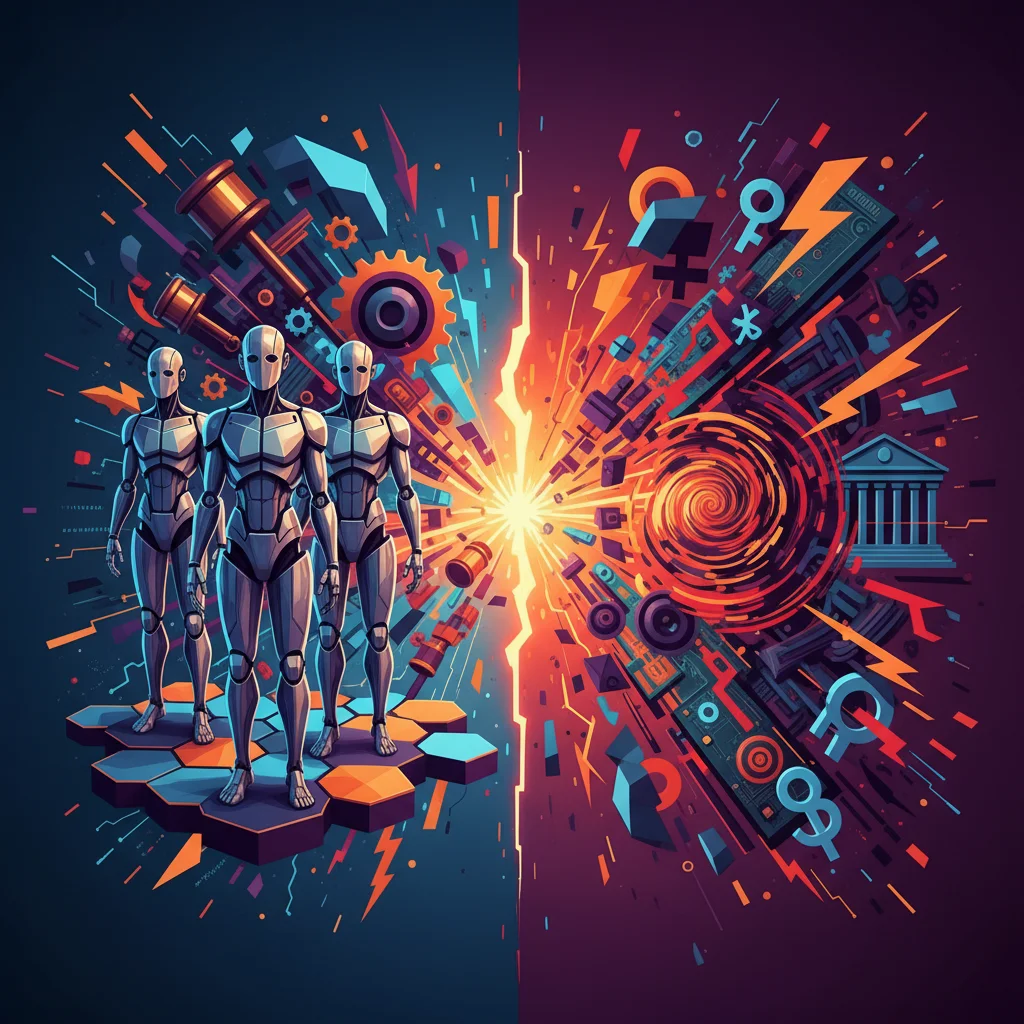
Humanoid Robots Are Here. Is a Political Storm Coming With Them?
It’s hard to miss them. Viral videos pop up on our feeds almost weekly: a robot deftly making a cup of coffee, another sorting items with uncanny precision, and yet another walking through a factory with a confident, human-like gait. These aren’t CGI creations from a Hollywood blockbuster. This is the reality of modern humanoid robotics, with startups like Figure, Apptronik, and giants like Tesla showcasing progress that feels like it’s been pulled directly from the future.
The immediate reaction is often one of awe and excitement. The engineering is brilliant, the software is revolutionary, and the potential seems limitless. But as we collectively “like” and “share” these technological marvels, we might be glossing over a much deeper, more complex conversation. According to a recent analysis in the Financial Times, our “delighted faith in the automatons” masks a looming threat of significant political and social disruption.
This isn’t just another step in automation; it’s a potential leap into a new societal paradigm. The question is no longer *if* humanoid robots will integrate into our world, but *how*—and whether we’re remotely prepared for the consequences.
From Caged Arms to Collaborative Coworkers
For decades, the word “robot” in a practical sense meant a highly specialized, powerful, and frankly, unintelligent arm bolted to a factory floor. Think of the massive robotic arms in a car manufacturing plant—they are incredibly efficient at one specific task, like welding a door panel, but operate within a safety cage, completely separate from human workers. They are tools, not colleagues.
The new wave of humanoid robots fundamentally shatters this model. Companies like Boston Dynamics with its jaw-dropping Atlas and Tesla with its developing Optimus bot are not building single-task machines. They are building general-purpose robots designed to operate in *our* world. The humanoid form factor is a deliberate choice; it allows them to navigate spaces built for humans, use tools designed for human hands, and perform a wide variety of tasks without needing a complete environmental overhaul.
This shift from specialized automation to general-purpose robotics is a game-changer. It unlocks the potential for automation in sectors that were previously untouched by it: logistics, retail, elder care, hospitality, and more. They are designed not to be caged, but to walk beside us.
The Innovation Stack: AI, Cloud, and the Code That Brings Them to Life
What’s enabling this quantum leap? It’s a convergence of several powerful technology trends, a testament to decades of innovation in both hardware and software.
- Artificial Intelligence & Machine Learning: At the core of these robots is a sophisticated AI brain. They aren’t just running pre-written scripts. They use advanced machine learning models, including reinforcement learning and imitation learning, to understand their environment, make decisions, and learn new tasks. This is what allows a robot like Figure 01 to watch a human make coffee and then replicate the action.
- Advanced Software & Programming: The complexity of the software required to control dozens of joints, process sensory input in real-time, and execute tasks is immense. It involves cutting-edge programming that blends robotics control systems with the latest in AI development.
- Cloud & SaaS Infrastructure: While much processing happens on the robot itself (at the “edge”), the cloud plays a critical role. Development teams run millions of simulations in the cloud to train their AI models before deploying them. In the future, fleets of robots will likely be managed and updated via SaaS (Software as a Service) platforms, creating new business models for startups in the robotics ecosystem.
This fusion of technologies is what separates modern humanoids from the clunky automatons of the past. They are learning, adapting platforms, not just mechanical puppets.
The New Iron Curtain: How AI and Cloud Software are Building Poland's Drone Shield
We are at a similar inflection point with humanoid robotics. The demos are intoxicating, and the promise of solving labor shortages and eliminating dangerous jobs is powerful. But we are once again focusing on the immediate “wow” factor while ignoring the second- and third-order consequences. The speed of this innovation is outpacing our societal and political ability to adapt. If we don’t start having serious, proactive conversations about regulation, job displacement, and social safety nets *now*, we risk being blindsided by a wave of disruption far greater than anything social media has caused.
Beyond the Uncanny Valley: Are We Too Comfortable?
For years, robotics design has been haunted by the “uncanny valley”—the idea that as robots become more human-like, they reach a point where they are just “off” enough to be creepy and unsettling. But the FT article highlights a fascinating counter-concept: the “strange valley.” This describes the unease we feel when a clearly non-human machine, like a disembodied robotic arm, exhibits autonomous, intelligent behavior (source). It’s a different kind of discomfort.
Ironically, the friendly, less-threatening appearance of humanoid robots might be a Trojan horse. By making them look familiar, we might be anthropomorphizing them and letting our guard down. We see a helper, not a technology capable of displacing millions of jobs and reshaping the economic landscape. This psychological comfort could prevent us from asking the hard questions until it’s too late.
The Political and Economic Minefield Ahead
When a technology has the potential to perform a significant percentage of human physical labor, the disruption isn’t just economic; it’s deeply political. The societal contract as we know it is based on the exchange of labor for wages. What happens when that foundation is fundamentally shaken?
To understand the scale of this shift, let’s compare the impact of traditional automation with the potential impact of humanoid robots.
| Area of Impact | Industrial Robots (The Past & Present) | Humanoid Robots (The Future) |
|---|---|---|
| Job Roles Displaced | Highly specific, repetitive manufacturing and assembly line jobs. | Broad range of physical labor: warehouse logistics, retail stocking, cleaning, construction, elder care assistance. |
| Work Environment | Requires highly structured, customized environments (factories, cages). | Operates in existing human-centric environments (shops, hospitals, homes). |
| Economic Barrier | High upfront cost in both robot and facility redesign. | Potentially lower barrier as they are “drop-in” solutions for existing infrastructure. |
| Societal Integration | Largely invisible to the public, confined to industrial zones. | Highly visible, working alongside humans in public and private spaces. |
This table illustrates a critical point: the coming wave of automation is broader, deeper, and far more personal. This raises several explosive political questions:
- Mass Job Displacement: What happens to the truck drivers, warehouse workers, and retail employees? Will we see a 21st-century Luddite movement? The scale of this potential displacement could make previous technological shifts look minor (source).
- Wealth Inequality: Will the productivity gains from this technology flow to the owners of the robots, further widening the gap between capital and labor?
- Cybersecurity and Control: A hacked industrial robot is a problem. A hacked fleet of thousands of humanoid robots operating in public spaces is a national security threat. The cybersecurity implications are staggering.
- Regulation and Liability: Who is responsible when a humanoid robot makes a mistake that causes injury or financial loss? The owner? The manufacturer? The AI software provider? Our legal frameworks are unprepared for these questions.
The AI Cold War: How China is Quietly Winning the Open-Source Revolution
A Call for Proactive Innovation and Responsible Governance
The genie is not going back in the bottle. The technological and economic incentives to develop and deploy these robots are too powerful. The challenge, therefore, is not to stop progress, but to guide it responsibly.
For developers, startups, and tech professionals, this means moving beyond a “move fast and break things” mentality. Ethical considerations, safety protocols, and the societal impact of your creations must be part of the programming and design process from day one. Responsible innovation should be the guiding principle.
For entrepreneurs and business leaders, this is a call to think about stakeholder capitalism in a new light. How can you deploy this technology to augment human workers, not just replace them? How can productivity gains be shared to create a more resilient workforce and consumer base?
For policymakers, the time for reactive governance is over. We need proactive discussions about the future of work, investments in lifelong education and reskilling programs, and the creation of new social safety nets. We need to build a regulatory framework that encourages innovation while protecting the public from the undeniable risks.
The Ultimate Debug: How AI and Startups Are Taking on Human Aging
Conclusion: Shaping Our Robotic Future
The rise of humanoid robots is one of the most exciting and consequential technological stories of our time. It represents a monumental achievement in artificial intelligence, engineering, and software. But technology is never neutral. It reflects the values and priorities of those who create and deploy it.
The videos of robots performing human tasks are more than just impressive demos; they are a preview of a future that is arriving faster than we think. We can either be passive observers, dazzled by the spectacle until the disruption is upon us, or we can be active participants in shaping this future. The choice we make today will determine whether humanoid robots lead to an era of unprecedented prosperity or one of social and political turmoil.