The Hidden Economic Toll of ‘Carspreading’: A New Risk for Your Portfolio?
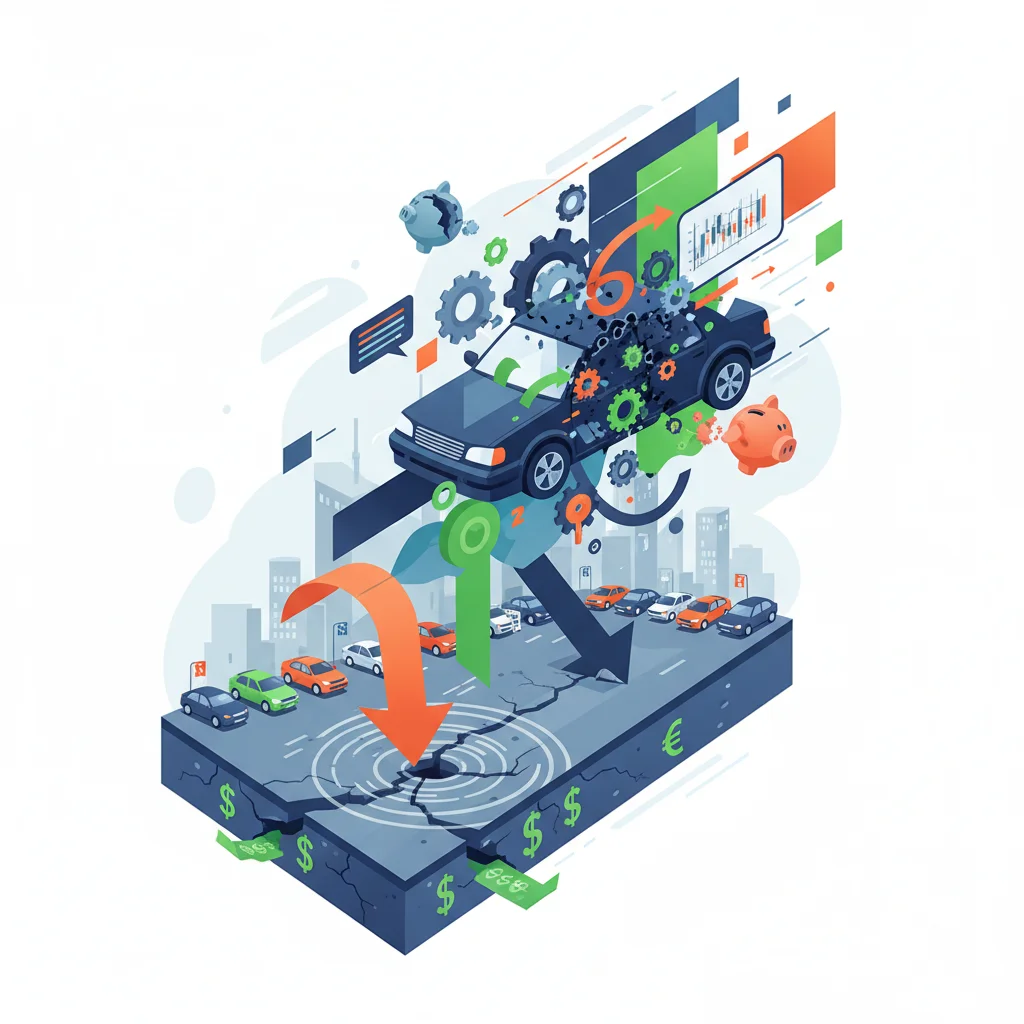
In cities and suburbs across the UK and Europe, a quiet but significant transformation is taking place. It’s not happening in the stock market or on a blockchain ledger, but in our streets and parking lots. Cars are getting bigger. Much bigger. This phenomenon, dubbed ‘carspreading’, is more than just a minor inconvenience for drivers; it’s a powerful economic undercurrent with far-reaching implications for investors, urban planners, and the financial health of our cities.
While the roar of a large engine might signal status to some, for economists and financial analysts, it sounds a warning bell. The trend toward larger, heavier, and wider vehicles—predominantly SUVs—is creating a cascade of hidden costs and economic externalities that are beginning to strain our public and private infrastructure. This isn’t merely about the frustration of finding a parking space; it’s about asset depreciation, infrastructure decay, and the emergence of new market risks and opportunities that every savvy investor should be monitoring.
The Data Behind the Driveway Squeeze
The shift in consumer preference is not a perception; it’s a measurable reality. A recent analysis highlighted a startling trend: new cars are, on average, growing wider by 1cm every two years. According to research by the campaign group Transport & Environment, this incremental expansion has led to a significant mismatch between modern vehicles and legacy infrastructure. In January 2023, the average new car sold in Europe was 180.3cm wide, a notable increase from 177.8cm in 2018 (source). Many of the most popular large SUVs now exceed 200cm in width.
This “automotive obesity” crisis becomes even clearer when viewed over a longer timeline. The dimensions of today’s vehicles are fundamentally different from those for which our cities were designed.
To illustrate this dimensional creep, consider the evolution of a popular model alongside the average vehicle width:
| Era | Example Model (VW Golf) Width | Average New Car Width | Change from Previous Era (Avg.) |
|---|---|---|---|
| 1970s | 161 cm (Mk1) | ~165 cm | Baseline |
| 1990s | 170 cm (Mk3) | ~172 cm | +7 cm |
| 2020s | 179 cm (Mk8) | ~180 cm | +8 cm |
This steady expansion means that nearly half of new cars sold are now too wide for the standard 180cm on-street parking spaces found in many UK and European cities (source). This isn’t just a problem of convenience; it’s a fundamental economic equation where the dimensions of new assets (vehicles) are incompatible with existing capital stock (infrastructure).
Beyond the Hype: An Investor's Guide to the Economics of Black Friday
The Unseen Balance Sheet: Economic Externalities of ‘Carspreading’
In economics, a negative externality is a cost that affects a party who did not choose to incur that cost. ‘Carspreading’ is a textbook example, generating substantial costs that are socialized across the entire economy rather than being borne by automakers or the individual consumer. For investors and business leaders, understanding these hidden liabilities is crucial for assessing risk in sectors from real estate to municipal bonds.
1. Infrastructure and Real Estate Depreciation
Our infrastructure—roads, bridges, and particularly multi-story and underground parking garages—was built for the vehicles of yesterday. The increased weight and size of modern cars accelerate wear and tear, leading to higher maintenance costs for both public and private asset owners. A study from the city of Paris noted that SUVs are “200kg heavier, 25cm longer, and 10cm wider” than the average car (source). This additional weight places unforeseen stress on structures, potentially shortening their lifespan and requiring massive capital expenditures for reinforcement or replacement. For commercial real estate investors, a property with a parking garage designed in the 1980s is now a depreciating asset, unable to efficiently serve modern clientele and potentially violating safety load limits.
2. The Inefficiency Tax on Commerce
The parking crunch is a direct tax on economic activity. When shoppers or clients struggle to park, they may choose to take their business elsewhere or shop online. This inefficiency reduces foot traffic for brick-and-mortar retailers and service providers. The time wasted circling for a suitable spot is a loss of productivity on a macroeconomic scale. This dynamic can suppress local economies and impact the valuation of commercial retail assets.
3. The Rising Cost of Risk: Insurance and Safety
While occupants may feel safer in a large SUV, they pose a greater risk to everyone else. The height, weight, and front-end design of these vehicles are associated with more severe outcomes for pedestrians, cyclists, and occupants of smaller cars in collisions. This reality is being priced into the insurance market. As the vehicle fleet becomes dominated by larger cars, expect insurance premiums to rise across the board to cover the increased severity of claims. This directly impacts household finance and is a key metric for the banking and insurance sectors of the economy.
An Investor’s Guide to Navigating the ‘Carspreading’ Economy
Like any major economic shift, ‘carspreading’ creates both significant risks and compelling opportunities. A forward-thinking investment strategy requires looking beyond the automotive sector itself and analyzing the second-order effects across the economy.
Here’s a breakdown of potential areas of impact for your portfolio:
| Sector | Potential Risks | Potential Opportunities |
|---|---|---|
| Automotive | Manufacturers heavily reliant on large SUV sales face regulatory risk (e.g., taxes, zoning) and shifting consumer sentiment. | Companies specializing in smaller, efficient EVs and urban mobility solutions. Niche manufacturers of compact vehicles. |
| Real Estate & Infrastructure | Owners of commercial/residential properties with outdated, small parking spaces may see asset devaluation. | Infrastructure funds focused on modernization. REITs that are proactively upgrading parking facilities. Construction firms specializing in retrofitting. |
| Insurance (Insurtech) | Traditional insurance models may struggle to accurately price the risk posed by oversized vehicles, leading to margin compression. | Insurtech companies using AI and telematics to create usage-based and vehicle-size-based insurance products. |
| Technology (Fintech) | Legacy payment systems for parking are ill-equipped for dynamic pricing models. | Companies developing smart parking apps, sensor technology, and automated payment systems. Financial technology platforms that offer dynamic pricing for parking based on vehicle size and demand. |
The key takeaway is that the ripple effects of ‘carspreading’ extend far beyond the dealership. Successful trading and investing in the coming decade will require an understanding of these interconnected dynamics.
Cracking the Code: A Crossword Solver's Guide to Navigating the Financial Markets
The Future: Policy, Technology, and Market Correction
The market is unlikely to solve this problem on its own. The trend will likely be shaped by a combination of government policy and technological innovation. Cities are already taking action. Paris’s plan to triple parking fees for SUVs is a clear signal of intent. We can expect other municipalities to follow suit with measures like weight-based registration fees, stricter emissions zones that penalize heavier vehicles, and updated building codes that mandate larger parking spaces in new constructions.
On the technology front, innovation could provide a path forward. The rise of sophisticated financial technology (fintech) platforms could enable dynamic road usage and parking pricing. Imagine a system where parking fees are calculated automatically based on the vehicle’s footprint and weight, paid seamlessly through a digital wallet. Some have even speculated that a decentralized ledger, or blockchain, could be used to create a transparent and peer-to-peer market for private parking spaces, optimizing the use of existing infrastructure. While still conceptual, these technological solutions highlight how innovation in banking and finance can help address physical-world economic problems.
The People's Budget: Decoding Public Demands in a High-Stakes UK Economy
Conclusion: Seeing the Bigger Picture
‘Carspreading’ is a powerful metaphor for a certain type of economic blindness. It represents a pursuit of individual optimization at the expense of systemic health. For decades, the focus has been on the vehicle itself—its features, its financing, its performance. Now, the economic consequences of the vehicle’s interaction with its environment can no longer be ignored.
For the general public, this means navigating increasingly congested and contested public spaces. For investors, finance professionals, and business leaders, it is a critical new variable in risk assessment and strategic planning. The ever-expanding size of our cars is a physical manifestation of a market trend that is testing the limits of our infrastructure and our economic models. Watching how we respond—through policy, technology, and shifts in the stock market—will be a defining feature of the next chapter in urban economics.

Related Posts

From Leaky Pipes to Leaky Portfolios: The Investment Drain of the UK Water Crisis
Beyond the Faucet: Why the South East Water Crisis is a Wake-Up Call for Investors
